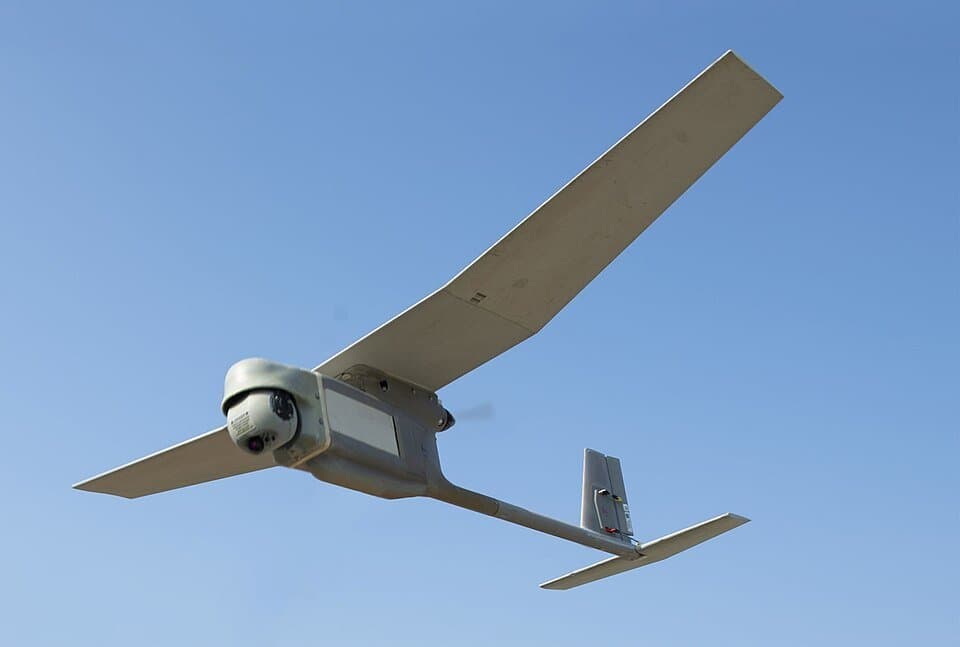

Credit
Public Affairs Alejandro Peña · Public domain · Resized · Public domain · Source ↗ · Modified


Preparing your view.

At a glance
Measured figures
Length
Single source3 ft (0,91 m)[source]
Evo II Pro V3 · folded
Single sourceConfiguration
| Specification | AeroVironment RQ-11 Raven | Autel Evo |
|---|---|---|
| Type | Miniature UAV[source] | Unmanned aerial vehicle[source] |
| Manufacturer | AeroVironment[source] | Autel Robotics[source] |
| Status | In active service[source] | In production[source] |
| Primary users | United States Army United States Air Force[source] | — |
Evo II Pro V3 · Length
Single source0.457 m (1 ft 6 in) (0.230 m (9.1 in) folded)[source]
Evo II Pro V3 · folded
Single sourceEvo II Pro V3 · Width
Single source0.558 m (1 ft 10 in) (0.130 m (5.1 in) folded)[source]
Evo II Pro V3 · Height
Single source0.108 m (4 in)[source]
Evo II Pro V3 · above sea level
Single source5,000 m (16,000 ft) above sea level[source]
Evo II Pro V3 · 1,600 ft/min
Single source8 m/s (1,600 ft/min)[source]
Bars compare reported quantities only. A larger figure does not make a system better; configurations and test conditions differ.
| Number built | 19,000+ airframes[source] | — |
|---|
| Manufactured | 2004–present[source] | 2018–present[source] |
|---|
| Introduction date | May 2003[source] | January 2018[source] |
|---|
| First flight | October 2001[source] | — |
|---|
| Developed from | FQM-151 Pointer[source] | — |
|---|
| Engine | Aveox 27/26/7-AV electric motor[source] | — |
|---|
| Role | small hand-launched remote-controlled unmanned aerial vehicle (or SUAV )[source] | — |
|---|
| Source measurement | The RQ-11 Raven was originally introduced as the FQM-151 in 1999, but in 2002 developed into its current form, resembling an enlarged FAI class F1C free flight model aircraft in general appearance. The craft is launched by hand and powered by a pusher configuration electric motor. The plane can fly up to 10 km at altitudes of 100-500 m above ground level , and over 4,200 m above mean sea level , at flying speeds of 32-81 km/h. The U.S. Army deploys the Raven at company -level.[source]AeroVironment RQ-11 Raven · Lead; only the objects and conditions stated in this passage The RQ-11B Raven UA weighs about 1.9 kg (4.2 lb), has a flight endurance of 60–90 minutes and an effective operational radius of approximately 10 km (6.2 miles).[source]AeroVironment RQ-11 Raven · Design and development; only the objects and conditions stated in this passage The RQ-11B Raven UA is launched by hand, thrown into the air like a free flight model airplane. The Raven lands itself by auto-piloting to a pre-defined landing point and then performing a 45° slope (1 foot down for every 1 foot forward) controlled "Autoland" descent. The UAS can provide day or night aerial intelligence, surveillance, target acquisition, and reconnaissance.[source]AeroVironment RQ-11 Raven · Design and development; only the objects and conditions stated in this passage In mid-2015, the US Marine Corps tested Harris Corporation 's Small Secure Data Link (SSDL), a radio device that fits onto a Raven's nose to provide beyond line-of-sight communications for Marines down to squad level. Acting as communications nodes for ground forces has become an important function for UASs, but has been restricted to larger platforms like the RQ-4 Global Hawk or RQ-21 Blackjack . Being certified for 'Secret' classification and at just 25 cubic inches (410 cm 3 ) (measuring 3 in × 5.3 in × 1.6 in) and weighing 18 oz (510 g), the Harris SSDL allows the small Raven UAS to extend communications for troops in the field.[source]AeroVironment RQ-11 Raven · Design and development; only the objects and conditions stated in this passage Solar Raven – In November 2012, the Air Force Research Laboratory integrated 20 cm 2 (3.1 in 2 ) flexible solar panels into the Raven platform's wing sections using a clear, protective plastic film and an adhesive to augment the existing battery power system, increasing endurance by 60%. Future improvements include improving the durability of the solar panels and reducing their weight. Integration work is also being conducted on the AeroVironment Wasp and the RQ-20 Puma .[source]AeroVironment RQ-11 Raven · Variants; only the objects and conditions stated in this passage Iran has claimed it has captured two RQ-11, one "in Shahrivar 1390 (August 21 – September 19, 2011) and the other one in Aban (October 22 – November 20, 2012)". It also indicated that "much of the data of these drones has been decoded", but did not indicate whether the drone has been duplicated, as has been done with the RQ-170 and the Boeing Insitu ScanEagle .[source]AeroVironment RQ-11 Raven · Operators; only the objects and conditions stated in this passage Wingspan : 4.5 ft (1,37 m)[source]AeroVironment RQ-11 Raven · Specifications; only the objects and conditions stated in this passage Length : 3 ft (0,91 m)[source]AeroVironment RQ-11 Raven · Specifications; only the objects and conditions stated in this passage Weight : 4.2 lb (1,9 kg)[source]AeroVironment RQ-11 Raven · Specifications; only the objects and conditions stated in this passage Cruising speed : approx. 18.64 mph (30.00 km/h)[source]AeroVironment RQ-11 Raven · Specifications; only the objects and conditions stated in this passage Range : 6.2 miles (10 km)[source]AeroVironment RQ-11 Raven · Specifications; only the objects and conditions stated in this passage | — |
|---|
| Country of origin | United States[source] United States[source] | — |
|---|
| National origin | — | China[source] |
|---|
| Battery | — | 11.55V 7100 mAh (82Wh) lithium polymer battery[source] |
|---|
| Camera | — | 20MP 1" CMOS[source] |
|---|
| GNSS compatibility | — | GPS Galileo BeiDou GLONASS[source] |
|---|