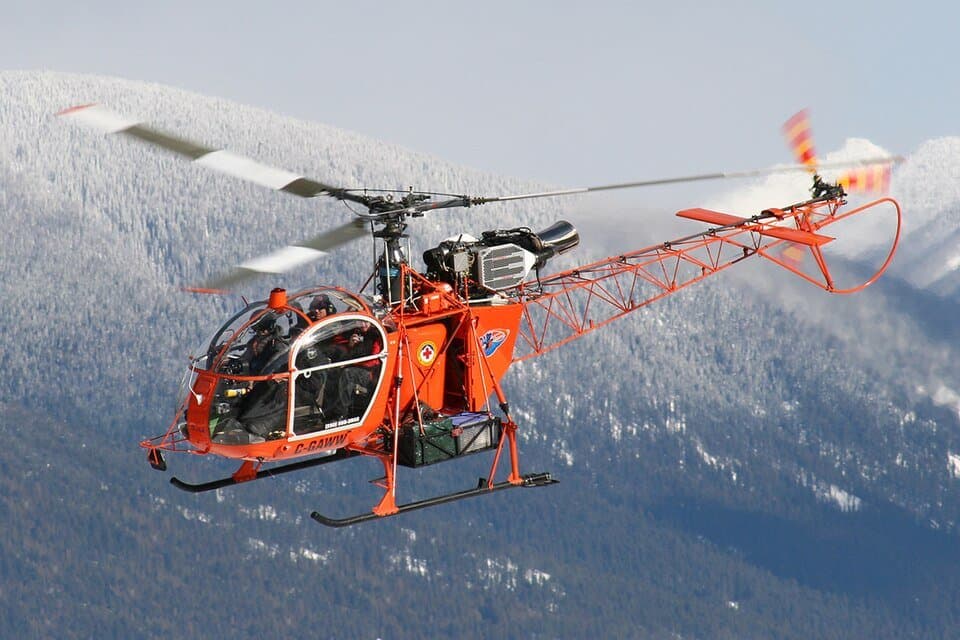

Credit
Calfo ( talk ) · CC BY-SA 3.0 · Resized · CC BY-SA 3.0 · Source ↗ · Modified


Preparing your view.


At a glance
True scale
Side by side. From every angle. A human reference for perspective.
3.11 MB · Loads when you open it| Model | Length | Width / span | Height |
|---|---|---|---|
| Aérospatiale SA 315B Lama | ≈ 10.24 m | ≈ 8.01 m (Width) | ≈ 3.24 m |
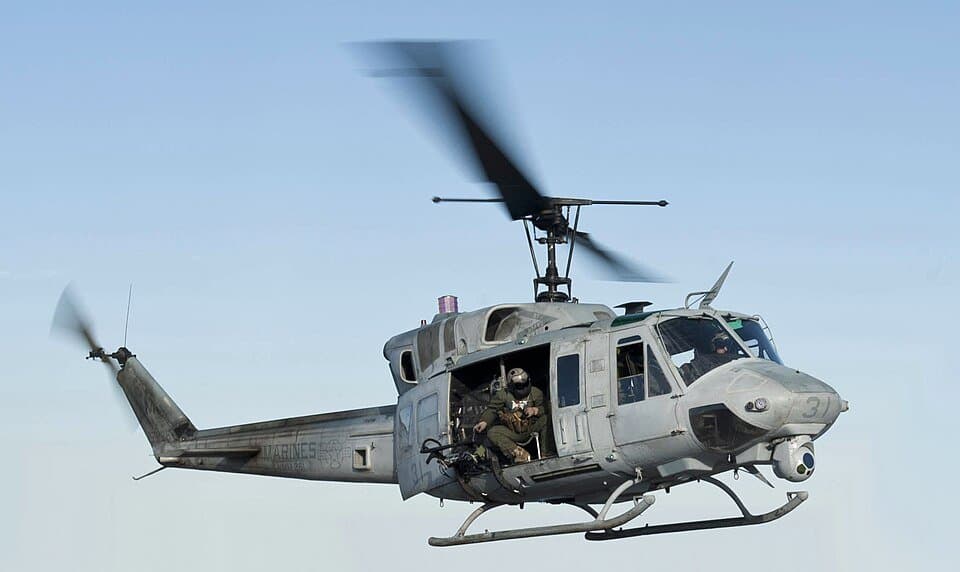
| Bell UH-1N Twin Huey | ≈ 17.58 m | ≈ 3.77 m (Width) | ≈ 5.47 m |
Scaled uniformly to the sourced length of 10.24 m. Not an official model or a measured survey.
ForceTally · All rights reserved
Scaled uniformly to the sourced length of 17.58 m. Not an official model or a measured survey.
ForceTally · All rights reserved
The human reference is a generic 1.75 m figure. Models describe external size, not combat performance.
Measured figures
SA 315B Lama · Length
Single source10.24 m (33 ft 7.25 in)[source]
Configuration
| Specification | Aérospatiale SA 315B Lama | Bell UH-1N Twin Huey |
|---|---|---|
| Type | Utility helicopter[source] | Utility helicopter[source] |
| National origin | France[source] | United States / Canada[source] |
| Manufacturer | Aérospatiale[source] | Bell Helicopter[source] |
| Built by | Helibras Hindustan Aeronautics Limited (HAL)[source] |
USMC UH-1N, as modified · Length
57 ft 8 in (17.58 m)[source]
Empty; SA 315B Lama · Empty weight
Single sourceGross; SA 315B Lama · Gross weight
Single sourceMaximum take-off; Peso Máximo al Despegue · Peso Máximo al Despegue
Single source1,021 kg (2,251 lb)[source]
2,300 kg (5,070 lb)[source]
2200 kg[source]Peso Máximo al Despegue
Maximum take-off; USMC UH-1N, as modified · Max takeoff weight
Single source10,500 lb (4,763 kg)[source]
SA 315B Lama · 1 × Turbomeca Artouste IIIB turboshaft derated to
Single sourceSA 315B Lama · Powerplant
Single source1 × Turbomeca Artouste IIIB turboshaft , 649 kW (870 hp) derated to 410 kW (550 hp)[source]
USMC UH-1N, as modified · 1 × Pratt & Whitney Canada T400-CP-400 coupled turboshaft engine, 1,250 shp (
Single source1 × Pratt & Whitney Canada T400-CP-400 coupled turboshaft engine, 1,250 shp (930 kW)[source]
Bars compare reported quantities only. A larger figure does not make a system better; configurations and test conditions differ.
| — |
| Status | In service[source] | In service[source] |
|---|
| Primary user | Afghan Air Force Indian Air Force[source] | — |
|---|
| Introduction date | July 1971[source] | October 1970[source] |
|---|
| First flight | 17 March 1969[source] | April 1969[source] |
|---|
| Developed from | Aérospatiale Alouette II[source] | Bell UH-1H Iroquois[source] |
|---|
| Capacity | 4 passengers or 1,135 kg (2,500 lb) slung payload[source] | 6–8 combat-equipped troops, or 4,400 lb (1,996 kg) equivalent cargo[source] |
|---|
| Main rotor area | 95.38 m 2 (1,026 sq ft)[source] | 1,808 sq ft (168.0 m 2 )[source] |
|---|
| Role | French single-engined helicopter[source] | medium military helicopter[source] |
|---|
| Source measurement | On 17 March 1969, the first SA 315B, powered by an Artouste IIB engine, undertook its maiden flight . On 30 September 1970, the type received its airworthiness certificate , and it was introduced to operational service in July 1971. Due to its favourable high altitude performance, the Lama quickly became popular with operators worldwide, often being deployed within mountainous environments. As with the Alouette series, the type can be fitted for various roles, such as light passenger transport, agricultural tasks, oil-and-gas exploration, aerial firefighting, and other specialised duties. The military variants of the Lama include liaison, observation, photography, air/sea rescue, transport and ambulance duties. The SA315B is particularly suited to mountainous areas due to its performance and can carry underslung loads of up to 1000 kg (2,205 lb). By December 1976, 191 Lamas had been ordered by 68 operators.[source]Aérospatiale SA 315B Lama · Design and development; only the objects and conditions stated in this passage During 1969, a series of early demonstration flights involving the SA 315B were performed in the Himalayas; during one such flight, a single rotorcraft carrying a crew of two and 120 kg of fuel landed and then took off at what was then the highest altitude to be recorded, 7,500 m (24,605 ft). On 21 June 1972, a Lama with a single pilot ( Jean Boulet ) aboard established a helicopter absolute altitude record of 12,442 m (40,814 ft), a record which still stands as of June 2022. During the same flight, the Lama's engine flamed out at the peak altitude of the flight, which led to an inadvertent record being set for the longest ever autorotation after which the rotorcraft was brought to a safe unpowered landing. Days before, the same pilot and aircraft had set a similar record at a higher weight.[source]Aérospatiale SA 315B Lama · Operational history; only the objects and conditions stated in this passage Derived from the SE 3150, it was designed for high altitude operations using a 650 kW (870 hp) Turbomeca Astazou IIIB turboshaft, derated to 410 kW (550shp). This derivative still holds the absolute altitude record for all types of helicopters since 1972: 12,442 m.[source]Aérospatiale SA 315B Lama · Variants; only the objects and conditions stated in this passage Modified armed combat variant. Changes include composite armouring, toughened glass, and gun sights . Armaments include two jettisonable weapons pods, each of which contains a single 12.7-mm machine gun and up to three 70-mm rockets.[source]Aérospatiale SA 315B Lama · Variants; only the objects and conditions stated in this passage Modernised Indian variant, fitted with the Turbomeca TM333-2M2 for high altitudes operations. Speed is increased to 210 km/h (130 mph) and range is increased to 640 km (400 mi). It has a payload capacity of 90 kg (200 lb) at 6 km (20,000 ft)-altitude and an endurance of 3.5 hours. The engine is fitted with a FADEC system for engine control and an Electronic Backup Control Box (EBCB) system. Additional features include modern cockpit instruments, such as electric-powered artificial horizon, directional gyro, flight monitoring system, cockpit voice recorder, as well as a master flasher warning system. First flight in January 2003. On 2 November, 2004 the helicopter set a world record of highest landing record at 7,070 meters in Himalayas. 10 order by Indian Air Force in 2006 and 20 ordered by Indian Army in 2013. All delivered.[source]Aérospatiale SA 315B Lama · Variants; only the objects and conditions stated in this passage Capacity: 4 passengers or 1,135 kg (2,500 lb) slung payload[source]Aérospatiale SA 315B Lama · Specifications (SA 315B Lama); only the objects and conditions stated in this passage Length: 10.24 m (33 ft 7.25 in)[source]Aérospatiale SA 315B Lama · Specifications (SA 315B Lama); only the objects and conditions stated in this passage Height: 3.09 m (10 ft 1.75 in)[source]Aérospatiale SA 315B Lama · Specifications (SA 315B Lama); only the objects and conditions stated in this passage Empty weight: 1,021 kg (2,251 lb)[source]Aérospatiale SA 315B Lama · Specifications (SA 315B Lama); only the objects and conditions stated in this passage Gross weight: 2,300 kg (5,070 lb)[source]Aérospatiale SA 315B Lama · Specifications (SA 315B Lama); only the objects and conditions stated in this passage Powerplant: 1 × Turbomeca Artouste IIIB turboshaft , 649 kW (870 hp) derated to 410 kW (550 hp)[source]Aérospatiale SA 315B Lama · Specifications (SA 315B Lama); only the objects and conditions stated in this passage Main rotor diameter: 11.02 m (36 ft 1.75 in)[source]Aérospatiale SA 315B Lama · Specifications (SA 315B Lama); only the objects and conditions stated in this passage Main rotor area: 95.38 m 2 (1,026 sq ft)[source]Aérospatiale SA 315B Lama · Specifications (SA 315B Lama); only the objects and conditions stated in this passage Maximum speed: 192 km/h (119 mph, 103 kn)[source]Aérospatiale SA 315B Lama · Specifications (SA 315B Lama); only the objects and conditions stated in this passage Range: 515 km (320 mi, 280 nmi)[source]Aérospatiale SA 315B Lama · Specifications (SA 315B Lama); only the objects and conditions stated in this passage Service ceiling: 5,400 m (17,715 ft)[source]Aérospatiale SA 315B Lama · Specifications (SA 315B Lama); only the objects and conditions stated in this passage Rate of climb: 5.5 m/s (1,080 ft/min)[source]Aérospatiale SA 315B Lama · Specifications (SA 315B Lama); only the objects and conditions stated in this passage | The Bell UH-1N Twin Huey is a twin-engined medium-sized military helicopter primarily operated as a utility transport. Power is provided by a PT6T-3/T400 Turbo Twin Pac, comprising a pair of Pratt & Whitney Canada PT6 turboshaft engines mounted side by side and driving a shared gearbox and single output shaft. These engines are capable of producing up to 1,342 kW (1,800 shp). In the event of a single power section failing, the remaining section can deliver 671 kW (900 shp) for up to 30 minutes or 571 kW (765 shp) continuously, enabling the UH-1N to maintain cruise performance at maximum weight. It is capable of flight under instrument flight rules and in nighttime conditions.[source]Bell UH-1N Twin Huey · Design; only the objects and conditions stated in this passage The UH-1N is often flown with a four-person crew, comprising two pilots and two crew chiefs; while in the air, these crew chiefs man the weapons, while one pilot functions as a navigator and the other actively flies. The interior is normally outfitted with a 15-seat configuration, in which it can be flown by a single pilot and carry up to 14 passengers; in practice, rarely could the UH-1N actually carry this many unless also carrying limited fuel and equipment due to weight limitations and weather conditions.[source]Bell UH-1N Twin Huey · Design; only the objects and conditions stated in this passage When configured to carry cargo, the cabin has an internal capacity of 220 ft³ (6.23 m³). Up to six litters can be carried in a medical evacuation arrangement. An external load of up to 5,000 lb (2,268 kg) can also be carried. In United States Marine Corps (USMC) service, up to three radios would be installed in the cabin so that commanders could remain airborne while coordinating ground troops. The UH-1N was normally armed with a single .50 caliber machine gun on the helicopter's left side, while a 7.62 millimeter machine gun is mounted on the right side.[source]Bell UH-1N Twin Huey · Design; only the objects and conditions stated in this passage Starting in late 1970, mere months after receiving its first deliveries of the type, the USAF begun to re-equip the 20th Special Operations Squadron in Vietnam with UH-1Ns, supplementing and eventually replacing the single-engined UH-1F and UH-1P. Armed with miniguns (or 40 mm grenade launchers) and rocket pods, and painted camouflage with no US markings and only a Green Hornet insignia, the UH-1N supported Special Forces reconnaissance missions from Cam Ranh Bay . |
|---|
| Primary users | — | United States Air Force United States Marine Corps (historical) Canadian Forces (historical) United States Navy (historical)[source] |
|---|
| Manufactured | — | 1969–1970s[source] |
|---|
| Variants | — | Bell 212 Bell 412 Bell UH-1Y Venom[source] |
|---|
| Blade section | — | - root: NACA 0010.8 ; tip: NACA 0005.4 mod[source] |
|---|
The AB 212ASW is a Model 212 Twin Huey with a prominent radome above the cockpit. Early production had a dome-shaped radome, while later production had a flatter "drum" radome. A left side winch is used for dipping the Bendix ASQ-18 sonar. Other changes include structural reinforcement for a gross weight of 11,197 lbs (5,080 kg), ECM , shipboard deck tie-down attachments and corrosion protection. Armament is two Mk 44 or Mk 46 torpedoes or two depth charges in the ASW role and four AS.12 air-to-surface wire-guided missiles for the anti-shipping role.[source]Bell UH-1N Twin Huey · Variants / Italian-built variants; only the objects and conditions stated in this passage
Capacity: 6–8 combat-equipped troops, or 4,400 lb (1,996 kg) equivalent cargo[source]Bell UH-1N Twin Huey · Specifications (USMC UH-1N, as modified); only the objects and conditions stated in this passage
Length: 57 ft 8 in (17.58 m)[source]Bell UH-1N Twin Huey · Specifications (USMC UH-1N, as modified); only the objects and conditions stated in this passage
Height: 14 ft 5 in (4.39 m)[source]Bell UH-1N Twin Huey · Specifications (USMC UH-1N, as modified); only the objects and conditions stated in this passage
Max takeoff weight: 10,500 lb (4,763 kg)[source]Bell UH-1N Twin Huey · Specifications (USMC UH-1N, as modified); only the objects and conditions stated in this passage
Powerplant: 1 × Pratt & Whitney Canada T400-CP-400 coupled turboshaft engine, 1,250 shp (930 kW)[source]Bell UH-1N Twin Huey · Specifications (USMC UH-1N, as modified); only the objects and conditions stated in this passage
900 shp (671 kW) emergency rating for each power section[source]Bell UH-1N Twin Huey · Specifications (USMC UH-1N, as modified); only the objects and conditions stated in this passage
Main rotor diameter: 48 ft 0 in (14.63 m)[source]Bell UH-1N Twin Huey · Specifications (USMC UH-1N, as modified); only the objects and conditions stated in this passage
Main rotor area: 1,808 sq ft (168.0 m 2 )[source]Bell UH-1N Twin Huey · Specifications (USMC UH-1N, as modified); only the objects and conditions stated in this passage
Maximum speed: 130 kn (150 mph, 240 km/h)[source]Bell UH-1N Twin Huey · Specifications (USMC UH-1N, as modified); only the objects and conditions stated in this passage
Cruise speed: 110 kn (130 mph, 200 km/h)[source]Bell UH-1N Twin Huey · Specifications (USMC UH-1N, as modified); only the objects and conditions stated in this passage
Range: 248 nmi (285 mi, 459 km)[source]Bell UH-1N Twin Huey · Specifications (USMC UH-1N, as modified); only the objects and conditions stated in this passage
Service ceiling: 17,300 ft (5,300 m)[source]Bell UH-1N Twin Huey · Specifications (USMC UH-1N, as modified); only the objects and conditions stated in this passage
Rate of climb: 1,755 ft/min (8.92 m/s)[source]Bell UH-1N Twin Huey · Specifications (USMC UH-1N, as modified); only the objects and conditions stated in this passage
2.75-inch (70 mm) rocket pods,[source]Bell UH-1N Twin Huey · Specifications (USMC UH-1N, as modified); only the objects and conditions stated in this passage
0.50 in (12.7 mm) GAU-16 machine gun,[source]Bell UH-1N Twin Huey · Specifications (USMC UH-1N, as modified); only the objects and conditions stated in this passage
7.62 mm (0.308 in) GAU-17 minigun or 7.62 mm (0.308 in) M240 lightweight machine gun[source]Bell UH-1N Twin Huey · Specifications (USMC UH-1N, as modified); only the objects and conditions stated in this passage
CH-135 Twin Huey 135137 in the original blue-gray and green camouflage pattern worn by these aircraft prior to 1986/88.[source]Bell UH-1N Twin Huey · Gallery; only the objects and conditions stated in this passage
CH-135 Twin Huey 135135 in the early-style SAR markings, 1988. This aircraft was serving with Base Rescue Goose Bay and had formerly been assigned to 424 Transport & Rescue Squadron, CFB Trenton .[source]Bell UH-1N Twin Huey · Gallery; only the objects and conditions stated in this passage
CH-135 Twin Huey 135103 in special flight test markings. The aircraft was used by the Aerospace Engineering Test Establishment at CFB Cold Lake , 1987.[source]Bell UH-1N Twin Huey · Gallery; only the objects and conditions stated in this passage