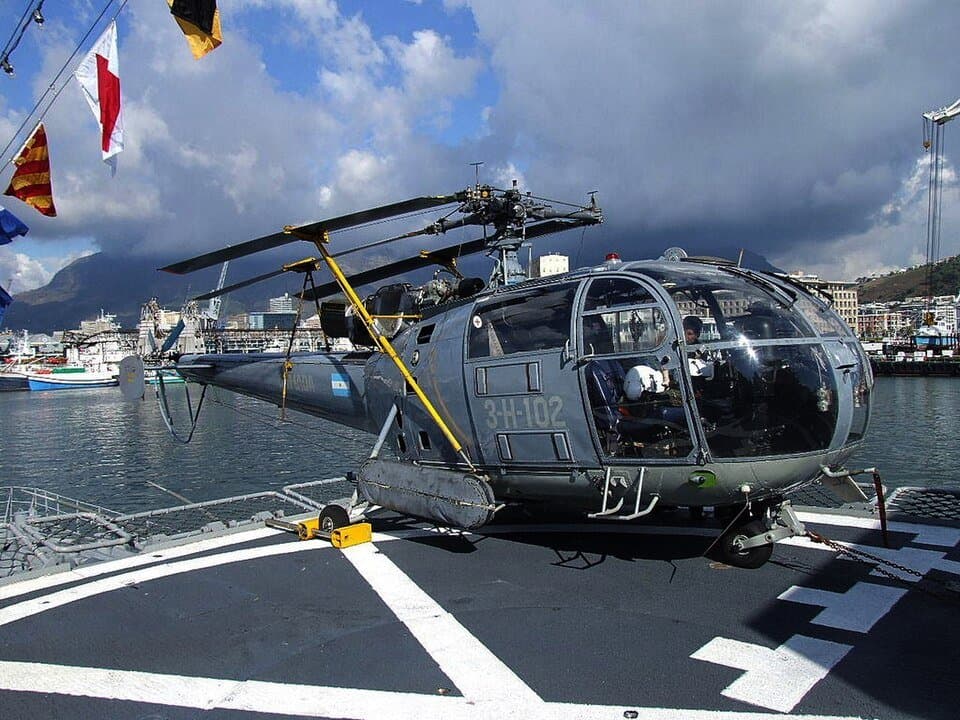

Credit
Bob Adams from George, South Africa · CC BY-SA 2.0 · Resized · CC BY-SA 2.0 · Source ↗ · Modified


Preparing your view.
At a glance
Measured figures
SA 316B · Length
Single source10.03 m (32 ft 11 in)[source]
Configuration
| Specification | Aérospatiale Alouette III | Kamov Ka-126 |
|---|---|---|
| Type | Light utility helicopter[source] | Light utility helicopter[source] |
| National origin | France[source] | Soviet Union[source] |
| Manufacturer | Sud Aviation Aérospatiale[source] | Industria Aeronautică Română[source] |
| Built by | Hindustan Aeronautics Limited (HAL) Industria Aeronautică Română (IAR)[source] |
Ka-126 · Length
7.775 m (25 ft 6 in)[source]
Empty; SA 316B · Empty weight
Single sourceGross; SA 316B · Gross weight
Single source1,143 kg (2,520 lb)[source]
2,200 kg (4,850 lb)[source]
2.200kg[source]ALOUETTE III SA316B
Empty; Ka-126 · Empty weight
Single sourceMaximum take-off; Ka-126 · Max takeoff weight
Single sourceCruise; SA 316B · Cruise speed
Single sourceMaximum; ALOUETTE III SA316B · Speed · ALOUETTE III SA316B · Speed
Single sourceMaximum; SA 316B · at sea level
Single source210 km/h (130 mph, 110 kn) at sea level[source]
185 km/h (115 mph, 100 kn)[source]
210 km/h[source]ALOUETTE III SA316B
Cruise; Ka-126 · Cruise speed
Single sourceMaximum; Ka-126 · Maximum speed
Single sourceBars compare reported quantities only. A larger figure does not make a system better; configurations and test conditions differ.
| — |
| Status | In service[source] | Active[source] |
|---|
| Primary users | French Armed Forces Indian Armed Forces Portuguese Air Force Rhodesian Air Force[source] | — |
|---|
| Number built | 2,000+[source] | 17[source] |
|---|
| Manufactured | Sud: 1961–1970 Aérospatiale: 1970–1985 HAL:1965–2021 IAR:1971–1987[source] | 1988–1991[source] |
|---|
| Introduction date | 1960[source] | 1989[source] |
|---|
| First flight | 28 February 1959[source] | 22 December 1988[source] |
|---|
| Developed from | Aérospatiale Alouette II[source] | Kamov Ka-26[source] |
|---|
| Variant | IAR 316[source] | — |
|---|
| Developed into | Aérospatiale Gazelle Atlas XH-1 Alpha[source] | Kamov Ka-226[source] |
|---|
| Capacity | 5 passengers[source] | 6 passengers (cargo/passenger pod) / 1,000 kg (2,205 lb) slung load / 1,000 L (260 US gal; 220 imp gal) chemical hopper[source] |
|---|
| Main rotor area | 95.38 m 2 (1,026.7 sq ft)[source] | 265.5 m 2 (2,858 sq ft)[source] |
|---|
| Role | single-engine, light utility helicopter[source] | Soviet light utility helicopter[source] |
|---|
| Source measurement | The Alouette III has its origins with an earlier helicopter design by French aircraft manufacturer Sud-Est , the SE 3120 Alouette , which, while breaking several helicopter speed and distance records in July 1953, was deemed to have been too complex to be realistic commercial product. Having received financial backing from the French government, which had taken an official interest in the venture, the earlier design was used as a starting point for a new rotorcraft that would harness the newly developed turboshaft engine; only a few years prior, Joseph Szydlowski , the founder of Turbomeca , had successfully managed to develop the Artouste , a 260 hp (190 kW) single shaft turbine engine derived from his Orédon turbine engine. An improved version of this engine was combined with the revised design to quickly produce a new helicopter, initially known as the SE 3130 Alouette II .[source]Aérospatiale Alouette III · Development / Origins; only the objects and conditions stated in this passage On 28 February 1959, the first prototype SE 3160 performed its maiden flight , piloted by French aviator Jean Boulet . Shortly thereafter, the SE 3160 would become more commonly known as the Alouette III. During its flight test programme, the prototype demonstrated its high altitude capabilities on several occasions; in June 1959, it landed at an altitude of over 4,000 metres in the Mont Blanc mountain range and, during October 1960, it was able to achieve the same feat at an altitude more than 6,000 metres in the Himalayas . During these attempts, it was flown by Jean Boulet, who was accompanied by a pair of passengers and 250 kg of equipment.[source]Aérospatiale Alouette III · Development / Into flight and production; only the objects and conditions stated in this passage (After its production ended, the SE 3160 has sometimes been retroactively redesignated "SA 316A", but its original SE 3160 designation is more commonly used, especially in older sources.) Both the SE 3160 and the SA 316B were powered by a more powerful version of the Artouste engine, the Artouste IIIB, whose turbine was rated to produce 858 horsepower (640 kW), though because of the limits of the engine's reduction gearbox, the Artouste IIIB was de-rated to generate 563 horsepower (420 kW) in service.[source]Aérospatiale Alouette III · Development / Into flight and production; only the objects and conditions stated in this passage It had been produced from 1961 to 1985 in France, however, license production continued.[source]Aérospatiale Alouette III · Development / Into flight and production; only the objects and conditions stated in this passage Indian civilian authorities and the Indian Air Force donated a DC-3 Dakota , a Twin Otter , and a Alouette III helicopter to the Bangladesh Air Force , during the Bangladesh Liberation War in 1971. The aircraft were engaged to take advantage of the lack of night-fighting capability of the Pakistan Air Force , and to launch hit-and-run attacks on sensitive targets inside East Pakistan. The Alouette helicopter was extensively modified with a 1 in (25 mm) steel plate welded to its floor for extra protection, and fitted with 14 rockets from pylons attached to its side and .303 Browning machine guns . The helicopter was operated by a three member crew consisting of Squadron Leader Sultan Mahmood, Flight Lieutenant Bodiul Alam, and Captain Shahabuddin, all of whom were awarded he Bir Uttam gallantry award.[source]Aérospatiale Alouette III · Operational history / Bangladesh; only the objects and conditions stated in this passage During June 1960, an Alouette III carrying seven people successfully performed both take-offs and landings on Mont Blanc in the French Alps at an altitude of 4,810 metres (15,780 feet), an unprecedented altitude for such activities by a helicopter at the time. The same helicopter again demonstrated the type ' s extraordinary performance in November 1960 by making take-offs and landings with a crew of two and a payload of 250 kg (551 lbs) in the Himalayas at an altitude of 6,004 metres (19,698 feet).[source]Aérospatiale Alouette III · Operational history / France; only the objects and conditions stated in this passage During June 2004, the Alouette III was retired from the French Air Force after 32 years of successful service, having been entirely replaced by the newer twin-engined Eurocopter EC 355 Ecureuil 2 . The French Army also withdrew the last of their examples during 2013 in favour of more modern rotorcraft such as the Airbus Helicopters H160 .[source]Aérospatiale Alouette III · Operational history / France; only the objects and conditions stated in this passage Portugal was the first country to use the Alouette III in combat. In 1963, during the Overseas Wars in Angola , Mozambique and Portuguese Guinea , Portugal began using Alouette IIIs in combat, mainly in air assault and medevac operations, where it proved its qualities. Besides the basic transport version (code named canibal , plural canibais ), Portugal used a special version of the Alouette III with a MG 151 20 mm autocannon mounted in the rear in order to fire from the left side door; it was designated helicanhão (heli-cannon) and code named lobo mau ( big bad wolf ).[source]Aérospatiale Alouette III · Operational history / Portugal; only the objects and conditions stated in this passage In the Overseas Wars, the Portuguese usually launched air assaults with groups of six or seven Alouette III: five or six canibais – each usually carrying five paratroopers or commandos – and a lobo mau heli-cannon. The Portuguese practice was for the troops to jump from the canibais when the helicopters were hovering two-three metres above the ground – famous images of these disembarking troops became an iconic image of the war. The landing of the troops was covered by the lobo mau . While the troops performed the ground assault, the canibais moved away from the combat zone, while the lobo mau stayed to provide fire support, destroying enemy resistance and concentration points with the fire from its 20 mm autocannon. Once the ground combat had finished, the canibais returned; firstly to collect the wounded, then the rest of the troops.[source]Aérospatiale Alouette III · Operational history / Portugal; only the objects and conditions stated in this passage In 1977, the Republic of Korea Navy started operating 12 Alouette IIIs. It was typically dispatched aboard several destroyers in an anti-submarine capacity. On 13 August 1983, the Republic of Korea Navy discovered a naval vessel of the Korean People's Army that had entering their sea. A single Alouette III engaged the spy ship and destroyed it using an AS.12 missile; following the mission, the specific helicopter involved received a victory marking , which was the only aircraft to receive such a mark in the entire Republic of Korea Armed Forces . The Alouette III was also operated as a rescue helicopter, responding to major incidents such as the crash of Asiana Airlines Flight 733 in Mokpo , Republic of Korea , on 26 July 1993.[source]Aérospatiale Alouette III · Operational history / Republic of Korea; only the objects and conditions stated in this passage SE 3160 : the first production version. Sometimes retroactively redesignated SA 3160 or SA 316A . Maximum weight of 2,100 kg (4,630 lb); powered by Turbomeca Artouste IIIB or IIIB1 turboshaft engine rated at 420 kW (563 hp) for takeoff (440 kW (590 hp) for IIIB1) and 405 kW (543 hp) continuous, but restricted by rotor transmission limitations to 405 kW (543 hp) for takeoff and 331 kW (444 hp) continuous.[source]Aérospatiale Alouette III · Variants; only the objects and conditions stated in this passage SA 316B : like SE 3160, but with strengthened main and tail rotor for greater performance; maximum weight of 2,200 kg (4,850 lb), and rotor transmission limit on takeoff power increased to 440 kW (590 hp). The SA 316B was built under licence in India as the HAL Chetak, and again under licence in Romania as the IAR 316. HAL Chetak : Indian production version of the SA 316B. HAL Chetan : HAL/Turbomecca TM 333-2M2 Shakti engine. IAR 316 : Romanian production version of the SA 316B. F+W Alouette IIIS : 60 SA-316B licence-assembled in Switzerland by F+W Emmen ( de ) between 1970 and 1974.[source]Aérospatiale Alouette III · Variants; only the objects and conditions stated in this passage SA 319B (sometimes called "Alouette III Astazou") : developed from the SA 316B. Maximum weight of 2,250 kg (4,960 lb); powered by a Turbomeca Astazou XIVB turboshaft engine rated at 440 kW (590 hp) for takeoff and 405 kW (543 hp) continuous, but rotor transmission limitations restricted continuous power to 368 kW (493 hp).[source]Aérospatiale Alouette III · Variants; only the objects and conditions stated in this passage SA 316C : developed from the SA 316B. Maximum weight of 2,250 kg (4,960 lb); powered by a Turbomeca Artouste IIID turboshaft engine rated at 440 kW (590 hp) for takeoff and 405 kW (543 hp) continuous, but rotor transmission limitations restricted continuous power to 368 kW (493 hp). The SA 316C was only built in small numbers.[source]Aérospatiale Alouette III · Variants; only the objects and conditions stated in this passage G-Car and K-Car : Helicopter gunship versions for the Rhodesian Air Force . The G-Car was armed with two side-mounted Browning .303 or a single 7.62mm MAG machine guns. The K-Car was armed with a 20 mm MG 151 cannon , fitted inside the cabin, firing from the port side of the helicopter.[source]Aérospatiale Alouette III · Variants; only the objects and conditions stated in this passage SA.3164 Alouette-Canon : Modified in 1964 as a gunship version armed with a 20mm gun in the nose and external hardpoints for missiles mounted on each side of the fuselage. Only one prototype was built.[source]Aérospatiale Alouette III · Variants; only the objects and conditions stated in this passage Capacity: 5 passengers[source]Aérospatiale Alouette III · Specifications (SA 316B); only the objects and conditions stated in this passage Length: 10.03 m (32 ft 11 in)[source]Aérospatiale Alouette III · Specifications (SA 316B); only the objects and conditions stated in this passage Height: 3 m (9 ft 10 in)[source]Aérospatiale Alouette III · Specifications (SA 316B); only the objects and conditions stated in this passage Empty weight: 1,143 kg (2,520 lb)[source]Aérospatiale Alouette III · Specifications (SA 316B); only the objects and conditions stated in this passage Gross weight: 2,200 kg (4,850 lb)[source]Aérospatiale Alouette III · Specifications (SA 316B); only the objects and conditions stated in this passage Powerplant: 1 × Turbomeca Artouste IIIB turboshaft derated to 425 kW (570 hp)[source]Aérospatiale Alouette III · Specifications (SA 316B); only the objects and conditions stated in this passage Main rotor diameter: 11.02 m (36 ft 2 in)[source]Aérospatiale Alouette III · Specifications (SA 316B); only the objects and conditions stated in this passage Main rotor area: 95.38 m 2 (1,026.7 sq ft)[source]Aérospatiale Alouette III · Specifications (SA 316B); only the objects and conditions stated in this passage Maximum speed: 210 km/h (130 mph, 110 kn) at sea level[source]Aérospatiale Alouette III · Specifications (SA 316B); only the objects and conditions stated in this passage Cruise speed: 185 km/h (115 mph, 100 kn)[source]Aérospatiale Alouette III · Specifications (SA 316B); only the objects and conditions stated in this passage Range: 540 km (340 mi, 290 nmi)[source]Aérospatiale Alouette III · Specifications (SA 316B); only the objects and conditions stated in this passage Service ceiling: 3,200 m (10,500 ft)[source]Aérospatiale Alouette III · Specifications (SA 316B); only the objects and conditions stated in this passage Rate of climb: 4.3 m/s (850 ft/min)[source]Aérospatiale Alouette III · Specifications (SA 316B); only the objects and conditions stated in this passage | One or two crew utility light helicopter, powered by a 720-shp (537-kW) (Glushenkov) OMKB TVD-100 turboshaft engines. First flown in 1986, and built under licence by IAR in Romania . 2 prototypes and 15 series helicopter built.[source]Kamov Ka-126 · Variants; only the objects and conditions stated in this passage One prototype, powered by a 722-shp (538-kW) Turbomeca Arriel 1D1 turboshaft engine.[source]Kamov Ka-126 · Variants; only the objects and conditions stated in this passage Powered by two 450-shp (335-kW) Rolls-Royce 250-C20R/2 turboshaft engines.[source]Kamov Ka-126 · Variants; only the objects and conditions stated in this passage The V-60 was a projected light (3500 kg) armed escort helicopter from Kamov based on the civil Kamov Ka-126. Only a model of the original V-60 exists. The existing model shows four missiles as its sole armament. The project was abandoned in the 1980s and is often confused to be an early concept of the Ka-60 . The initial prototype and pre-series version of the Ka-60 carried another designation, V-62 .[source]Kamov Ka-126 · Variants / Kamov V-60; only the objects and conditions stated in this passage Capacity: 6 passengers (cargo/passenger pod) / 1,000 kg (2,205 lb) slung load / 1,000 L (260 US gal; 220 imp gal) chemical hopper[source]Kamov Ka-126 · Specifications (Ka-126); only the objects and conditions stated in this passage Length: 7.775 m (25 ft 6 in)[source] |
|---|
| Designer | — | Kamov[source] |
|---|
| Blade sections | — | NACA 23015 modified root, NACA 23012 modified tip[source] |
|---|
Height: 4.155 m (13 ft 8 in)[source]Kamov Ka-126 · Specifications (Ka-126); only the objects and conditions stated in this passage
Empty weight: 1,915 kg (4,222 lb)[source]Kamov Ka-126 · Specifications (Ka-126); only the objects and conditions stated in this passage
Max takeoff weight: 3,250 kg (7,165 lb)[source]Kamov Ka-126 · Specifications (Ka-126); only the objects and conditions stated in this passage
Powerplant: 1 × Omsk TVO-100 turboshaft , 522 kW (700 hp)[source]Kamov Ka-126 · Specifications (Ka-126); only the objects and conditions stated in this passage
Main rotor diameter: 2 × 13 m (42 ft 8 in)[source]Kamov Ka-126 · Specifications (Ka-126); only the objects and conditions stated in this passage
Main rotor area: 265.5 m 2 (2,858 sq ft)[source]Kamov Ka-126 · Specifications (Ka-126); only the objects and conditions stated in this passage
Maximum speed: 180 km/h (110 mph, 97 kn)[source]Kamov Ka-126 · Specifications (Ka-126); only the objects and conditions stated in this passage
Cruise speed: 160 km/h (99 mph, 86 kn)[source]Kamov Ka-126 · Specifications (Ka-126); only the objects and conditions stated in this passage
Range: 713 km (443 mi, 385 nmi)[source]Kamov Ka-126 · Specifications (Ka-126); only the objects and conditions stated in this passage
Service ceiling: 3,850 m (12,630 ft)[source]Kamov Ka-126 · Specifications (Ka-126); only the objects and conditions stated in this passage
Rate of climb: 6.6 m/s (1,300 ft/min)[source]Kamov Ka-126 · Specifications (Ka-126); only the objects and conditions stated in this passage