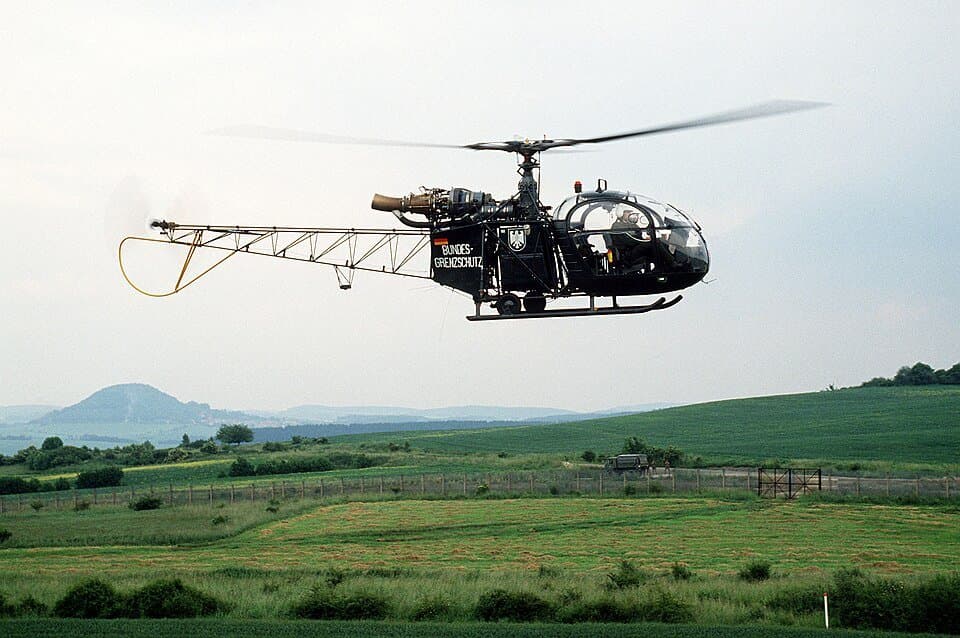

Credit
Original uploader was Wikifreund at de.wikipedia DOD-author: Staff Sergeant Fernando Serna · Public domain · Resized · Public domain · Source ↗ · Modified


Preparing your view.
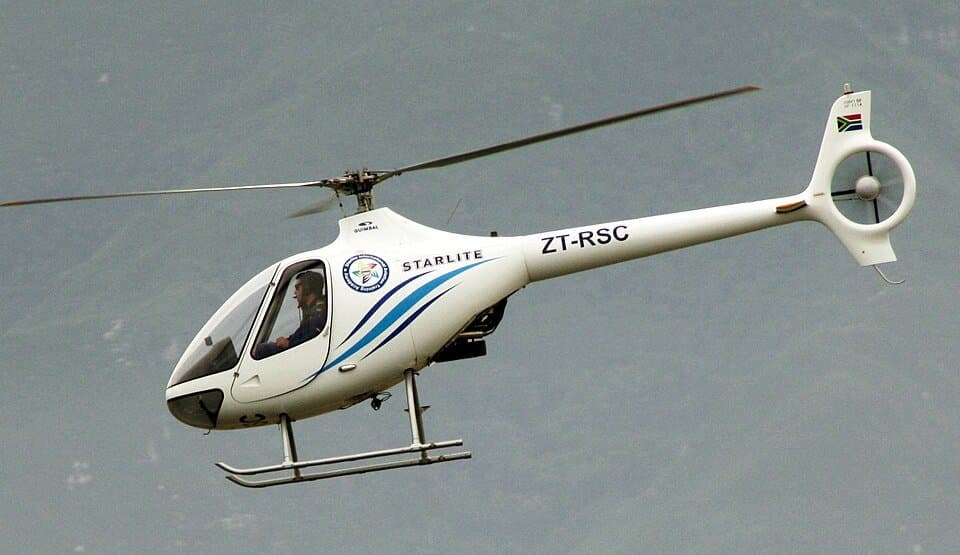
At a glance
True scale
Side by side. From every angle. A human reference for perspective.
3.09 MB · Loads when you open it| Model | Length | Width / span | Height |
|---|---|---|---|
| Aérospatiale Alouette II | ≈ 9.66 m | ≈ 7.96 m (Width) | ≈ 3.55 m |
| Guimbal Cabri G2 | ≈ 6.12 m | ≈ 5.36 m (Width) | ≈ 2.82 m |
Scaled uniformly to the sourced length of 9.66 m. Not an official model or a measured survey.
ForceTally · All rights reserved
Scaled uniformly so that the main rotor matches the sourced 7.2 m rotor diameter. Not an official model or a measured survey.
ForceTally · All rights reserved
The human reference is a generic 1.75 m figure. Models describe external size, not combat performance.
Measured figures
SE 313B Alouette II · overall, blades folded
Single source9.66 m (31 ft 8 in) (overall, blades folded)[source]
Configuration
| Specification | Aérospatiale Alouette II | Guimbal Cabri G2 |
|---|---|---|
| Type | Light helicopter[source] | Light helicopter[source] |
| National origin | France[source] | France[source] |
| Manufacturer | Sud Aviation Aérospatiale[source] | Hélicoptères Guimbal[source] |
| Status | Limited service[source] |
Length
6.31 m (20 ft 8 in)[source]
SE 313B Alouette II · 1 × Turbomeca Artouste IIC6 turboshaft (530 shp) derated to
Single sourceSE 313B Alouette II · Powerplant
Single source1 × Turbomeca Artouste IIC6 turboshaft , 400 kW (530 shp) derated to 269 kW (360 hp)[source]
1 × Lycoming O-360 -J2A piston engine
Single source1 × Lycoming O-360 -J2A piston engine , 108 kW (145 hp)[source]
SE 313B Alouette II · 820 ft/min
Single source4.2 m/s (820 ft/min)[source]
Bars compare reported quantities only. A larger figure does not make a system better; configurations and test conditions differ.
In production[source] |
| Primary users | French Army French Air Force German Army Swiss Air Force (retired)[source] | — |
|---|
| Number built | 1,300+[source] | 300 (July 2022)[source] |
|---|
| Manufactured | 1956–1975[source] | — |
|---|
| Introduction date | 2 May 1957[source] | 2008[source] |
|---|
| First flight | 12 March 1955[source] | 31 March 2005[source] |
|---|
| Variant | Aérospatiale SA 315B Lama[source] | — |
|---|
| Developed into | Aérospatiale Alouette III[source] | Airbus Helicopters VSR700[source] |
|---|
| Capacity | 4 passengers[source] | — |
|---|
| Fuel capacity | 580 L (150 US gal; 130 imp gal)[source] | — |
|---|
| Main rotor area | 81.7 m 2 (879 sq ft)[source] | — |
|---|
| Designer | — | Bruno Guimbal[source] |
|---|
| Role | — | two-seat light helicopter[source] |
|---|
| Source measurement | — | During the early 1990s, Eurocopter elected to sponsor the program, as well as providing technical assistance during testing. In April 1992, the first prototype Cabri G2-01 conducted its maiden flight , which lasted for a total of 45 minutes. In 1996, this prototype set a world record distance for a helicopter under 500 kg, with a distance of 481.32 km. In 2000, Bruno Guimbal left Eurocopter to establish a new company, Hélicoptères Guimbal, in order to certify the Cabri G2 and to place the type into commercial production. To this end, research and production facilities were set up in Aix-en-Provence Aerodrome , France.[source]Guimbal Cabri G2 · Development; only the objects and conditions stated in this passage It had originally been hoped to have the Cabri certified in 2003. In March 2005, the first production Cabri performed its first flight. Following a six-year development program and 300 hours of flight testing, the Cabri G2 received type certification from the European Aviation Safety Agency (EASA) in December 2007. The granting of EASA certification made the Cabri the first twin-seat reciprocating-engine helicopter to be certified in more than 30 years.[source]Guimbal Cabri G2 · Development; only the objects and conditions stated in this passage The Airbus Helicopters VSR700 naval UAV, powered by a 155-hp Continental CD-155 , will fly as a prototype in 2018 before a 2021 introduction.[source]Guimbal Cabri G2 · Development / Unmanned aerial vehicle; only the objects and conditions stated in this passage Various features for personal helicopter usage, such as an externally accessible 200-litre baggage compartment, power sockets within the main cabin, leather seating, and incidental under-seat storage, are also present.[source]Guimbal Cabri G2 · Design; only the objects and conditions stated in this passage The Cabri is powered by a single 180 hp (134 kW) Lycoming O-360 piston engine, which has been rated to 145 hp (108 kW) max continuous power and 160 hp (119 kW) 5-minute power. The engine incorporates a solid-state electronic ignition system which protects against over-speed upon startup and has greater reliability. The engine mounts also utilize vibration isolation techniques for increased crew comfort. The engine is positioned directly behind the cabin, making it easier to access for maintenance; while the engine exhaust is elevated above the tail boom in order to reduce noise and lower the risk of ground fires upon landing. The maintenance costs of the Cabri are claimed to be "very low", in part due to only three components on the rotorcraft being time-limited , all others being condition-limited instead. The cost per overhaul of the Cabri is half of that of comparable rotorcraft such as the Robinson R22 .[source]Guimbal Cabri G2 · Design; only the objects and conditions stated in this passage A mid-air collision between a Cessna 152 and a Cabri G2 occurred on 17 November 2017 in the UK, causing four fatalities, two in each aircraft. Both aircraft were on training flights.[source]Guimbal Cabri G2 · Accidents; only the objects and conditions stated in this passage On November 8, 2020, two Cabri G2 (Registration 9M-HCA & 9M-HCB) collided in mid-air with one of the helicopters crashing while the other crash landed safely in nearby Taman Melawati, a suburb of Kuala Lumpur, Malaysia. Two people were killed. Both were from the same Heli Club based out of Subang Airport (SZB), Malaysia on training flights.[source]Guimbal Cabri G2 · Accidents; only the objects and conditions stated in this passage Length: 6.31 m (20 ft 8 in)[source]Guimbal Cabri G2 · Specifications; only the objects and conditions stated in this passage Width: 1.24 m (4 ft 1 in)[source]Guimbal Cabri G2 · Specifications; only the objects and conditions stated in this passage Height: 2.37 m (7 ft 9 in)[source]Guimbal Cabri G2 · Specifications; only the objects and conditions stated in this passage Gross weight: 700 kg (1,543 lb)[source]Guimbal Cabri G2 · Specifications; only the objects and conditions stated in this passage Powerplant: 1 × Lycoming O-360 -J2A piston engine , 108 kW (145 hp)[source]Guimbal Cabri G2 · Specifications; only the objects and conditions stated in this passage Main rotor diameter: 7.2 m (23 ft 7 in)[source]Guimbal Cabri G2 · Specifications; only the objects and conditions stated in this passage Maximum speed: 185 km/h (115 mph, 100 kn)[source]Guimbal Cabri G2 · Specifications; only the objects and conditions stated in this passage Cruise speed: 166 km/h (104 mph, 90 kn)[source]Guimbal Cabri G2 · Specifications; only the objects and conditions stated in this passage Range: 700 km (430 mi, 380 nmi)[source]Guimbal Cabri G2 · Specifications; only the objects and conditions stated in this passage Endurance: 4.5 hours[source]Guimbal Cabri G2 · Specifications; only the objects and conditions stated in this passage Service ceiling: 3,963 m (13,000 ft)[source]Guimbal Cabri G2 · Specifications; only the objects and conditions stated in this passage |
|---|
Gross; Max gross weight · Max gross weight
Single sourceMaximum take-off; Cabri G2 · maximum gross aircraft weight, 2024 manufacturer specification; not empty weight or payload · Cabri G2 · maximum gross aircraft weight, 2024 manufacturer specification; not empty weight or payload · Cabri G2
Single source