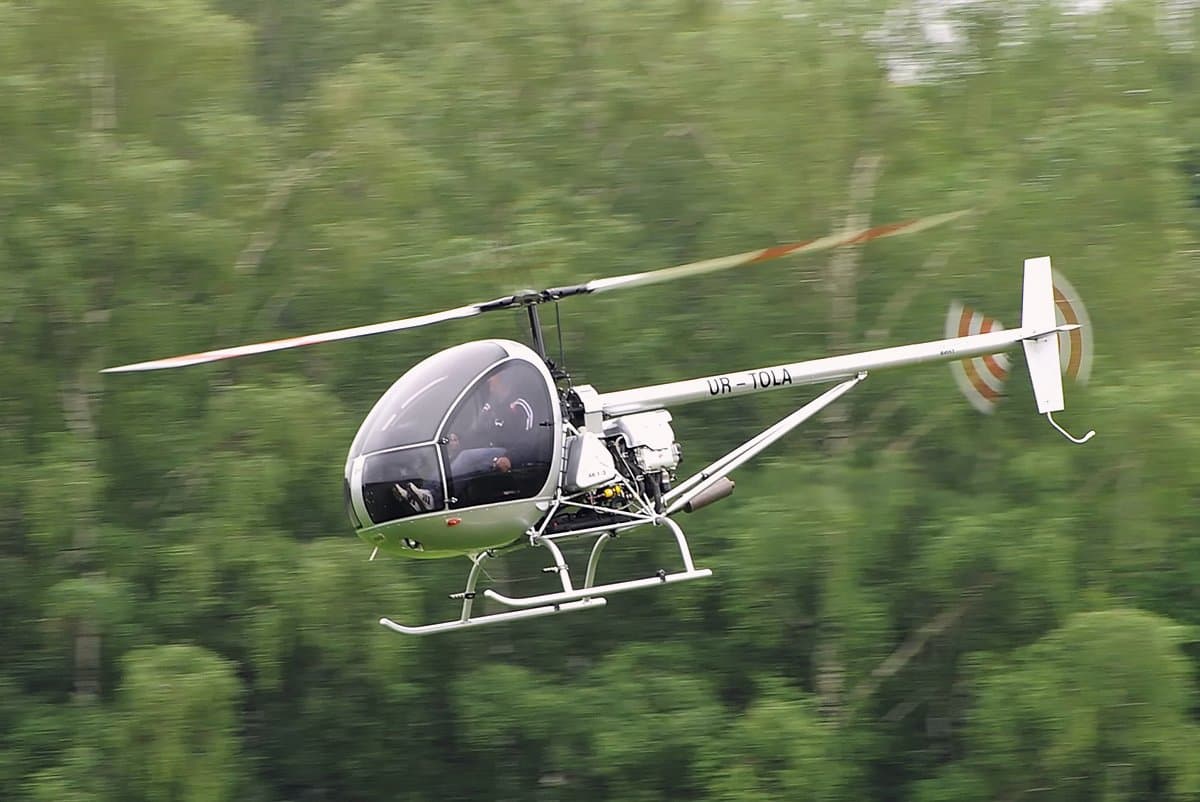

Credit
Aleksandr Markin · CC BY-SA 2.0 · Resized · CC BY-SA 2.0 · Source ↗ · Modified


Preparing your view.


At a glance
Aerokopter AK1-3 Sankalarger figure on 0 of 4
Measured figures
Configuration
| Specification | Aerokopter AK1-3 Sanka | Northrop Grumman MQ-8C Fire Scout |
|---|---|---|
| Type | Helicopter[source] | UAV helicopter[source] |
| National origin | Ukraine[source] | — |
| Manufacturer | Aerokopter[source] | Northrop Grumman Bell Helicopter[source] |
| Status | In production (2014)[source] | Development testing[source] |
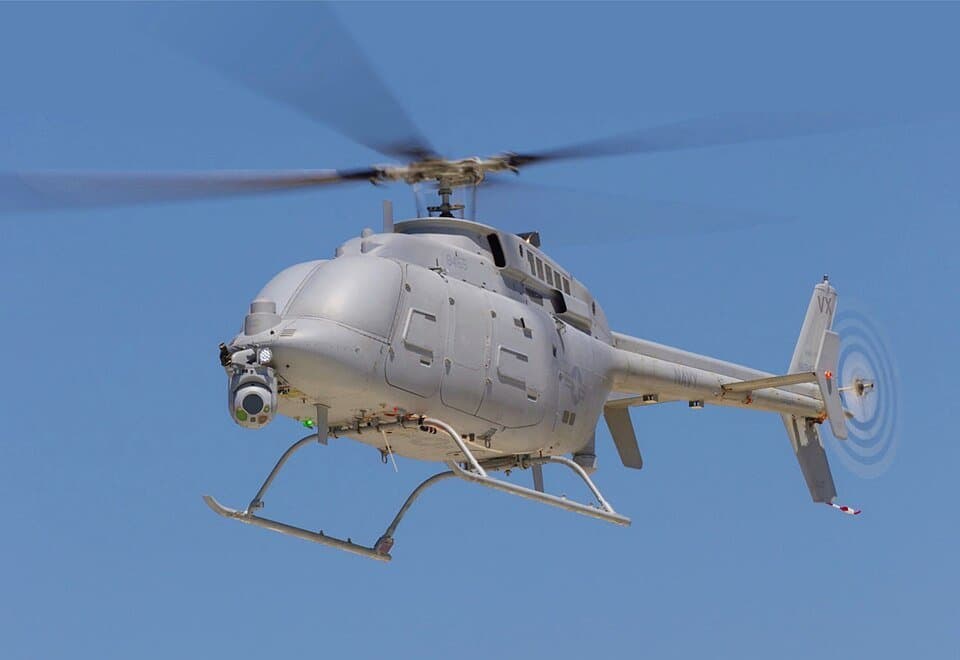
Northrop Grumman MQ-8C Fire Scoutlarger figure on 4 of 4
Counts only measures both sources give with the same scope. A larger figure is not a better system.
Length
34 ft 8 in (10.6 m)[source]
Empty; AK1-3 · Empty weight
Single sourceEmpty; Empty weight
Single sourceGross; AK1-3 · Gross weight
Single sourceMaximum take-off; Ultra light Helicopter AK1-3 · 3.1. ESTIMATED WEIGHTS · Ultra light Helicopter AK1-3 · 3.1. ESTIMATED WEIGHTS
Single source380 kg (838 lb)[source]
650 kg (1,433 lb)[source]
650 kg[source]Ultra light Helicopter AK1-3 · 3.1. ESTIMATED WEIGHTS
380 kg (1 433 lb )[source]
650 kg (833 lb )[source]Source text · numeric interpretation needs review
Maximum take-off; Max takeoff weight
Single source6,000 lb (2,721 kg)[source]
Maximum; Maximum speed
Single sourceCruise; AK1-3 · Cruise speed
Single sourceMaximum; AK1-3 · Maximum speed
Single source180 km/h (110 mph, 97 kn)[source]
160 km/h (99 mph, 86 kn)[source]
180 km/h[source]
Maximum; Maximum speed
Single source140 kn (160 mph, 260 km/h)[source]
AK1-3 · current manufacturer product configuration · flight range
Manufacturer claimRange
Single source350 km[source]AK1-3 · current manufacturer product configuration · flight range
350 km[source]AK1-3 · current manufacturer product configuration · flight range
350 km[source]
Own Bell 407-based MQ-8C range; excludes predecessor MQ-8B performance
Single source150 nmi (170 mi; 280 km)[source]Own Bell 407-based MQ-8C range; excludes predecessor MQ-8B performance
AK1-3 · 1 × Subaru EJ25 four cylinder, water-cooled, four stroke automotive engine
Single source1 × Subaru EJ25 four cylinder, water-cooled, four stroke automotive engine, 116 kW (156 hp)[source]
1 × Rolls-Royce 250-C47B , 813 shp (
Single source1 × Rolls-Royce 250-C47B , 813 shp (606 kW)[source]
AK1-3 · 1,600 ft/min
Single source8 m/s (1,600 ft/min)[source]
Bars compare reported quantities only. A larger figure does not make a system better; configurations and test conditions differ.
| Number built | 102 (December 2020)[source] | 38[source] |
|---|
| First flight | 1999[source] | 2013[source] |
|---|
| Capacity | one passenger[source] | 2,950 lb (1,338 kg)[source] |
|---|
| Fuel capacity | 75 litres (16 imp gal; 20 US gal)[source] | — |
|---|
| Source measurement | A BRIEF DESCRIPTION OF THE HELICOPTER 2.1 CONSTRUCTIONS AND LAY-OUT DIAGRAM 2.1.1. The AK1-3 helicopter (Fig. 2.1) is a fabricated structure with a 3-bladed rotor and a 2-bladed anti-torque rotor. 2.2. HELICOPTER TYPE AND DESIGNATION 2.2.1. The helicopter falls into the normal category of light aircraft, and is designated to fulfill the following tasks: - Patrolling (power lines, canals, pipelines, highways, hard-to-reach border regions); - Agriculture (pollination, spraying, sowing, animal watch); - Forest and wild animal protection; - Advertising; - Searching; - Aerial inspection (aerial photography, geological and fishing exploration); - Flying lessons for both military and civilian students; - Participation in aviation sports competitions. 2.3 ENGINE TYPE AND QUANTITY 2.3.1. The helicopter uses one piston liquid-cooled engine produced by the Japanese Subaru, EJ-25 model, which is installed behind the cockpit. 2.4. DEVELOPER AND MODEL 2.4.1 The developer is Аэрокоптер Ltd., Ukraine. Model: AK1-3 helicopter. 2.5. CREW PERSONNEL AND HELICOPTER’S TRANSPORTING CAPABILITIES 2.5.1. Depending on its mission, the helicopter crew may include one or two persons:[source]Ultra light Helicopter AK1-3 · 1.6. STENCILLING AND INSCRIPTIONS ON THE HELICOPTER · native source block · component and conditions remain verbatim MAIN FEATURES 3.1. ESTIMATED WEIGHTS 3.1.1. Maximum takeoff weight 650 kg 3.1.2. Maximum weight of loaded helicopter without fuel 590 kg 3.1.3. Maximum payload weight (including pilot and fuel) 270 kg 3.1.5. Empty helicopter weight 380 kg 3.1.6. Helicopter equipment weight, including: - crew parachutes (2) 20 kg - crew (2 persons) 160 kg - protective helmets (2) 2.3 kg - engine oil 3 kg - unusable fuel 0,5 kg З.2. REGULATION CURVES[source]Ultra light Helicopter AK1-3 · 2.4. DEVELOPER AND MODEL · native source block · component and conditions remain verbatim Crosshead traverse 24±1mm 3. Slope angles of wobble plate and control rod traverses that correspond to them[source]Ultra light Helicopter AK1-3 · 3.1. ESTIMATED WEIGHTS · 3.1.6. Helicopter equipment weight, including: · component and conditions remain verbatim 6. Control rod labor not more than 3 kg.[source]Ultra light Helicopter AK1-3 · 3.1. ESTIMATED WEIGHTS · native source block · component and conditions remain verbatim 7. Foot pedals labor with anti- torque rotor attached not more than 7 kg.[source]Ultra light Helicopter AK1-3 · 3.1. ESTIMATED WEIGHTS · native source block · component and conditions remain verbatim 8. Labor for the Lead/Gas shift, with normal shifting from one extreme position to the other taking no less than 20 seconds, not more than 5 kg.[source]Ultra light Helicopter AK1-3 · 3.1. ESTIMATED WEIGHTS · native source block · component and conditions remain verbatim 3.3. CENTERING CHARACTERISTICS 3.3.1 Centering capacity during takeoff, flight, and landing: - noseheaviness, before the rotor axis 38 mm - bowheaviness, behind the rotor axis 59 mm 3.3.2. Longitudinal centering for an empty helicopter 173mm 3.4. FLIGHT CHARACTERISTICS 3.4.1. Maximum ground airspeed 186 km/h 3.4.2. Ground cruising airspeed 160 km/h 3.4.3. Rotation speed around vertical axis during hovering < 45 degrees/s 3.4.4. Static ceiling for hovering 1500 m 3.4.5. Maximum ground climbing capacity 8 m/s 3.4.6. Minimal vertical descent rate while floating in autorotation regime at VDesc=90 km/h 7,4 m/s 3.4.7. Flight duration at Н=0 - 500 m with 5 % necessary fuel supply 3 hrs 3.4.8. Practical ground range ability with 5 % necessary fuel supply 450 km 3.4.9. Maximum exploitation load range +0.5…+2.5[source]Ultra light Helicopter AK1-3 · 3.1. ESTIMATED WEIGHTS · native source block · component and conditions remain verbatim 3.5.2. Cockpit Internal dimensions: - length 1.5 m - width 1.4 m - height 1.2 m Entrance door 0.95х1 m 3.5.3. Undercarriage - length 1.8 m - distance between skids 1.6 m 3.6. ENGINE INFORMATION 3.6.1. Engine quantity, type, and marking: one horizontal piston four-cylinder four-act liquid-cooled engine Subaru EJ-25. 3.6.2. General characteristics of Subaru EJ-25: Engine working volume 2500 cm3[source]Ultra light Helicopter AK1-3 · 3.5. GEOMETRICAL DIMENSIONS · 3.5.2. Cockpit · component and conditions remain verbatim Engine power 165 horsepower (121 kW) Engine dry weight 110 kg Overall dimensions of the engine: - length 0.8 m - height 0.7 m - width 0.5 m 3.6.3. Subaru EJ-25 operating limitations: Continuous working time in regime - unlimited 3.6.4. Engine mounting units: - three shock-absorbing pads, of which two are on the engine mounting, and one near the flywheel. 3.7. GEOMETRICAL ADJECTIVES OF THE ROTORS 3.7.1. Geometrical adjectives of the rotor - rotor diameter 6.84 m - blade number 3 - carrier blade chord 0.17 m - blade profile NACA 63012/63015 - outline blade shape rectangular - peripheral velocity of blade tip 205 m/s - duty factor 0.0475 3.7.2. Geometrical adjectives of the anti-torque rotor[source]Ultra light Helicopter AK1-3 · 3.6. ENGINE INFORMATION · 3.6.2. General characteristics of Subaru EJ-25: · component and conditions remain verbatim - rotor diameter 1.28 m - blade number 2[source]Ultra light Helicopter AK1-3 · 3.7. GEOMETRICAL ADJECTIVES OF THE ROTORS · 3.7.2. Geometrical adjectives of the anti-torque rotor · component and conditions remain verbatim - carrier blade chord 0.115 mm - blade profile NACA 63012 - peripheral velocity of blade tip 186.3 m/s - duty factor 0.1144 3.8. ALTITUDE RANGES, OPERATING TEMPERATURE RANGES, AND WEATHER CONDITIONS 3.8.1. Temperature range: –30…+30°С 3.8.2. Altitude range (limited by the absence of oxygen equipment) 0…3000 m 3.8.3. The helicopter is designated for use under normal weather conditions in daylight according to visual flight rules in any latitudes. 3.9. LIFETIME The overall technical lifetime (design life) of the helicopter is 2,000 flight hours. The passing of design life is warranted by revisions and checkups that are included in regular technical service.[source]Ultra light Helicopter AK1-3 · 3.7. GEOMETRICAL ADJECTIVES OF THE ROTORS · native source block · component and conditions remain verbatim Steel 30HGSA GOST 4543-86, VТ 3-1, D-16Т, bulk graphite zytel polyamide ТU 6-05-988-93, , steel 08Х15N5D2ТS (VNS-2), glass fiber cloth Т-25, building agent EDT-69N Floor 16 mm plywood, glass fiber cloth Т-10 Carbonic cloth Lorit 287, 285 4.3. FRAMEWORK The framework (Fig. 4.2) is a welded construction made of pipes, and serves as a base for different components of the helicopter. Overall dimensions: 1133х720х878 mm[source]Ultra light Helicopter AK1-3 · 4.2. MATERIALS USED · native source block · component and conditions remain verbatim The helicopter’s propulsion is mainly produced by the engine. The helicopter features a piston engine Subaru EJ-25, which is horizontal, four-cylinder, opposed, four-act, and liquid-cooled. Its working volume is 2500 cm3, power – 165 horsepower (121 kW). The engine has a sixteen-valve gas-distributing mechanism with a distribution shaft in each of the two cylinder heads. The engine is flexibly affixed to the framework. It is positioned in such a way, that with a specified centering it provides easy access to the devices which demand frequent service. The helicopter’s transmission (Fig. 5.1) provides the power transfer from the engine to the rotors, with rotary speed being the most advantageous for both rotors. Transmission is also responsible for the concrete direction of rotors and the power transfer for other devices and mechanisms.[source]Ultra light Helicopter AK1-3 · 5.1. GENERAL INFORMATON · native source block · component and conditions remain verbatim | In March 2013, the Navy incorporated the Rolls-Royce 250-C47E engine into the MQ-8C for a 5 percent increase in hot and high power, 2 percent reduced fuel consumption, 8 percent increase in rated takeoff power, and better reliability. The Bell 407-based MQ-8C has an endurance of 12 hours, a range of 150 nmi (170 mi; 280 km), and a payload capacity of about 318 kg (701 lb). It has twice the endurance and three times the payload as the MQ-8B.[source]Northrop Grumman MQ-8C Fire Scout · Design and development; only the objects and conditions stated in this passage In September 2013, the MQ-8C Fire-X delivered to the Navy turned on its engines for 10 minutes in preparation for first flight. First flight was scheduled for early to mid-October, although the exact date was not determined, as such tests are often delayed by minor system problems. The MQ-8C flight test regime was for six months.[source]Northrop Grumman MQ-8C Fire Scout · Design and development; only the objects and conditions stated in this passage The MQ-8C Fire Scout first flew on 31 October 2013. It flew for 7 minutes in restricted airspace using autonomous controls at Naval Base Ventura County . It flew a second time hours later that day to an altitude of 500 ft. The MQ-8C was jointly operated by Northrop Grumman and the Navy. Northrop Grumman delivered the second MQ-8C in November 2013. They were under contract to build 14 helicopters.[source]Northrop Grumman MQ-8C Fire Scout · Design and development; only the objects and conditions stated in this passage In December 2014, the MQ-8C began testing aboard the destroyer Jason Dunham , executing 22 landings and recoveries in less than four hours. Testing was completed on 19 December, executing 32 takeoffs and recoveries over three flights. The MQ-8C will be ready to perform surface warfare missions in 2018 and mine countermeasure missions in 2020. The aircraft's first deployment is expected for 2016 to give Littoral Combat Ships a 50 nmi (58 mi; 93 km)-radius ISR capability. |
|---|
| Engine | 1 Subaru EJ25 quattro cilindri, motore automobilistico a quattro tempi, raffreddato ad acqua[source] | — |
|---|
| Primary user | — | United States Navy[source] |
|---|
| Introduction date | — | 2019[source] |
|---|
| Developed from | — | Bell 407 Northrop Grumman MQ-8 Fire Scout[source] |
|---|
| Role | — | unmanned helicopter[source] |
|---|
| Country of origin | — | Canada, United States[source] Canada[source] United States[source] |
|---|
In May 2016, NAVAIR signed a contract for the Osprey 30 lightweight AESA radar for the MQ-8C, the first system of its type to offer full spherical coverage with no moving parts. The 360-degree, 50 kg (110 lb) airborne radar uses fixed panels distributed around the body of aircraft, mounting antennas weighing just over 11 kg (24 lb) each. The radar is classified as the AN/ZPY-8 and will be retrofitted onto the Navy's MQ-8C's.[source]Northrop Grumman MQ-8C Fire Scout · Design and development; only the objects and conditions stated in this passage
In December 2014, the first operational MQ-8C was delivered to the US Navy. Its final developmental flight was completed in April 2015, after 450 hours completed in 327 flights. In August 2015, Northrop Grumman demonstrated the MQ-8C's endurance with an 11-hour flight. In November 2015, the MQ-8C completed a 3-week operational assessment period to assess system performance, endurance, and reliability of the unmanned helicopter over 83.4 hours in 11 flights. To date, the aircraft logged 730 flight hours over 427 flights. Ship-based testing is expected to begin in 2017. In July 2018, Air Test and Evaluation Squadron 1 concluded the initial operational test and evaluation of the MQ-8C, conducted aboard the USS Coronado .[source]Northrop Grumman MQ-8C Fire Scout · Design and development; only the objects and conditions stated in this passage
Capacity: 2,950 lb (1,338 kg)[source]Northrop Grumman MQ-8C Fire Scout · Specifications; only the objects and conditions stated in this passage
Length: 34 ft 8 in (10.6 m)[source]Northrop Grumman MQ-8C Fire Scout · Specifications; only the objects and conditions stated in this passage
Height: 10 ft 11 in (3.3 m)[source]Northrop Grumman MQ-8C Fire Scout · Specifications; only the objects and conditions stated in this passage
Max takeoff weight: 6,000 lb (2,721 kg)[source]Northrop Grumman MQ-8C Fire Scout · Specifications; only the objects and conditions stated in this passage
Powerplant: 1 × Rolls-Royce 250-C47B , 813 shp (606 kW)[source]Northrop Grumman MQ-8C Fire Scout · Specifications; only the objects and conditions stated in this passage
Main rotor diameter: 36 ft 7 in (11.2 m)[source]Northrop Grumman MQ-8C Fire Scout · Specifications; only the objects and conditions stated in this passage
Maximum speed: 140 kn (160 mph, 260 km/h)[source]Northrop Grumman MQ-8C Fire Scout · Specifications; only the objects and conditions stated in this passage
Endurance: 15 hours maximum[source]Northrop Grumman MQ-8C Fire Scout · Specifications; only the objects and conditions stated in this passage
Service ceiling: 20,000 ft (6,100 m)[source]Northrop Grumman MQ-8C Fire Scout · Specifications; only the objects and conditions stated in this passage