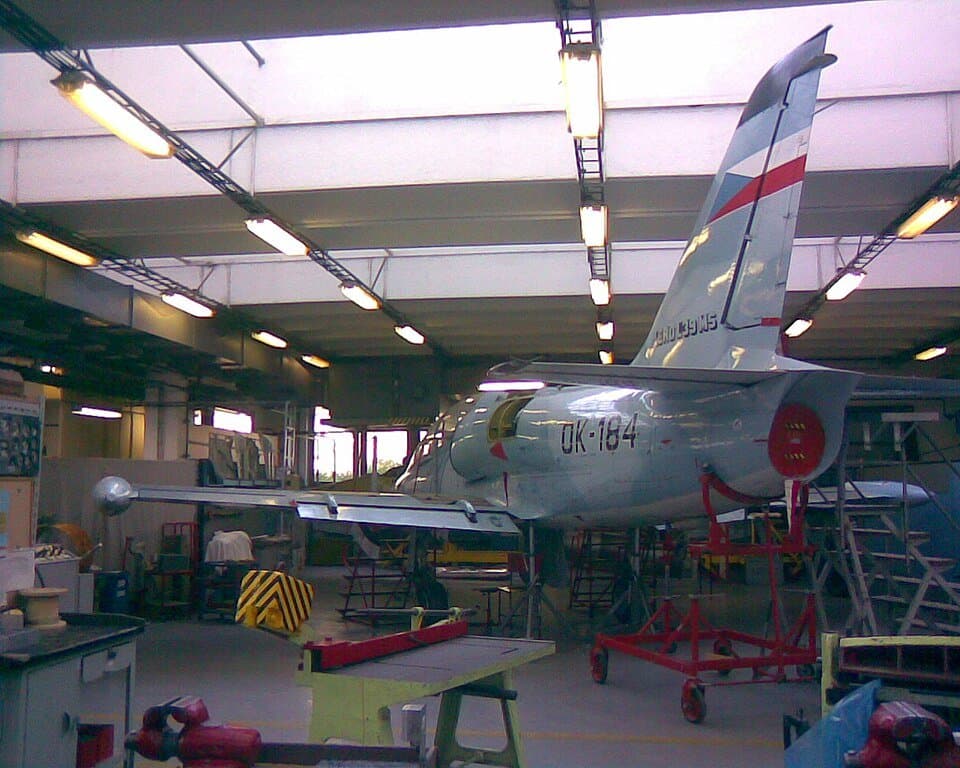
Credit
Michal šenki · Public domain · Resized · Public domain · Source ↗ · Modified


Preparing your view.

At a glance
Measured figures
L-59E · Length
Single source12.20 m (40 ft 0 in)[source]
Beechcraft C-12 Huron · Length
Configuration
| Specification | Aero L-59 Super Albatros | Beechcraft C-12 Huron |
|---|---|---|
| Type | Military trainer aircraft COIN[source] | Military utility aircraft[source] |
| Manufacturer | Aero Vodochody[source] | Beechcraft[source] |
| Status | Out of production, in service[source] | Active service[source] |
| Primary users | Czech Air Force Egyptian Air Force Tunisian Air Force[source] |
43 ft 9 in (13.34 m)[source]
Empty; L-59E · includes gun
Single sourceMaximum take-off; L-59E · Max takeoff weight
Single source4,030 kg (8,885 lb) (includes gun)[source]
7,000 kg (15,432 lb)[source]
Empty; Beechcraft C-12 Huron · Empty weight
Single sourceMaximum take-off; Beechcraft C-12 Huron · Max takeoff weight
Single sourceL-59E · at 7,000 m (23,000 ft) (with maximum internal and external fuel)
Single source2,000 km (1,200 mi, 1,100 nmi) at 7,000 m (23,000 ft) (with maximum internal and external fuel)[source]
Beechcraft C-12 Huron · 2 × Pratt & Whitney Canada PT6A-42 turboprop engines, 850 shp ( ) each
Single source2 × Pratt & Whitney Canada PT6A-42 turboprop engines, 850 shp (630 kW) each[source]
L-59E · 1 × Lotarev DV-2 turbofan thrust
Single source1 × Lotarev DV-2 turbofan , 21.57 kN (4,850 lbf) thrust[source]
Bars compare reported quantities only. A larger figure does not make a system better; configurations and test conditions differ.
United States Air Force United States Army United States Marine Corps United States Navy[source] |
| Number built | 80[source] | — |
|---|
| Manufactured | 1986–1996[source] | 1974–present[source] |
|---|
| First flight | 30 September 1986[source] | — |
|---|
| Developed from | Aero L-39 Albatros[source] | Beechcraft Super King Air[source] |
|---|
| Variant | Aero L-159 ALCA[source] | Beechcraft RC-12 Guardrail[source] |
|---|
| Fuel capacity | 1,537 L (406 US gal; 338 imp gal) including tip tanks[source] | 675.2 US gal (562.2 imp gal; 2,556 L) ; 1,035.2 US gal (862.0 imp gal; 3,919 L) with ferry tanks[source] |
|---|
| Stall speed | 185 km/h (115 mph, 100 kn) (flaps down)[source] | — |
|---|
| Guns | one GSh-23L cannon in under-fuselage pod[source] | — |
|---|
| Hardpoints | four underwing hardpoints with a capacity of inner hardpoints 500 kg (1,100 lb)capacity, outer hardpoints 250 kg (550 lb)[source] | — |
|---|
| Country of origin | Czechoslovakia[source]Inventory Origin column; table 1, row 26, cell 2; revision 1374778711; retrieved 2026-10-01 | United States[source] United States[source] |
|---|
| Introduction date | — | 1974[source] |
|---|
| Capacity | — | 13 passengers[source] |
|---|
| Airfoil | — | root: NACA 23018 ; tip: NACA 23012[source] |
|---|
| Propellers | — | 4-bladed constant-speed propellers[source] |
|---|
| Wing loading | — | 41.3 lb/sq ft (202 kg/m 2 )[source] |
|---|
| Power/mass | — | 0.14 hp/lb (0.23 kW/kg)[source] |
|---|
| Status (TC-12B) | — | The Navy retired the TC-12B aircraft on 16 May 2017 after the USAF ceased sending student pilots eliminating the need for the TC-12B as the Navy's fleet of T-44C aircraft was sufficient to meet the USN, USMC and USCG multi engine pilot training need.[source]TC-12B · source-literal variant status |
|---|
| Source measurement | — | The U.S. Navy followed suit in 1979, ordering a version of the Super King Air A200C (modified with a 1.32 m by 1.32 m; 52 inch by 52 inch cargo door from the Super King Air 200C), designating it the UC-12B, for logistics support between Naval and Marine Corps air stations, air facilities, and other activities, both in CONUS and overseas. The cabin can readily accommodate cargo, passengers or both. It is also equipped to accept litter patients in medical evacuation missions. Through 1982, the Navy ordered 64 of these aircraft.[source]Beechcraft C-12 Huron · Design and development; only the objects and conditions stated in this passage The UC-12F and UC-12M are light passenger and cargo airlift versions procured for the U.S. Navy and Marine Corps from 1986 and 1987 respectively. They are based on the Super King Air 200, use PT6A-42 engines, and have a maximum takeoff weight (MTOW) of 13,500 lb (6,100 kg). They are configured as combi aircraft and are also used for multi-engine training and testing.[source]Beechcraft C-12 Huron · Design and development / UC-12F/M; only the objects and conditions stated in this passage The UC-12W is an improved version of the UC-12F/M for the Marine Corps procured from 2010 for the same missions. It is based on the Super King Air 350, uses PT6A-60A engines, and has an MTOW of 16,500 lb (7,500 kg). According to its 2022 Marine Aviation Plan, United States Marine Corps Aviation plans to phase out the Model 200-based UC-12F and UC-12M along with the Cessna UC-35D and replace them with new UC-12Ws by 2032.[source]Beechcraft C-12 Huron · Design and development / UC-12W; only the objects and conditions stated in this passage Used by the U.S. Army and U.S. Air Force for liaison and attache transport. Based on the King Air A200, with 750 shp (560 kW) PT6A-38 engines driving three-bladed propellers, and normally seating for eight passengers. 60 delivered to US Army and 30 to USAF, with one to Greek Air Force. Survivors later upgraded to C-12C standard.[source]Beechcraft C-12 Huron · Variants / King Air 200-based variants; only the objects and conditions stated in this passage U.S. Navy / U.S. Marine Corps version with an additional cargo door and powered by 850 shp (630 kW) PT6A-41 engines. Based on the King Air A200C. 66 built.[source]Beechcraft C-12 Huron · Variants / King Air 200-based variants; only the objects and conditions stated in this passage Based on C-12A but with 850 shp (630 kW) PT6A-41 engines. 14 new build aircraft for U.S. Army together with converted C-12As.[source]Beechcraft C-12 Huron · Variants / King Air 200-based variants; only the objects and conditions stated in this passage RC-12G[source]Beechcraft C-12 Huron · Variants / King Air 200-based variants; only the objects and conditions stated in this passage RC-12H[source]Beechcraft C-12 Huron · Variants / King Air 200-based variants; only the objects and conditions stated in this passage UC-12M[source]Beechcraft C-12 Huron · Variants / King Air 200-based variants; only the objects and conditions stated in this passage RC-12M[source]Beechcraft C-12 Huron · Variants / King Air 200-based variants; only the objects and conditions stated in this passage Conversion of UC-12M for range surveillance duties with AN/APS-140/504 surface search radar. Two converted.[source]Beechcraft C-12 Huron · Variants / King Air 200-based variants; only the objects and conditions stated in this passage Support aircraft for US Army based on King Air B200C, powered by 850 shp (630 kW) PT6A-42 engines driving 4-bladed propellers and with EFIS glass cockpit instrumentation. 29 built. Modifications for Global air-traffic management given designation C-12R-1 .[source]Beechcraft C-12 Huron · Variants / King Air 200-based variants; only the objects and conditions stated in this passage U.S. Army version based on the King Air 350, with seating for 8 to 15 passengers and quick cargo conversion capability.[source]Beechcraft C-12 Huron · Variants / King Air 350-based variants; only the objects and conditions stated in this passage USAF version modified for the Intelligence, Surveillance & Reconnaissance (ISR) role; originally 8 King Air 350s and 29 King Air 350ERs and ending with 42 350ERs (including one combat loss). In service since June 2009 in Iraq and Afghanistan and globally for USSOCOM. All aircraft were transferred to USSOCOM, US Army, and other US government agencies by 2015. The last MC-12W Liberty under U.S. Air Force Special Operations Command was retired in September 2025. The Royal Canadian Air Force ordered 3 similar, if not exact, variants.[source]Beechcraft C-12 Huron · Variants / King Air 350-based variants; only the objects and conditions stated in this passage Used by the U.S. Air Force's Pacific Air Forces , and Air Force Materiel Command . It carries 2 crew and 19 passengers. The C-12J is based on the Beechcraft 1900 C and carries the serials UD-1 through UD-6.[source]Beechcraft C-12 Huron · Variants / Beechcraft 1900-based variant; only the objects and conditions stated in this passage SIGINT aircraft for US Army based on King Air A200CT, with 1,200 shp (890 kW) PT-6A-67 engines driving four-bladed propellers and with increased (16,000 lb (7,260 kg) max take-off weight. Fitted with Guardrail/Common Sensor System 4 system. Nine built.[source]Beechcraft C-12 Huron · Variants / Special military variants; only the objects and conditions stated in this passage SIGINT aircraft for US Army based on King Air A200CT/C-12F airframe with 1,200 shp (890 kW) PT-6A-67 engines driving four-bladed propellers and 16,200 lb (7,350 kg) max take-off weight. Fitted with Guardrail/Common Sensor System 1 system. 15 C-12Fs converted to this standard.[source]Beechcraft C-12 Huron · Variants / Special military variants; only the objects and conditions stated in this passage SIGINT aircraft for US Army based on King Air A200CT/C-12F airframe with 1,200 shp (890 kW) PT-6A-67 engines driving four-bladed propellers and 16,200 lb (7,350 kg) max take-off weight. Fitted with Guardrail/Common Sensor System 2 system. 9 built.[source]Beechcraft C-12 Huron · Variants / Special military variants; only the objects and conditions stated in this passage Capacity: 13 passengers[source]Beechcraft C-12 Huron · Specifications (Beechcraft C-12 Huron); only the objects and conditions stated in this passage Length: 43 ft 9 in (13.34 m)[source]Beechcraft C-12 Huron · Specifications (Beechcraft C-12 Huron); only the objects and conditions stated in this passage Wingspan: 54 ft 6 in (16.61 m)[source]Beechcraft C-12 Huron · Specifications (Beechcraft C-12 Huron); only the objects and conditions stated in this passage Height: 15 ft (4.6 m)[source]Beechcraft C-12 Huron · Specifications (Beechcraft C-12 Huron); only the objects and conditions stated in this passage Wing area: 303 sq ft (28.1 m 2 )[source]Beechcraft C-12 Huron · Specifications (Beechcraft C-12 Huron); only the objects and conditions stated in this passage Empty weight: 7,755 lb (3,518 kg)[source]Beechcraft C-12 Huron · Specifications (Beechcraft C-12 Huron); only the objects and conditions stated in this passage Max takeoff weight: 12,500 lb (5,670 kg)[source]Beechcraft C-12 Huron · Specifications (Beechcraft C-12 Huron); only the objects and conditions stated in this passage Powerplant: 2 × Pratt & Whitney Canada PT6A-42 turboprop engines, 850 shp (630 kW) each[source]Beechcraft C-12 Huron · Specifications (Beechcraft C-12 Huron); only the objects and conditions stated in this passage Maximum speed: 289 kn (333 mph, 535 km/h) at 15,000 ft (4,572 m)[source]Beechcraft C-12 Huron · Specifications (Beechcraft C-12 Huron); only the objects and conditions stated in this passage Range: 1,450 nmi (1,670 mi, 2,690 km) C-12J[source]Beechcraft C-12 Huron · Specifications (Beechcraft C-12 Huron); only the objects and conditions stated in this passage Ferry range: 1,800 nmi (2,100 mi, 3,300 km) C-12J with maximum fuel and 45-minute reserve[source]Beechcraft C-12 Huron · Specifications (Beechcraft C-12 Huron); only the objects and conditions stated in this passage Service ceiling: 35,000 ft (11,000 m)[source]Beechcraft C-12 Huron · Specifications (Beechcraft C-12 Huron); only the objects and conditions stated in this passage Rate of climb: 2,450 ft/min (12.4 m/s)[source]Beechcraft C-12 Huron · Specifications (Beechcraft C-12 Huron); only the objects and conditions stated in this passage |
|---|