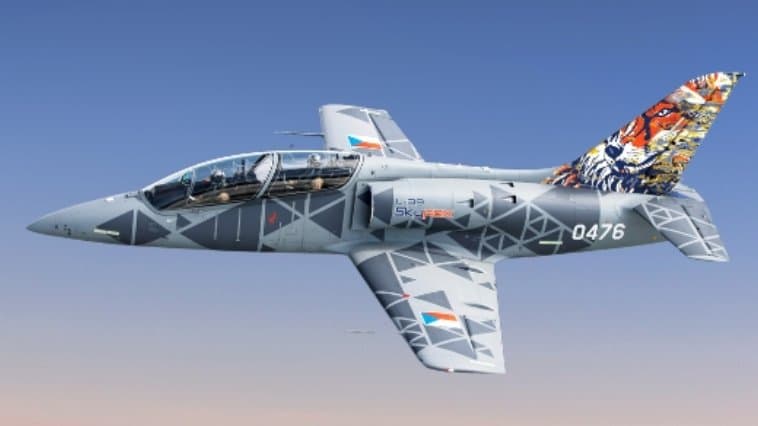

Credit
Aero Vodochody · CC BY-SA 4.0 · Resized · CC BY-SA 4.0 · Source ↗ · Modified


Preparing your view.

BTrainer aircraft
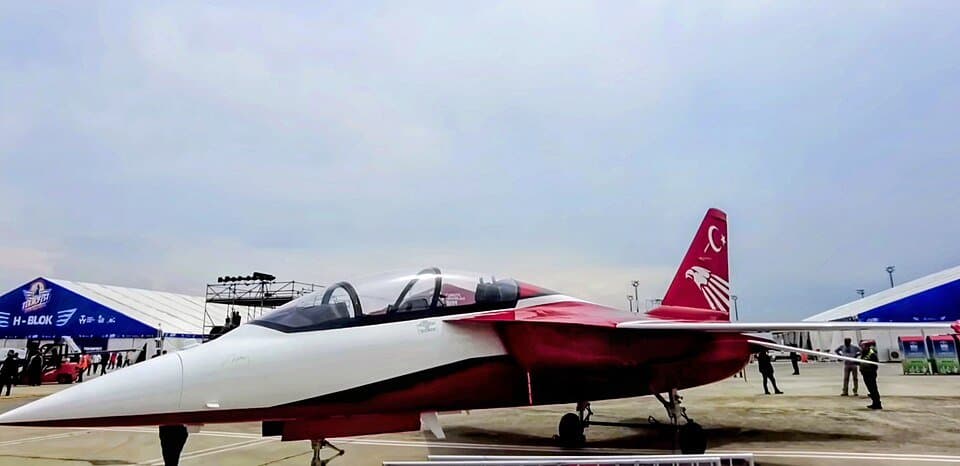
Advanced jet trainer ( lead-in fighter trainer ) and Light combat aircraft
At a glance
Measured figures
L-39 SKYFOX · external metric dimensions
Single sourceL-39 Skyfox · Length
Single sourceConfiguration
| Specification | Aero L-39 Skyfox | TAI Hürjet |
|---|---|---|
| Other name | L-39NG[source] | — |
| Type | Advanced jet trainer Light combat aircraft[source] | Advanced jet trainer ( lead-in fighter trainer ) and Light combat aircraft[source] |
| National origin | Czech Republic[source] | Türkiye[source] |
| Manufacturer | Aero Vodochody[source] | Turkish Aerospace Industries[source] |
Length
Single source13.6 m (44 ft 9 in)[source]
Empty; L-39 Skyfox · Empty weight
Single sourceEmpty; L-39 SKYFOX technical specifications · Empty weight
Single sourceMaximum take-off; L-39 Skyfox · Rear view of a L-39 Skyfox and its Williams FJ44 engine
Single source3,100 kg (6,834 lb)[source]
5,800 kg (12,787 lb) Rear view of a L-39 Skyfox and its Williams FJ44 engine[source]
7 231 lb[source]L-39 SKYFOX technical specifications
3 280 kg[source]L-39 SKYFOX technical specifications
kg( lb)[source]噴射自由鳥 Hürjet
Maximum; L-39 Skyfox · TAS at 6,000 m (20,000 ft)
Single sourceMaximum; L-39 SKYFOX technical specifications · Maximum speed
Manufacturer claim900 km/h (560 mph, 490 kn) TAS at 6,000 m (20,000 ft)[source]
490 KCAS[source]L-39 SKYFOX technical specifications
907 km/h[source]L-39 SKYFOX technical specifications
Mach 1.4[source]
L-39 Skyfox · 1 × Williams International FJ44-4M turbofan engine thrust
Single source1 × Williams International FJ44-4M turbofan engine, 16.89 kN (3,800 lbf) thrust[source]
1 × General Electric F404 -GE-104 afterburning turbofan engine thrust dry
Single sourcewith afterburner
Single source1 × General Electric F404 -GE-104 afterburning turbofan engine, 53.07 kN (11,930 lbf) thrust dry, 78.7 kN (17,700 lbf) with afterburner[source]
L-39 Skyfox · four hours and internal fuel
Single sourcefour hours and 30 minutes (internal fuel)[source]
Bars compare reported quantities only. A larger figure does not make a system better; configurations and test conditions differ.
| Status | In service[source] | Scheduled to enter operational service[source] |
|---|
| Primary users | Vietnam People's Air Force Hungarian Air Force Flight Training Center Pardubice[source] | — |
|---|
| Number built | ~ 24 (2025)[source] |
|---|
| Manufactured | 2015–2024 (developmental) 2024 onwards (serial)[source] | — |
|---|
| First flight | 14 September 2015 (L-39CW) 22 December 2018 (L-39NG)[source] | 25 April 2023[source] |
|---|
| Developed from | Aero L-39 Albatros[source] | — |
|---|
| Airfoil | NACA 64A012[source] | — |
|---|
| Hardpoints | Up to 1,640 kg (3,616 lb) of stores on five external hardpoints[source] | Provision for a total of seven pylon stations (one × under-fuselage, four × under-wing plus two × wingtip)[source] |
|---|
| Role | turbofan -powered military trainer and light combat aircraft[source] | single-engine, tandem seat , supersonic advanced jet trainer and light combat aircraft ,[source] |
|---|
| Source measurement | During July 2014, Aero Vodochody announced the launch of the L-39NG programme. By April 2015, the company revealed a partnership between itself, Draken International and Williams International to jointly work on the project — the latter provides its FJ44-4M turbofan engine for the aircraft, while Draken will be responsible for the type on the North American market, as well as operate its own fleet. On 14 September 2015, the maiden flight of the L-39NG technology demonstrator (L-39CW) was performed. On 14 March 2018, type certification of the L-39CW was received. On 22 December 2018, the first L-39NG prototype conducted its first flight. In September 2020, the Czech defence ministry certificated the L-39NG using supranational military standards. In October 2024, as the company reached serial production, the type was officially named as Skyfox . By January 2025 the first L-39 Skyfox had been delivered to Flight Training Center Pardubice (which is the training organization of Czech Air Force ).[source]Aero L-39 Skyfox · Lead; only the objects and conditions stated in this passage The L-39NG aircraft is being developed and marketed in two stages. The L-39NG upgrade program (Stage 1) involves an installation of FJ44-4M turbofan engine and optionally the Stage 2 avionics to existing L-39 Albatros. The FJ44-4M engine generated almost identical thrust output to the Soviet -era Ivchenko AI-25 engine that powered the original L-39 series, but at a considerably lower fuel consumption as well as possessing more favourable operating characteristics. On 14 September 2015, the maiden flight of the L-39NG technology demonstrator (L-39CW) was performed, the first stage of development was declared to be complete that same month. On 20 November 2017, Aero Vodochody announced they have completed the development of the L-39CW. On 14 March 2018, the company announced that the L-39CW had received type certification , signifying its airworthiness and readiness for serial manufacture.[source]Aero L-39 Skyfox · Design and development; only the objects and conditions stated in this passage The technology demonstrator L-39CW, a conventional airframe outfitted with the FJ44-4M engine and other retrofitted elements, performed its first flight from Vodochody airport on 14 September 2015. In September 2016, Aero Vodochody announced that it had completed the first phase of testing with the L-39CW, and was now ready to proceed with the development of the more comprehensive new-build L-39NG.[source]Aero L-39 Skyfox · Design and development / Testing; only the objects and conditions stated in this passage On 25 May 2020, the L-39 Skyfox commenced static fatigue testing, one reported aim of which is to validate the new airframe's operating life of 5,000 flight hours. By September 2020, roughly 300 test flights has been performed by the two flying prototypes, while additional ground-based testing using a pair of static airframes had also been conducted. Aero has claimed that life cycle testing has shown the aircraft to have a viable service life of up to 15,000 flight hours, three times that of the original L-39. The engine's increased efficiency has also reportedly facilitated a maximum range of 1,900 km without external fuel tanks, 800 km greater than that of the L-39. During January 2022, Aero announced the successful completion of fatigue testing. According to an article published in 2025, the L-39NG costs between $15-$20 million per jet.[source]Aero L-39 Skyfox · Design and development / Testing; only the objects and conditions stated in this passage Technology demonstrator of the L-39NG based on the L-39C airframe, powered by a Williams International FJ44-4M turbofan engine.[source]Aero L-39 Skyfox · Variants / L-39CW; only the objects and conditions stated in this passage Re-engined L-39 Albatros powered by the Williams International FJ44-4M turbofan. This version has the original "dry" wing with wingtip fuel tanks. Optionally includes an installation of the L-39NG Stage 2 avionics.[source]Aero L-39 Skyfox · Variants / L-39NG Stage 1; only the objects and conditions stated in this passage New-build L-39NG trainer aircraft, outfitted with Genesys Aerosystems avionics suite and glass cockpit. The new airframe is equipped with a new wet wing with internal fuel tanks and five hardpoints; it is powered by a FJ44-4M engine.[source]Aero L-39 Skyfox · Variants / L-39NG Stage 2 (Skyfox); only the objects and conditions stated in this passage Length: 11.83 m (38 ft 10 in)[source]Aero L-39 Skyfox · Specifications (L-39 Skyfox); only the objects and conditions stated in this passage Wingspan: 9.37 m (30 ft 9 in)[source]Aero L-39 Skyfox · Specifications (L-39 Skyfox); only the objects and conditions stated in this passage Empty weight: 3,100 kg (6,834 lb)[source]Aero L-39 Skyfox · Specifications (L-39 Skyfox); only the objects and conditions stated in this passage Max takeoff weight: 5,800 kg (12,787 lb) Rear view of a L-39 Skyfox and its Williams FJ44 engine[source]Aero L-39 Skyfox · Specifications (L-39 Skyfox); only the objects and conditions stated in this passage Powerplant: 1 × Williams International FJ44-4M turbofan engine, 16.89 kN (3,800 lbf) thrust[source]Aero L-39 Skyfox · Specifications (L-39 Skyfox); only the objects and conditions stated in this passage Maximum speed: 900 km/h (560 mph, 490 kn) TAS at 6,000 m (20,000 ft)[source]Aero L-39 Skyfox · Specifications (L-39 Skyfox); only the objects and conditions stated in this passage Range: 2,590 km (1,610 mi, 1,400 nmi) (internal fuel)[source]Aero L-39 Skyfox · Specifications (L-39 Skyfox); only the objects and conditions stated in this passage Endurance: four hours and 30 minutes (internal fuel)[source]Aero L-39 Skyfox · Specifications (L-39 Skyfox); only the objects and conditions stated in this passage Service ceiling: 11,500 m (37,700 ft)[source]Aero L-39 Skyfox · Specifications (L-39 Skyfox); only the objects and conditions stated in this passage Rate of climb: 23 m/s (4,500 ft/min)[source]Aero L-39 Skyfox · Specifications (L-39 Skyfox); only the objects and conditions stated in this passage Up to 1,640 kg (3,616 lb) of stores on five external hardpoints Up to 570 kg (1,250 lb) of external fuel on two "wet" hardpoints IR seeking AA missiles (incl. CATM) Laser guided air-to-ground bombs (GBU) Laser guided air-to-ground rockets (70mm) Free fall air-to-ground bombs (Mk.82) FFAR unguided air-to-ground rockets (70mm) Air-to-air or air-to-ground gun pod (12.7/20mm)[source]Aero L-39 Skyfox · Specifications (L-39 Skyfox); only the objects and conditions stated in this passage Wing span 30.10 ft / Length 38.10 ft / height 15.12 ft[source]L-39 SKYFOX · published imperial dimensions; conversion notation unresolvedSource text · numeric interpretation needs review | The Turkish Air Force intends to use the design to replace the Northrop T-38M Talon in the trainer role and also to supplement the General Dynamics F-16C Fighting Falcon for close air support . The aircraft is also planned to replace the Northrop F-5A/2000 Freedom Fighter used by the Turkish Stars aerobatic team. A naval version of the aircraft may also be developed. The company also plans to pursue export orders to countries looking to replace older trainer and ground attack aircraft.[source]TAI Hürjet · Lead; only the objects and conditions stated in this passage On September 3, 2023, the Hürjet prototype successfully conducted a formation flight with the Turkish Stars aerobatic team, completing a total of 17 flights, accumulating a total of 9 hours and 8 minutes of flight time.[source]TAI Hürjet · Development and design; only the objects and conditions stated in this passage On July 11, 2024, the Hürjet prototype successfully conducted a transonic flight test, reaching a speed of Mach 0.9 at an altitude of 30,000 feet, completing a total of 79 flights.[source]TAI Hürjet · Development and design; only the objects and conditions stated in this passage On August 16, 2024, the Hürjet prototype successfully conducted its 100th flight piloted by TAI test pilots Ercan Çelik and Orhan Boran, accumulating a total of 118 hours of flight time.[source]TAI Hürjet · Development and design; only the objects and conditions stated in this passage On 12 November the second prototype of Hürjet successfully completed its first flight. The second Hürjet prototype (PT-2, TUS-A003), remained airborne for 26 minutes on its first flight, reaching a speed of 260 knots and an altitude of 10,000 feet, with an F-16D flying ‘chase’. |
|---|
| Prototypes | — | 3 prototypes[source] |
|---|
| Introduction date | — | 2026[source] |
|---|
| g limits | — | + 8 − 3[source] |
|---|
Length: 13.6 m (44 ft 9 in)[source]TAI Hürjet · Specifications; only the objects and conditions stated in this passage
Wingspan: 9.5 m (31 ft 2 in)[source]TAI Hürjet · Specifications; only the objects and conditions stated in this passage
Height: 4.1 m (13 ft 5 in)[source]TAI Hürjet · Specifications; only the objects and conditions stated in this passage
Wing area: 25 m 2 (270 sq ft)[source]TAI Hürjet · Specifications; only the objects and conditions stated in this passage
Payload : 3,402 kg (7,500 lb)[source]TAI Hürjet · Specifications; only the objects and conditions stated in this passage
Powerplant: 1 × General Electric F404 -GE-104 afterburning turbofan engine, 53.07 kN (11,930 lbf) thrust dry, 78.7 kN (17,700 lbf) with afterburner[source]TAI Hürjet · Specifications; only the objects and conditions stated in this passage
Range: 1,960 km (1,220 mi, 1,060 nmi)[source]TAI Hürjet · Specifications; only the objects and conditions stated in this passage
Service ceiling: 14,000 m (45,000 ft)[source]TAI Hürjet · Specifications; only the objects and conditions stated in this passage
Rate of climb: 246 m/s (48,500 ft/min)[source]TAI Hürjet · Specifications; only the objects and conditions stated in this passage