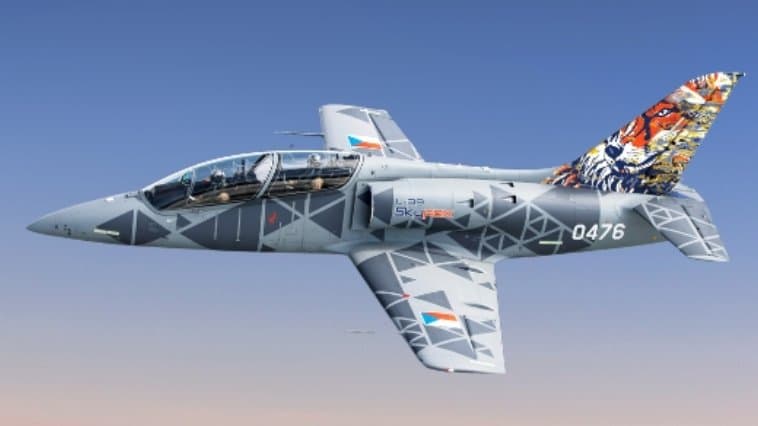
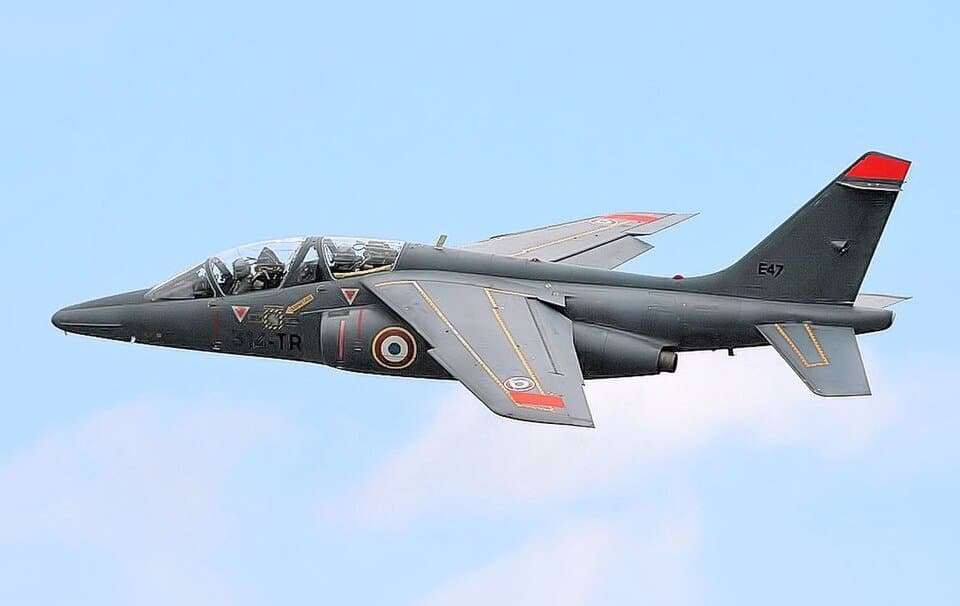
Credit
Aero Vodochody · CC BY-SA 4.0 · Resized · CC BY-SA 4.0 · Source ↗ · Modified


Preparing your view.

At a glance
True scale
Side by side. From every angle. A human reference for perspective.
3.39 MB · Loads when you open it| Model | Length | Width / span | Height |
|---|---|---|---|
| Aero L-39 Skyfox | ≈ 11.83 m | ≈ 9.38 m (Wingspan) | ≈ 4.87 m |
| Dassault/Dornier Alpha Jet | ≈ 13.23 m | ≈ 9.11 m (Wingspan) | ≈ 4.19 m |
Scaled uniformly to the sourced length of 11.83 m. The shape was turned square to the axes; the height was fitted to the sourced 4.87 m; the width was fitted to the sourced 9.38 m wingspan. Not an official model or a measured survey.
ForceTally · All rights reserved
Scaled uniformly to the sourced length of 13.23 m. The shape was turned square to the axes; the height was fitted to the sourced 4.19 m; the width was fitted to the sourced 9.11 m wingspan. Not an official model or a measured survey.
ForceTally · All rights reserved
The human reference is a generic 1.75 m figure. Models describe external size, not combat performance.
Measured figures
L-39 SKYFOX · external metric dimensions
Single sourceL-39 Skyfox · Length
Single sourceConfiguration
| Specification | Aero L-39 Skyfox | Dassault/Dornier Alpha Jet |
|---|---|---|
| Other name | L-39NG[source] | — |
| Type | Advanced jet trainer Light combat aircraft[source] | Light attack and advanced trainer aircraft[source] |
| National origin | Czech Republic[source] | France / West Germany[source] |
| Manufacturer | Aero Vodochody[source] | Dassault Aviation / Dornier Flugzeugwerke[source] |
Close-support version · Length
Single source13.23 m (43 ft 5 in)[source]
Empty; L-39 Skyfox · Empty weight
Single sourceEmpty; L-39 SKYFOX technical specifications · Empty weight
Single sourceMaximum take-off; L-39 Skyfox · Rear view of a L-39 Skyfox and its Williams FJ44 engine
Single source3,100 kg (6,834 lb)[source]
5,800 kg (12,787 lb) Rear view of a L-39 Skyfox and its Williams FJ44 engine[source]
7 231 lb[source]L-39 SKYFOX technical specifications
3 280 kg[source]L-39 SKYFOX technical specifications
Empty; Close-support version · Empty weight
Single sourceGross; Close-support version · Gross weight
Single sourceMaximum; L-39 Skyfox · TAS at 6,000 m (20,000 ft)
Single sourceMaximum; L-39 SKYFOX technical specifications · Maximum speed
Manufacturer claim900 km/h (560 mph, 490 kn) TAS at 6,000 m (20,000 ft)[source]
490 KCAS[source]L-39 SKYFOX technical specifications
907 km/h[source]L-39 SKYFOX technical specifications
Maximum; Close-support version · at sea level
Single source1,000 km/h (620 mph, 540 kn) at sea level[source]
Close-support version · lo-lo-lo profile, gun pod, underwing weapons and two drop tanks
Single source610 km (380 mi, 330 nmi) lo-lo-lo profile, gun pod, underwing weapons and two drop tanks[source]
L-39 Skyfox · 1 × Williams International FJ44-4M turbofan engine thrust
Single source1 × Williams International FJ44-4M turbofan engine, 16.89 kN (3,800 lbf) thrust[source]
Close-support version · 2 × SNECMA Turbomeca Larzac 04-C5 turbofan engines thrust each
Single source2 × SNECMA Turbomeca Larzac 04-C5 turbofan engines, 13.24 kN (2,980 lbf) thrust each[source]
L-39 Skyfox · four hours and internal fuel
Single sourcefour hours and 30 minutes (internal fuel)[source]
Close-support version · at high altitude
Single sourceClose-support version · internal fuel only at low altitude
Single source(internal fuel only) 2 hours 30 minutes at low altitude; 3 hours 30 minutes at high altitude[source]
Close-support version · Wing area
Single source17.5 m 2 (188 sq ft)[source]
Bars compare reported quantities only. A larger figure does not make a system better; configurations and test conditions differ.
| Status | In service[source] | In service[source] |
|---|
| Primary users | Vietnam People's Air Force Hungarian Air Force Flight Training Center Pardubice[source] | French Air and Space Force Top Aces Egyptian Air Force Royal Thai Air Force[source] |
|---|
| Number built | ~ 24 (2025)[source] | 480[source] |
|---|
| Manufactured | 2015–2024 (developmental) 2024 onwards (serial)[source] | 1973–1991[source] |
|---|
| First flight | 14 September 2015 (L-39CW) 22 December 2018 (L-39NG)[source] | 26 October 1973[source] |
|---|
| Developed from | Aero L-39 Albatros[source] | — |
|---|
| Airfoil | NACA 64A012[source] | — |
|---|
| Hardpoints | Up to 1,640 kg (3,616 lb) of stores on five external hardpoints[source] | 5 with a capacity of 2,500 kg (5,512 lb), with provisions to carry combinations of:[source] |
|---|
| Role | turbofan -powered military trainer and light combat aircraft[source] | light attack jet and advanced jet trainer co-manufactured[source] |
|---|
| Source measurement | During July 2014, Aero Vodochody announced the launch of the L-39NG programme. By April 2015, the company revealed a partnership between itself, Draken International and Williams International to jointly work on the project — the latter provides its FJ44-4M turbofan engine for the aircraft, while Draken will be responsible for the type on the North American market, as well as operate its own fleet. On 14 September 2015, the maiden flight of the L-39NG technology demonstrator (L-39CW) was performed. On 14 March 2018, type certification of the L-39CW was received. On 22 December 2018, the first L-39NG prototype conducted its first flight. In September 2020, the Czech defence ministry certificated the L-39NG using supranational military standards. In October 2024, as the company reached serial production, the type was officially named as Skyfox . By January 2025 the first L-39 Skyfox had been delivered to Flight Training Center Pardubice (which is the training organization of Czech Air Force ).[source]Aero L-39 Skyfox · Lead; only the objects and conditions stated in this passage The L-39NG aircraft is being developed and marketed in two stages. The L-39NG upgrade program (Stage 1) involves an installation of FJ44-4M turbofan engine and optionally the Stage 2 avionics to existing L-39 Albatros. The FJ44-4M engine generated almost identical thrust output to the Soviet -era Ivchenko AI-25 engine that powered the original L-39 series, but at a considerably lower fuel consumption as well as possessing more favourable operating characteristics. On 14 September 2015, the maiden flight of the L-39NG technology demonstrator (L-39CW) was performed, the first stage of development was declared to be complete that same month. On 20 November 2017, Aero Vodochody announced they have completed the development of the L-39CW. On 14 March 2018, the company announced that the L-39CW had received type certification , signifying its airworthiness and readiness for serial manufacture.[source]Aero L-39 Skyfox · Design and development; only the objects and conditions stated in this passage The technology demonstrator L-39CW, a conventional airframe outfitted with the FJ44-4M engine and other retrofitted elements, performed its first flight from Vodochody airport on 14 September 2015. In September 2016, Aero Vodochody announced that it had completed the first phase of testing with the L-39CW, and was now ready to proceed with the development of the more comprehensive new-build L-39NG.[source]Aero L-39 Skyfox · Design and development / Testing; only the objects and conditions stated in this passage On 25 May 2020, the L-39 Skyfox commenced static fatigue testing, one reported aim of which is to validate the new airframe's operating life of 5,000 flight hours. By September 2020, roughly 300 test flights has been performed by the two flying prototypes, while additional ground-based testing using a pair of static airframes had also been conducted. Aero has claimed that life cycle testing has shown the aircraft to have a viable service life of up to 15,000 flight hours, three times that of the original L-39. The engine's increased efficiency has also reportedly facilitated a maximum range of 1,900 km without external fuel tanks, 800 km greater than that of the L-39. During January 2022, Aero announced the successful completion of fatigue testing. According to an article published in 2025, the L-39NG costs between $15-$20 million per jet.[source]Aero L-39 Skyfox · Design and development / Testing; only the objects and conditions stated in this passage Technology demonstrator of the L-39NG based on the L-39C airframe, powered by a Williams International FJ44-4M turbofan engine.[source]Aero L-39 Skyfox · Variants / L-39CW; only the objects and conditions stated in this passage Re-engined L-39 Albatros powered by the Williams International FJ44-4M turbofan. This version has the original "dry" wing with wingtip fuel tanks. Optionally includes an installation of the L-39NG Stage 2 avionics.[source]Aero L-39 Skyfox · Variants / L-39NG Stage 1; only the objects and conditions stated in this passage New-build L-39NG trainer aircraft, outfitted with Genesys Aerosystems avionics suite and glass cockpit. The new airframe is equipped with a new wet wing with internal fuel tanks and five hardpoints; it is powered by a FJ44-4M engine.[source]Aero L-39 Skyfox · Variants / L-39NG Stage 2 (Skyfox); only the objects and conditions stated in this passage Length: 11.83 m (38 ft 10 in)[source]Aero L-39 Skyfox · Specifications (L-39 Skyfox); only the objects and conditions stated in this passage Wingspan: 9.37 m (30 ft 9 in)[source]Aero L-39 Skyfox · Specifications (L-39 Skyfox); only the objects and conditions stated in this passage Empty weight: 3,100 kg (6,834 lb)[source]Aero L-39 Skyfox · Specifications (L-39 Skyfox); only the objects and conditions stated in this passage Max takeoff weight: 5,800 kg (12,787 lb) Rear view of a L-39 Skyfox and its Williams FJ44 engine[source]Aero L-39 Skyfox · Specifications (L-39 Skyfox); only the objects and conditions stated in this passage Powerplant: 1 × Williams International FJ44-4M turbofan engine, 16.89 kN (3,800 lbf) thrust[source]Aero L-39 Skyfox · Specifications (L-39 Skyfox); only the objects and conditions stated in this passage Maximum speed: 900 km/h (560 mph, 490 kn) TAS at 6,000 m (20,000 ft)[source]Aero L-39 Skyfox · Specifications (L-39 Skyfox); only the objects and conditions stated in this passage Range: 2,590 km (1,610 mi, 1,400 nmi) (internal fuel)[source]Aero L-39 Skyfox · Specifications (L-39 Skyfox); only the objects and conditions stated in this passage Endurance: four hours and 30 minutes (internal fuel)[source]Aero L-39 Skyfox · Specifications (L-39 Skyfox); only the objects and conditions stated in this passage Service ceiling: 11,500 m (37,700 ft)[source]Aero L-39 Skyfox · Specifications (L-39 Skyfox); only the objects and conditions stated in this passage Rate of climb: 23 m/s (4,500 ft/min)[source]Aero L-39 Skyfox · Specifications (L-39 Skyfox); only the objects and conditions stated in this passage Up to 1,640 kg (3,616 lb) of stores on five external hardpoints Up to 570 kg (1,250 lb) of external fuel on two "wet" hardpoints IR seeking AA missiles (incl. CATM) Laser guided air-to-ground bombs (GBU) Laser guided air-to-ground rockets (70mm) Free fall air-to-ground bombs (Mk.82) FFAR unguided air-to-ground rockets (70mm) Air-to-air or air-to-ground gun pod (12.7/20mm)[source]Aero L-39 Skyfox · Specifications (L-39 Skyfox); only the objects and conditions stated in this passage Wing span 30.10 ft / Length 38.10 ft / height 15.12 ft[source]L-39 SKYFOX · published imperial dimensions; conversion notation unresolvedSource text · numeric interpretation needs review | Manufacture of Alpha Jet sub-assemblies was divided between France (Dassault), Germany (Dornier) and Belgium ( SABCA ), each country performing final assembly and checkout of the type in separate facilities. Dassault hosted the largest of these three assembly lines, typically producing 13 aircraft per month to meet the needs of French and export customers. It was reportedly capable of a maximum output of 15 Alpha Jets per month. The Dornier final assembly line typically maintained a maximum rate of six aircraft per month. In contrast to the final assembly arrangements, none of the three sources duplicated the manufacture of any component: Dassault-Breguet produced the front and center fuselage, Dornier constructed the wing, tail and rear fuselage, while SABCA manufactured the nose and flaps of the aircraft. A total of 4,500 people were employed in the manufacturing of the Alpha Jet in Germany, an equal number in France also worked on the programme.[source]Dassault/Dornier Alpha Jet · Development / Into production; only the objects and conditions stated in this passage The Alpha Jet is a light twin-engine aircraft equipped with an intentionally simple airframe despite the performance delivered. Both the leading edges and air intakes are fixed; while the aerodynamic shape of the aircraft, which was developed with the aid of computer aided design (CAD), conforms with the area rule . Fully powered controls are used, comprising a dual- hydraulic systems and load-factor limited dynamic feel system arrangement attached to conventional flight control surfaces . The cockpit is pressurised for greater comfort during training. The Alpha Jet is designed to accommodate ten-minute turn around times with minimal ground equipment, using features such as pressurised single-point refueling, ladder-less entry/exit of the cockpit, and a ten-hour endurance of the liquid oxygen system.[source]Dassault/Dornier Alpha Jet · Design; only the objects and conditions stated in this passage The Alpha Jet is powered by a pair of SNECMA Turbomeca Larzac turbofan engines. It is a low bypass-ratio, twin-spool engine that uses modular construction methods. The Larzac was a new engine at the time, having only performed its first run a year prior to being selected to power the Alpha Jet. The need for greater thrust to power the aircraft than the original model of the engine could generate led to the development and adoption of the 2,970 lb Larzac 04 in February 1972. This version of the engine initially powered the Alpha Jet. |
|---|
| Introduction date | — | 4 November 1977[source] |
|---|
| Aspect ratio | — | 4.8[source] |
|---|
| Fuel capacity | — | 1,520 kg (3,351 lb)[source] |
|---|
| Stall speed | — | 167 km/h (104 mph, 90 kn) (flaps and undercarriage down)[source] |
|---|
| g limits | — | +12 / -6.4 (ultimate)[source] |
|---|
| Time to altitude | — | 9,145 m (30,000 ft) in less than 7 minutes[source] |
|---|
| Landing speed | — | 170 km/h (110 mph; 92 kn)[source] |
|---|
| Take-off run | — | 410 m (1,350 ft)[source] |
|---|
| Landing run | — | 610 m (2,000 ft)[source] |
|---|
| Guns | — | One 27 mm Mauser BK-27 cannon in centreline gun pack with 150 rounds or one 30 mm DEFA cannon in centreline pod with 150 rounds[source] |
|---|
| Rockets | — | Two Matra rocket pods with eighteen SNEB 68 mm rockets each or two CRV7 rocket pods with nineteen 70 mm rockets each[source] |
|---|
| Missiles | — | Two AIM-9 Sidewinders ; two Matra Magic IIs ; two AGM-65 Mavericks[source] |
|---|
| Bombs | — | a variety of bombs (such as the Hunting BL755 cluster bomb )[source] |
|---|
| Other | — | Two 310 L (82 US gal; 68 imp gal) Drop tanks[source] |
|---|
Maximum take-off; Close-support version · Max takeoff weight
Single sourceThe Alpha Jet was more complex than competing second generation trainer aircraft, requiring seven man hours of maintenance for every flight hour. Nearly 5,000lb of munitions and equipment can be carried on five hardpoints, four on the wings and one at the centerline on the lower fuselage. In an armed configuration, a gun pod containing a 30 mm DEFA cannon , as installed on French aircraft, or 27 mm Mauser BK-27 cannon , as installed on German aircraft, would typically be installed upon the centerline hard point.[source]Dassault/Dornier Alpha Jet · Design; only the objects and conditions stated in this passage
In September 2014, Direction générale de l'armement (DGA) and French Air Force officials were reportedly investigating the Alenia Aermacchi M-346 Master as a replacement for the Alpha Jet. Alenia Aermacchi claimed that France was interested in procuring 35 M-346s in this capacity. In April 2015, the DGA issued an initial pre-solicitation request for a replacement trainer aircraft. Likely candidates for this requirement reportedly include the M-346 Master, Aero L-39 Albatros , Beechcraft T-6 Texan II and Pilatus PC-21 . The PC-21 was introduced in 2018.[source]Dassault/Dornier Alpha Jet · Operational history / France; only the objects and conditions stated in this passage
During the early 1980s, an additional 15 aircraft, designated Alpha Jet MS2 , were ordered. The Alpha Jet MS2 bore high levels of similarity to Dassault's proposed Alpha Jet NGEA , featuring a Sagem -built Uliss 81 nav/attack system, a Thomson-CSF -built laser rangefinder and HUD, along with a digital multiplex databus . The Egyptian Air Force Alpha Jets were based at As Salahiya airbase in 308 (Close Air Support) Tactical Wing with 57 Squadron and 58 Squadron. In 2015 the 308 CAS Tactical Wing moved with both squadrons to El Mansoura airbase for ground attack training. The Egyptian Air Force used the Alpha Jet MS1 fleet to replace the Aero L-29 Delfín and Mikoyan-Gurevich MiG-15 in the trainer role, while the later-built MS2 standard aircraft served to replace the Mikoyan-Gurevich MiG-17 in the ground-attack role. In February 2000, Egypt was reportedly seeking to replace their Alpha Jet fleet, and was investigating several options, including the BAE Systems Hawk .[source]Dassault/Dornier Alpha Jet · Operational history / Egypt; only the objects and conditions stated in this passage
Nigerian Air Force (Alpha Jet E) – 24 acquired. 4 upgraded in 2011, 9 more reactivated. 11 in service.[source]Dassault/Dornier Alpha Jet · Operators; only the objects and conditions stated in this passage
Length: 13.23 m (43 ft 5 in)[source]Dassault/Dornier Alpha Jet · Specifications (Close-support version); only the objects and conditions stated in this passage
Wingspan: 9.11 m (29 ft 11 in)[source]Dassault/Dornier Alpha Jet · Specifications (Close-support version); only the objects and conditions stated in this passage
Height: 4.19 m (13 ft 9 in)[source]Dassault/Dornier Alpha Jet · Specifications (Close-support version); only the objects and conditions stated in this passage
Wing area: 17.5 m 2 (188 sq ft)[source]Dassault/Dornier Alpha Jet · Specifications (Close-support version); only the objects and conditions stated in this passage
Empty weight: 3,515 kg (7,749 lb)[source]Dassault/Dornier Alpha Jet · Specifications (Close-support version); only the objects and conditions stated in this passage
Gross weight: 5,000 kg (11,023 lb)[source]Dassault/Dornier Alpha Jet · Specifications (Close-support version); only the objects and conditions stated in this passage
Max takeoff weight: 7,500 kg (16,535 lb)[source]Dassault/Dornier Alpha Jet · Specifications (Close-support version); only the objects and conditions stated in this passage
Fuel capacity: 1,520 kg (3,351 lb)[source]Dassault/Dornier Alpha Jet · Specifications (Close-support version); only the objects and conditions stated in this passage
Powerplant: 2 × SNECMA Turbomeca Larzac 04-C5 turbofan engines, 13.24 kN (2,980 lbf) thrust each[source]Dassault/Dornier Alpha Jet · Specifications (Close-support version); only the objects and conditions stated in this passage
Maximum speed: 1,000 km/h (620 mph, 540 kn) at sea level[source]Dassault/Dornier Alpha Jet · Specifications (Close-support version); only the objects and conditions stated in this passage
Stall speed: 167 km/h (104 mph, 90 kn) (flaps and undercarriage down)[source]Dassault/Dornier Alpha Jet · Specifications (Close-support version); only the objects and conditions stated in this passage
216 km/h (134 mph; 117 kn) (flaps and undercarriage up)[source]Dassault/Dornier Alpha Jet · Specifications (Close-support version); only the objects and conditions stated in this passage
Combat range: 610 km (380 mi, 330 nmi) lo-lo-lo profile, gun pod, underwing weapons and two drop tanks[source]Dassault/Dornier Alpha Jet · Specifications (Close-support version); only the objects and conditions stated in this passage
1,095 km (680 mi; 591 nmi) hi-lo-hi profile, gun pod, underwing weapons and two drop tanks[source]Dassault/Dornier Alpha Jet · Specifications (Close-support version); only the objects and conditions stated in this passage
Ferry range: 2,940 km (1,830 mi, 1,590 nmi) with 2x 310 L (82 US gal; 68 imp gal) droptanks[source]Dassault/Dornier Alpha Jet · Specifications (Close-support version); only the objects and conditions stated in this passage
Endurance: (internal fuel only) 2 hours 30 minutes at low altitude; 3 hours 30 minutes at high altitude[source]Dassault/Dornier Alpha Jet · Specifications (Close-support version); only the objects and conditions stated in this passage
Service ceiling: 14,630 m (48,000 ft)[source]Dassault/Dornier Alpha Jet · Specifications (Close-support version); only the objects and conditions stated in this passage
Rate of climb: 57 m/s (11,200 ft/min) max[source]Dassault/Dornier Alpha Jet · Specifications (Close-support version); only the objects and conditions stated in this passage
Time to altitude: 9,145 m (30,000 ft) in less than 7 minutes[source]Dassault/Dornier Alpha Jet · Specifications (Close-support version); only the objects and conditions stated in this passage
Landing speed: 170 km/h (110 mph; 92 kn)[source]Dassault/Dornier Alpha Jet · Specifications (Close-support version); only the objects and conditions stated in this passage
Take-off run: 410 m (1,350 ft)[source]Dassault/Dornier Alpha Jet · Specifications (Close-support version); only the objects and conditions stated in this passage
Landing run: 610 m (2,000 ft)[source]Dassault/Dornier Alpha Jet · Specifications (Close-support version); only the objects and conditions stated in this passage
Guns: One 27 mm Mauser BK-27 cannon in centreline gun pack with 150 rounds or one 30 mm DEFA cannon in centreline pod with 150 rounds[source]Dassault/Dornier Alpha Jet · Specifications (Close-support version); only the objects and conditions stated in this passage
Hardpoints: 5 with a capacity of 2,500 kg (5,512 lb), with provisions to carry combinations of: Rockets: Two Matra rocket pods with eighteen SNEB 68 mm rockets each or two CRV7 rocket pods with nineteen 70 mm rockets each Missiles: Two AIM-9 Sidewinders ; two Matra Magic IIs ; two AGM-65 Mavericks Bombs: a variety of bombs (such as the Hunting BL755 cluster bomb ) Other: Two 310 L (82 US gal; 68 imp gal) Drop tanks[source]Dassault/Dornier Alpha Jet · Specifications (Close-support version); only the objects and conditions stated in this passage