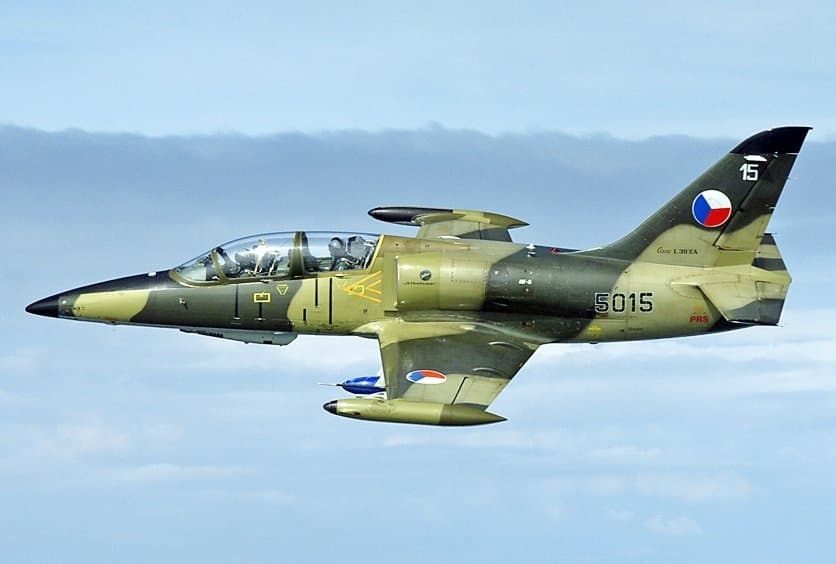
Credit
Milan Nykodym · CC BY-SA 4.0 · Resized · CC BY-SA 4.0 · Source ↗ · Modified


Preparing your view.
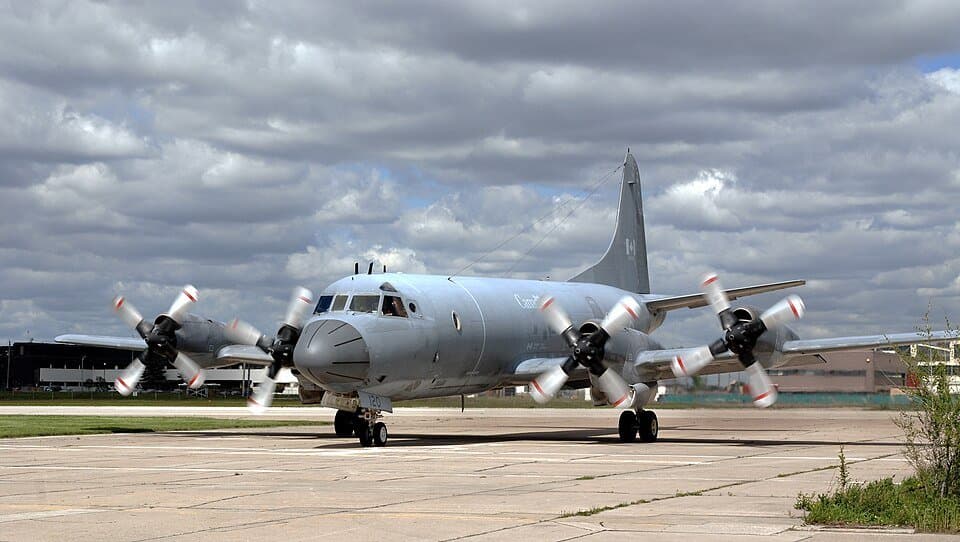

BTrainer aircraft
Maritime patrol aircraft (CP-140) MPA trainer aircraft (CP-140A)
At a glance
Measured figures
L-39C · Length
Single source12.13 m (39 ft 10 in)[source]
CP-140 Aurora · Length
Single sourceConfiguration
| Specification | Aero L-39 Albatros | Lockheed CP-140 Aurora |
|---|---|---|
| Type | Military trainer aircraft Light ground-attack aircraft[source] | Maritime patrol aircraft (CP-140) MPA trainer aircraft (CP-140A)[source] |
| National origin | Czechoslovakia[source] | — |
| Manufacturer | Aero Vodochody[source] | Lockheed Corporation[source] |
| Designer | Jan Vlček[source] | — |
| Status |
CP-140 · Length
Single sourceMaximum; L-39C · at 5,000 m (16,000 ft)
Single source750 km/h (470 mph, 400 kn) at 5,000 m (16,000 ft)[source]
CP-140 · 4 × Allison T56-A-14-LFE turboprop engines each
Single source4 × Allison T56-A-14-LFE turboprop engines, 4,909 hp (3,661 kW) each[source]
L-39C · 1 × Ivchenko AI-25TL turbofan engine thrust
Single source1 × Ivchenko AI-25TL turbofan engine, 16.87 kN (3,790 lbf) thrust[source]
L-39C · internal and external fuel
Single sourceL-39C · two hours and (internal fuel), three hours and
Single sourcetwo hours and 30 minutes (internal fuel), three hours and 50 minutes (internal and external fuel)[source]
CP-140 · on station at 1,000 nmi (1,151 mi; 1,852 km) radius
Single source8 hours 12 minutes on station at 1,000 nmi (1,151 mi; 1,852 km) radius[source]
L-39C · 4,100 ft/min
Single source21 m/s (4,100 ft/min)[source]
CP-140 · Hardpoints: 8 in weapons bay; 10 under-wing from capacity with a capacity of
Single sourceCP-140 · total in weapons bay, with provisions to carry combinations of
Single sourceHardpoints: 8 in weapons bay; 10 under-wing from 611 to 2,450 lb (277 to 1,111 kg) capacity with a capacity of 4,800 lb (2,177 kg) total in weapons bay, with provisions to carry combinations of:[source]
Bars compare reported quantities only. A larger figure does not make a system better; configurations and test conditions differ.
In service[source] |
Active (CP-140M only)[source] |
| Primary users | Soviet Air Force (historical) Ukrainian Air Force Czechoslovak Air Force Libyan Air Force[source] | — |
|---|
| Number built | 2,900[source] | 21 (18 CP-140M + 3 CP-140A)[source] |
|---|
| Manufactured | 1971–1996 2015–present (L-39 Skyfox)[source] | — |
|---|
| Introduction date | 28 March 1972 with the Czechoslovak Air Force[source] | 1980[source] |
|---|
| First flight | 4 November 1968[source] | 22 March 1979 (CP-140)[source] |
|---|
| Developed from | Aero L-29 Delfín[source] | Lockheed P-3 Orion[source] |
|---|
| Developed into | Aero L-59 Super Albatros Aero L-159 ALCA Aero L-39 Skyfox[source] | — |
|---|
| Airfoil | NACA 64A012 modified[source] | root: NACA 0014 (modified) ; tip: NACA 0012 (modified)[source] |
|---|
| Never exceed speed | 980 km/h (610 mph, 530 kn) / M0.8[source] | — |
|---|
| Time to altitude | 5,000 m (16,000 ft) in 5 minutes[source] | — |
|---|
| Wing loading | 250 kg/m 2 (51 lb/sq ft)[source] | — |
|---|
| Thrust/weight | 0.37[source] | — |
|---|
| Take-off roll | 530 m (1,740 ft)[source] | — |
|---|
| Landing roll | 650 m (2,130 ft)[source] | — |
|---|
| Hardpoints | Up to 284 kg (626 lb) of stores on two external hardpoints[source] | 8 in weapons bay; 10 under-wing from 611 to 2,450 lb (277 to 1,111 kg) capacity with a capacity of 4,800 lb (2,177 kg) total in weapons bay, with provisions to carry combinations of:[source] |
|---|
| Former operator · Abkhazia | Abkhazia[source] | — |
|---|
| Former operator · Cambodia | Cambodia[source] | — |
|---|
| Former operator · East Germany | East Germany[source] | — |
|---|
| Former operator · Iraq | Iraq[source] | — |
|---|
| Former operator · Lithuania | Lithuania[source] | — |
|---|
| Former operator · Thailand | Thailand[source] | — |
|---|
| Role | high-performance jet trainer[source] | maritime patrol aircraft[source] |
|---|
| Source measurement | One of the replacements for the L-39 Albatros was the Aero L-159 ALCA , a modernised version of the L-39. Originally, Aero Vodochody had intended to develop the L-159 in partnership with Elbit, but the Czech Ministry of Defense instead selected Rockwell Collins to partner on the program. The limited success of the L-159 led Aero to announce at the 2014 Farnborough Airshow that it was developing an upgraded version of the L-39, designated L-39NG ( Skyfox ), to compete with the Alenia Aermacchi M-346 and British Aerospace Hawk . The L-39 Skyfox replaces the AI-25 turbofan with a Williams FJ44 engine; the airframe is modified, the wingtip fuel tanks being eliminated, and a new suite of avionics will be provided. The first flight of the L-39 Skyfox was in December 2018, and final military type certification was granted by the Czech Military Aviation Authority in 2022. The first production L-39NG is expected to fly by the end of 2022.[source]Aero L-39 Albatros · Development; only the objects and conditions stated in this passage The low-set, straight wing has a double-taper planform, 2½-deg dihedral from the roots, a relatively low aspect ratio , and 100 litres (26 US gal; 22 imp gal) fuel tanks permanently attached to the wingtips .[source]Aero L-39 Albatros · Design; only the objects and conditions stated in this passage Operational g-force limits at 4,200 kilograms (9,300 lb) are +8/-4 g.[source]Aero L-39 Albatros · Design; only the objects and conditions stated in this passage A long, pointed nose leads back to the tandem cockpit, in which the student and instructor sit on Czech-built VS-1 ejection seats under individual canopies, which are opened manually and are hinged on the right. The rear seat, typically used by the instructor, is elevated slightly to readily enable observation and guidance of the student's actions in the forward position. The design of the cockpit, panel layout and many of its fittings resemble or are identical in function to those of other commonly used Soviet aircraft; for example, the procedure for deploying the ejection seat is exactly the same as for the Mikoyan MiG-29 . The cockpit is partially pressurized, requiring the air crew to wear oxygen masks when flying in excess of 23,000 feet. A gyro gunsight for weapon-aiming purposes is typically present in the forward position only.[source]Aero L-39 Albatros · Design; only the objects and conditions stated in this passage A single turbofan engine , an Ivchenko AI-25 TL (made in the Soviet Union ) is positioned in the rear fuselage, fed through shoulder-mounted, semi-circular air intakes (fitted with splitter plates ) just behind the cockpit and the tailpipe below the horizontal tailplane. The engine has a time between overhaul (TBO) of 1,000 flight hours; it is allegedly cheaper than the majority of turbine engines to overhaul. Five rubber bag fuel tanks are located in the fuselage behind the cockpit. Several heavy radio units are typically installed in an aft avionics bay; these are often removed on civilian-operated aircraft and replaced with a 70-gallon fuel tank. Additional fuel tanks can be fitted in the rear cockpit position and externally underneath the wings; the tip-tanks can also be expanded for a greater fuel capacity.[source]Aero L-39 Albatros · Design; only the objects and conditions stated in this passage Following the dissolution of the Soviet Union and the formation of the Russian Air Force in 1991, the newly formed service found itself with hundreds of L-39 aircraft, the majority of which were surplus to their training requirements. According to author Stephan Wilkinson, by 2005, Russia was seeking to potentially sell up to 800 of their L-39s, which were receiving only a basic level of maintenance once per month while their fate was being decided. Starting in the early 1990s, the Russian Air Force has pursued the development of a domestically built jet trainer, for which the Yakovlev Yak-130 was selected; the Yak-130 shall eventually replace the L-39 in Russian service within its operational roles.[source]Aero L-39 Albatros · Operational history / Russia; only the objects and conditions stated in this passage L-39CM (CM for Cvičná modernizovaná – modernised training)[source]Aero L-39 Albatros · Variants; only the objects and conditions stated in this passage Single-seat target tug version for Czechoslovakia. Equipped to tow KT-04 target on 1,700 m (5,600 ft) cable. Prototype plus eight production aircraft built[source]Aero L-39 Albatros · Variants; only the objects and conditions stated in this passage Interim weapon trainer variant for export. Four pylons stressed for 500 kg (1,100 lb) (inboard) and 250 kg (550 lb) (outboard), with total external load of 1,150 kg (2,500 lb). First flew 25 June 1975, with initial deliveries to Iraq in 1977. 337 built.[source]Aero L-39 Albatros · Variants; only the objects and conditions stated in this passage Significantly upgraded L-39ZO for armed training and light attack, employing sturdier landing gear, a higher payload (total 1,290 kg (2,844 lb)) and notably provision for a GSh-23L 23-millimeter twin-barreled cannon attached in a conformal pod under the pilots' compartment, having a 150-round magazine within the airframe. Outer pylons wired to carry K-13 or R-60 air-to-air missiles . Two prototypes, with first flying on 29 September 1976. 208 aircraft delivered.[source]Aero L-39 Albatros · Variants; only the objects and conditions stated in this passage The Aero L-39MS is a second generation military trainer aircraft developed from the firm's earlier L-39. Compared to its predecessor, it featured a strengthened fuselage, longer nose, a vastly updated cockpit, and a more powerful (21.6 kN (4,850 lbf)) Lotarev DV-2 engine, allowing operation at higher weights and speeds (max speed 872 km/h (542 mph)). First flight on 30 September 1986. It was later designated as the Aero L-59.[source]Aero L-39 Albatros · Variants; only the objects and conditions stated in this passage Revised version with western avionics and 17.99 kN (4,045 lbf) Garrett TFE731-4-1T engine. Single prototype built.[source]Aero L-39 Albatros · Variants; only the objects and conditions stated in this passage On 26 September 1987, Mihai Smighelschi, a 21-year-old student of the Romanian Air Force Academy , flew an L-39ZA trainer to Turkey and requested political asylum . His aircraft was later recovered and onboard data recorders showed that he had flown no higher than 150 m (490 ft) above ground at 700 km/h (430 mph) to evade radar detection. Smighelschi had less than 100 hours at the time, including high-school glider training, and less than 3 hours on the L-39ZA. Without satellite navigation or any maps, he had navigated a straight line over Romania , Bulgaria and Turkey using only ground marks and the memory of a map of Europe present at the Academy. He eventually landed in Kirklareli , Turkey, on a street near several jeeps that seemed to have American insignia, damaging the aircraft's front wheel and the nose.[source]Aero L-39 Albatros · Notable accidents and incidents; only the objects and conditions stated in this passage Length: 12.13 m (39 ft 10 in)[source]Aero L-39 Albatros · Specifications (L-39C); only the objects and conditions stated in this passage Wingspan: 9.46 m (31 ft 0 in)[source]Aero L-39 Albatros · Specifications (L-39C); only the objects and conditions stated in this passage Height: 4.77 m (15 ft 8 in)[source]Aero L-39 Albatros · Specifications (L-39C); only the objects and conditions stated in this passage Wing area: 18.8 m 2 (202 sq ft)[source]Aero L-39 Albatros · Specifications (L-39C); only the objects and conditions stated in this passage Empty weight: 3,455 kg (7,617 lb)[source]Aero L-39 Albatros · Specifications (L-39C); only the objects and conditions stated in this passage Max takeoff weight: 4,700 kg (10,362 lb)[source]Aero L-39 Albatros · Specifications (L-39C); only the objects and conditions stated in this passage Powerplant: 1 × Ivchenko AI-25TL turbofan engine, 16.87 kN (3,790 lbf) thrust[source]Aero L-39 Albatros · Specifications (L-39C); only the objects and conditions stated in this passage Maximum speed: 750 km/h (470 mph, 400 kn) at 5,000 m (16,000 ft)[source]Aero L-39 Albatros · Specifications (L-39C); only the objects and conditions stated in this passage Never exceed speed : 980 km/h (610 mph, 530 kn) / M0.8[source]Aero L-39 Albatros · Specifications (L-39C); only the objects and conditions stated in this passage Range: 1,100 km (680 mi, 590 nmi)(internal fuel)[source]Aero L-39 Albatros · Specifications (L-39C); only the objects and conditions stated in this passage Ferry range: 1,750 km (1,090 mi, 940 nmi) (internal and external fuel)[source]Aero L-39 Albatros · Specifications (L-39C); only the objects and conditions stated in this passage Endurance: two hours and 30 minutes (internal fuel), three hours and 50 minutes (internal and external fuel)[source]Aero L-39 Albatros · Specifications (L-39C); only the objects and conditions stated in this passage Service ceiling: 11,000 m (36,000 ft)[source]Aero L-39 Albatros · Specifications (L-39C); only the objects and conditions stated in this passage Rate of climb: 21 m/s (4,100 ft/min)[source]Aero L-39 Albatros · Specifications (L-39C); only the objects and conditions stated in this passage Time to altitude: 5,000 m (16,000 ft) in 5 minutes[source]Aero L-39 Albatros · Specifications (L-39C); only the objects and conditions stated in this passage Take-off roll: 530 m (1,740 ft)[source]Aero L-39 Albatros · Specifications (L-39C); only the objects and conditions stated in this passage Landing roll: 650 m (2,130 ft)[source]Aero L-39 Albatros · Specifications (L-39C); only the objects and conditions stated in this passage | Once AIMP was completed the CP-140 was designated as CP-140M.[source]Lockheed CP-140 Aurora · Design and development / Aurora Incremental Modernization Project; only the objects and conditions stated in this passage Several options had been suggested for a CP-140M replacement. These included the Boeing P-8 Poseidon and the Raytheon Sentinel , based on the Bombardier Global Express -6500, as well as late entrant PAL Aerospace Global Express 6500-based P-6.[source]Lockheed CP-140 Aurora · Operational history / Replacement; only the objects and conditions stated in this passage The RCAF had planned to downsize the fleet from eighteen to fourteen aircraft, with three already being withdrawn and a fourth test aircraft to be retired in the near future. The retirement of the CP-140 was originally expected around 2030, and could have resulted in a capability gap as the RCAF did not anticipate replacements to be delivered until 2032 to 2038. The RCAF's Weapon System Manager (WSM) had prepared plans to have the CP-140M operational until 2035 to 2040.[source]Lockheed CP-140 Aurora · Operational history / Replacement; only the objects and conditions stated in this passage Royal Canadian Air Force 404 Long Range Patrol and Training Squadron , CFB Greenwood , Nova Scotia 4 × CP-140M Aurora 405 Long Range Patrol Squadron , CFB Greenwood , Nova Scotia 11 × CP-140M Aurora and 1 × CP-140 Aurora to be retained as a test aircraft until retirement in the near future. 415 Long Range Patrol Force Development Squadron , CFB Greenwood , Nova Scotia 407 Long Range Patrol Squadron , CFB Comox , British Columbia 3 × CP-140M Aurora[source]Lockheed CP-140 Aurora · Operators; only the objects and conditions stated in this passage Length: 116 ft 10 in (35.61 m) |
|---|
| Primary user | — | Royal Canadian Air Force[source] |
|---|
| Retired | — | 2011 (CP-140A only)[source] |
|---|
| Aspect ratio | — | 7.5[source] |
|---|
| Fuel capacity | — | 7,661 imp gal (9,200 US gal; 34,828 L) usable fuel in one fuselage tank and four wing integral tanks[source] |
|---|
| Propellers | — | 4-bladed Hamilton Standard 54H60, 13 ft 6 in (4.11 m) diameter constant-speed fully-feathering reversible-pitch propellers[source] |
|---|
| Maximum transit speed | — | 395 kn (455 mph; 732 km/h) at optimum altitude[source] |
|---|
| FAR balanced field length | — | 7,900 ft (2,408 m)[source] |
|---|
| Take-off distance to 50 ft (15 m) | — | 6,000 ft (1,829 m)[source] |
|---|
| Landing distance from 50 ft (15 m) | — | 3,200 ft (975 m) at 114,000 lb (51,710 kg) landing weight[source] |
|---|
| Other | — | signal chargers, smoke markers , illumination flares[source] |
|---|
| Rockets | — | air-to-surface rockets can be fitted after a minor retrofit.[source] |
|---|
| Bombs | — | Mk 46 Mod V torpedoes, conventional bombs[source] |
|---|
| Country of origin | — | United States[source] United States[source] United States[source]Inventory Origin column; table 1, row 7, cell 2; revision 1376991819; retrieved 2026-10-02 |
|---|
| Reported operators |
| — |
|---|
Wingspan: 99 ft 8 in (30.38 m)[source]Lockheed CP-140 Aurora · Specifications (CP-140); only the objects and conditions stated in this passage
Height: 33 ft 8.5 in (10.274 m)[source]Lockheed CP-140 Aurora · Specifications (CP-140); only the objects and conditions stated in this passage
Wing area: 1,300 sq ft (120 m 2 )[source]Lockheed CP-140 Aurora · Specifications (CP-140); only the objects and conditions stated in this passage
Gross weight: 61,362 lb (27,833 kg)[source]Lockheed CP-140 Aurora · Specifications (CP-140); only the objects and conditions stated in this passage
Powerplant: 4 × Allison T56-A-14-LFE turboprop engines, 4,909 hp (3,661 kW) each[source]Lockheed CP-140 Aurora · Specifications (CP-140); only the objects and conditions stated in this passage
Propellers: 4-bladed Hamilton Standard 54H60, 13 ft 6 in (4.11 m) diameter constant-speed fully-feathering reversible-pitch propellers[source]Lockheed CP-140 Aurora · Specifications (CP-140); only the objects and conditions stated in this passage
Maximum speed: 375 kn (432 mph, 694 km/h) below cruise ceiling[source]Lockheed CP-140 Aurora · Specifications (CP-140); only the objects and conditions stated in this passage
Maximum transit speed: 395 kn (455 mph; 732 km/h) at optimum altitude[source]Lockheed CP-140 Aurora · Specifications (CP-140); only the objects and conditions stated in this passage
Range: 5,000 nmi (5,800 mi, 9,300 km)[source]Lockheed CP-140 Aurora · Specifications (CP-140); only the objects and conditions stated in this passage
Endurance: 8 hours 12 minutes on station at 1,000 nmi (1,151 mi; 1,852 km) radius[source]Lockheed CP-140 Aurora · Specifications (CP-140); only the objects and conditions stated in this passage
Service ceiling: 35,100 ft (10,700 m)[source]Lockheed CP-140 Aurora · Specifications (CP-140); only the objects and conditions stated in this passage
FAR balanced field length: 7,900 ft (2,408 m)[source]Lockheed CP-140 Aurora · Specifications (CP-140); only the objects and conditions stated in this passage
Take-off distance to 50 ft (15 m): 6,000 ft (1,829 m)[source]Lockheed CP-140 Aurora · Specifications (CP-140); only the objects and conditions stated in this passage
Landing distance from 50 ft (15 m): 3,200 ft (975 m) at 114,000 lb (51,710 kg) landing weight[source]Lockheed CP-140 Aurora · Specifications (CP-140); only the objects and conditions stated in this passage
Hardpoints: 8 in weapons bay; 10 under-wing from 611 to 2,450 lb (277 to 1,111 kg) capacity with a capacity of 4,800 lb (2,177 kg) total in weapons bay, with provisions to carry combinations of: Other: signal chargers, smoke markers , illumination flares[source]Lockheed CP-140 Aurora · Specifications (CP-140); only the objects and conditions stated in this passage