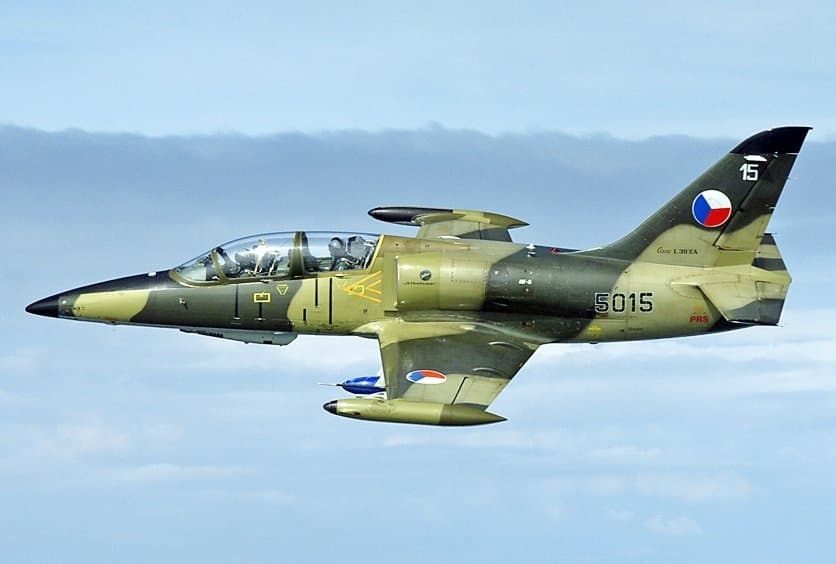
Credit
Milan Nykodym · CC BY-SA 4.0 · Resized · CC BY-SA 4.0 · Source ↗ · Modified


Preparing your view.
At a glance
Measured figures
Ferry; L-39C · internal and external fuel
Single sourceL-39C · internal fuel
Single source1,100 km (680 mi, 590 nmi)(internal fuel)[source]
1,750 km (1,090 mi, 940 nmi) (internal and external fuel)[source]
Ferry; Close-support version · with 2x 310 L (82 US gal; 68 imp gal) droptanks
Single source2,940 km (1,830 mi, 1,590 nmi) with 2x 310 L (82 US gal; 68 imp gal) droptanks[source]
Close-support version · lo-lo-lo profile, gun pod, underwing weapons and two drop tanks
Single source610 km (380 mi, 330 nmi) lo-lo-lo profile, gun pod, underwing weapons and two drop tanks[source]
L-39C · 1 × Ivchenko AI-25TL turbofan engine thrust
Single source1 × Ivchenko AI-25TL turbofan engine, 16.87 kN (3,790 lbf) thrust[source]
Close-support version · 2 × SNECMA Turbomeca Larzac 04-C5 turbofan engines thrust each
Single source2 × SNECMA Turbomeca Larzac 04-C5 turbofan engines, 13.24 kN (2,980 lbf) thrust each[source]
L-39C · internal and external fuel
Single sourceL-39C · two hours and (internal fuel), three hours and
Single sourcetwo hours and 30 minutes (internal fuel), three hours and 50 minutes (internal and external fuel)[source]
Close-support version · at high altitude
Single sourceClose-support version · internal fuel only at low altitude
Single source(internal fuel only) 2 hours 30 minutes at low altitude; 3 hours 30 minutes at high altitude[source]
Bars compare reported quantities only. A larger figure does not make a system better; configurations and test conditions differ.
Configuration
| Specification | Aero L-39 Albatros | Dassault/Dornier Alpha Jet |
|---|---|---|
| Type | Military trainer aircraft Light ground-attack aircraft[source] | Light attack and advanced trainer aircraft[source] |
| National origin | Czechoslovakia[source] | France / West Germany[source] |
| Manufacturer | Aero Vodochody[source] | Dassault Aviation / Dornier Flugzeugwerke[source] |
| Designer | Jan Vlček[source] | — |
| Status | In service[source] | In service[source] |
| Primary users | Soviet Air Force (historical) Ukrainian Air Force Czechoslovak Air Force Libyan Air Force[source] | French Air and Space Force Top Aces Egyptian Air Force Royal Thai Air Force[source] |
| Number built | 2,900[source] | 480[source] |
| Manufactured | 1971–1996 2015–present (L-39 Skyfox)[source] | 1973–1991[source] |
| Introduction date | 28 March 1972 with the Czechoslovak Air Force[source] | 4 November 1977[source] |
| First flight | 4 November 1968[source] | 26 October 1973[source] |
| Developed from | Aero L-29 Delfín[source] | — |
| Developed into | Aero L-59 Super Albatros Aero L-159 ALCA Aero L-39 Skyfox[source] | — |
| Airfoil | NACA 64A012 modified[source] | — |
| Never exceed speed | 980 km/h (610 mph, 530 kn) / M0.8[source] | — |
| Time to altitude | 5,000 m (16,000 ft) in 5 minutes[source] | 9,145 m (30,000 ft) in less than 7 minutes[source] |
| Wing loading | 250 kg/m 2 (51 lb/sq ft)[source] | — |
| Thrust/weight | 0.37[source] | — |
| Take-off roll | 530 m (1,740 ft)[source] | — |
| Landing roll | 650 m (2,130 ft)[source] | — |
| Hardpoints | Up to 284 kg (626 lb) of stores on two external hardpoints[source] | 5 with a capacity of 2,500 kg (5,512 lb), with provisions to carry combinations of:[source] |
| Former operator · Abkhazia | Abkhazia[source] | — |
| Former operator · Cambodia | Cambodia[source] | — |
| Former operator · East Germany | East Germany[source] | — |
| Former operator · Iraq | Iraq[source] | — |
| Former operator · Lithuania | Lithuania[source] | — |
| Former operator · Thailand | Thailand[source] | — |
| Role | high-performance jet trainer[source] | light attack jet and advanced jet trainer co-manufactured[source] |
| Source measurement | One of the replacements for the L-39 Albatros was the Aero L-159 ALCA , a modernised version of the L-39. Originally, Aero Vodochody had intended to develop the L-159 in partnership with Elbit, but the Czech Ministry of Defense instead selected Rockwell Collins to partner on the program. The limited success of the L-159 led Aero to announce at the 2014 Farnborough Airshow that it was developing an upgraded version of the L-39, designated L-39NG ( Skyfox ), to compete with the Alenia Aermacchi M-346 and British Aerospace Hawk . The L-39 Skyfox replaces the AI-25 turbofan with a Williams FJ44 engine; the airframe is modified, the wingtip fuel tanks being eliminated, and a new suite of avionics will be provided. The first flight of the L-39 Skyfox was in December 2018, and final military type certification was granted by the Czech Military Aviation Authority in 2022. The first production L-39NG is expected to fly by the end of 2022.[source]Aero L-39 Albatros · Development; only the objects and conditions stated in this passage The low-set, straight wing has a double-taper planform, 2½-deg dihedral from the roots, a relatively low aspect ratio , and 100 litres (26 US gal; 22 imp gal) fuel tanks permanently attached to the wingtips .[source]Aero L-39 Albatros · Design; only the objects and conditions stated in this passage Operational g-force limits at 4,200 kilograms (9,300 lb) are +8/-4 g.[source]Aero L-39 Albatros · Design; only the objects and conditions stated in this passage A long, pointed nose leads back to the tandem cockpit, in which the student and instructor sit on Czech-built VS-1 ejection seats under individual canopies, which are opened manually and are hinged on the right. The rear seat, typically used by the instructor, is elevated slightly to readily enable observation and guidance of the student's actions in the forward position. The design of the cockpit, panel layout and many of its fittings resemble or are identical in function to those of other commonly used Soviet aircraft; for example, the procedure for deploying the ejection seat is exactly the same as for the Mikoyan MiG-29 . The cockpit is partially pressurized, requiring the air crew to wear oxygen masks when flying in excess of 23,000 feet. A gyro gunsight for weapon-aiming purposes is typically present in the forward position only.[source]Aero L-39 Albatros · Design; only the objects and conditions stated in this passage A single turbofan engine , an Ivchenko AI-25 TL (made in the Soviet Union ) is positioned in the rear fuselage, fed through shoulder-mounted, semi-circular air intakes (fitted with splitter plates ) just behind the cockpit and the tailpipe below the horizontal tailplane. The engine has a time between overhaul (TBO) of 1,000 flight hours; it is allegedly cheaper than the majority of turbine engines to overhaul. Five rubber bag fuel tanks are located in the fuselage behind the cockpit. Several heavy radio units are typically installed in an aft avionics bay; these are often removed on civilian-operated aircraft and replaced with a 70-gallon fuel tank. Additional fuel tanks can be fitted in the rear cockpit position and externally underneath the wings; the tip-tanks can also be expanded for a greater fuel capacity.[source]Aero L-39 Albatros · Design; only the objects and conditions stated in this passage Following the dissolution of the Soviet Union and the formation of the Russian Air Force in 1991, the newly formed service found itself with hundreds of L-39 aircraft, the majority of which were surplus to their training requirements. According to author Stephan Wilkinson, by 2005, Russia was seeking to potentially sell up to 800 of their L-39s, which were receiving only a basic level of maintenance once per month while their fate was being decided. Starting in the early 1990s, the Russian Air Force has pursued the development of a domestically built jet trainer, for which the Yakovlev Yak-130 was selected; the Yak-130 shall eventually replace the L-39 in Russian service within its operational roles.[source]Aero L-39 Albatros · Operational history / Russia; only the objects and conditions stated in this passage L-39CM (CM for Cvičná modernizovaná – modernised training)[source]Aero L-39 Albatros · Variants; only the objects and conditions stated in this passage Single-seat target tug version for Czechoslovakia. Equipped to tow KT-04 target on 1,700 m (5,600 ft) cable. Prototype plus eight production aircraft built[source]Aero L-39 Albatros · Variants; only the objects and conditions stated in this passage Interim weapon trainer variant for export. Four pylons stressed for 500 kg (1,100 lb) (inboard) and 250 kg (550 lb) (outboard), with total external load of 1,150 kg (2,500 lb). First flew 25 June 1975, with initial deliveries to Iraq in 1977. 337 built.[source]Aero L-39 Albatros · Variants; only the objects and conditions stated in this passage Significantly upgraded L-39ZO for armed training and light attack, employing sturdier landing gear, a higher payload (total 1,290 kg (2,844 lb)) and notably provision for a GSh-23L 23-millimeter twin-barreled cannon attached in a conformal pod under the pilots' compartment, having a 150-round magazine within the airframe. Outer pylons wired to carry K-13 or R-60 air-to-air missiles . Two prototypes, with first flying on 29 September 1976. 208 aircraft delivered.[source]Aero L-39 Albatros · Variants; only the objects and conditions stated in this passage The Aero L-39MS is a second generation military trainer aircraft developed from the firm's earlier L-39. Compared to its predecessor, it featured a strengthened fuselage, longer nose, a vastly updated cockpit, and a more powerful (21.6 kN (4,850 lbf)) Lotarev DV-2 engine, allowing operation at higher weights and speeds (max speed 872 km/h (542 mph)). First flight on 30 September 1986. It was later designated as the Aero L-59.[source]Aero L-39 Albatros · Variants; only the objects and conditions stated in this passage Revised version with western avionics and 17.99 kN (4,045 lbf) Garrett TFE731-4-1T engine. Single prototype built.[source]Aero L-39 Albatros · Variants; only the objects and conditions stated in this passage On 26 September 1987, Mihai Smighelschi, a 21-year-old student of the Romanian Air Force Academy , flew an L-39ZA trainer to Turkey and requested political asylum . His aircraft was later recovered and onboard data recorders showed that he had flown no higher than 150 m (490 ft) above ground at 700 km/h (430 mph) to evade radar detection. Smighelschi had less than 100 hours at the time, including high-school glider training, and less than 3 hours on the L-39ZA. Without satellite navigation or any maps, he had navigated a straight line over Romania , Bulgaria and Turkey using only ground marks and the memory of a map of Europe present at the Academy. He eventually landed in Kirklareli , Turkey, on a street near several jeeps that seemed to have American insignia, damaging the aircraft's front wheel and the nose.[source]Aero L-39 Albatros · Notable accidents and incidents; only the objects and conditions stated in this passage Length: 12.13 m (39 ft 10 in)[source]Aero L-39 Albatros · Specifications (L-39C); only the objects and conditions stated in this passage Wingspan: 9.46 m (31 ft 0 in)[source]Aero L-39 Albatros · Specifications (L-39C); only the objects and conditions stated in this passage Height: 4.77 m (15 ft 8 in)[source]Aero L-39 Albatros · Specifications (L-39C); only the objects and conditions stated in this passage Wing area: 18.8 m 2 (202 sq ft)[source]Aero L-39 Albatros · Specifications (L-39C); only the objects and conditions stated in this passage Empty weight: 3,455 kg (7,617 lb)[source]Aero L-39 Albatros · Specifications (L-39C); only the objects and conditions stated in this passage Max takeoff weight: 4,700 kg (10,362 lb)[source]Aero L-39 Albatros · Specifications (L-39C); only the objects and conditions stated in this passage Powerplant: 1 × Ivchenko AI-25TL turbofan engine, 16.87 kN (3,790 lbf) thrust[source]Aero L-39 Albatros · Specifications (L-39C); only the objects and conditions stated in this passage Maximum speed: 750 km/h (470 mph, 400 kn) at 5,000 m (16,000 ft)[source]Aero L-39 Albatros · Specifications (L-39C); only the objects and conditions stated in this passage Never exceed speed : 980 km/h (610 mph, 530 kn) / M0.8[source]Aero L-39 Albatros · Specifications (L-39C); only the objects and conditions stated in this passage Range: 1,100 km (680 mi, 590 nmi)(internal fuel)[source]Aero L-39 Albatros · Specifications (L-39C); only the objects and conditions stated in this passage Ferry range: 1,750 km (1,090 mi, 940 nmi) (internal and external fuel)[source]Aero L-39 Albatros · Specifications (L-39C); only the objects and conditions stated in this passage Endurance: two hours and 30 minutes (internal fuel), three hours and 50 minutes (internal and external fuel)[source]Aero L-39 Albatros · Specifications (L-39C); only the objects and conditions stated in this passage Service ceiling: 11,000 m (36,000 ft)[source]Aero L-39 Albatros · Specifications (L-39C); only the objects and conditions stated in this passage Rate of climb: 21 m/s (4,100 ft/min)[source]Aero L-39 Albatros · Specifications (L-39C); only the objects and conditions stated in this passage Time to altitude: 5,000 m (16,000 ft) in 5 minutes[source]Aero L-39 Albatros · Specifications (L-39C); only the objects and conditions stated in this passage Take-off roll: 530 m (1,740 ft)[source]Aero L-39 Albatros · Specifications (L-39C); only the objects and conditions stated in this passage Landing roll: 650 m (2,130 ft)[source]Aero L-39 Albatros · Specifications (L-39C); only the objects and conditions stated in this passage | Manufacture of Alpha Jet sub-assemblies was divided between France (Dassault), Germany (Dornier) and Belgium ( SABCA ), each country performing final assembly and checkout of the type in separate facilities. Dassault hosted the largest of these three assembly lines, typically producing 13 aircraft per month to meet the needs of French and export customers. It was reportedly capable of a maximum output of 15 Alpha Jets per month. The Dornier final assembly line typically maintained a maximum rate of six aircraft per month. In contrast to the final assembly arrangements, none of the three sources duplicated the manufacture of any component: Dassault-Breguet produced the front and center fuselage, Dornier constructed the wing, tail and rear fuselage, while SABCA manufactured the nose and flaps of the aircraft. A total of 4,500 people were employed in the manufacturing of the Alpha Jet in Germany, an equal number in France also worked on the programme.[source]Dassault/Dornier Alpha Jet · Development / Into production; only the objects and conditions stated in this passage The Alpha Jet is a light twin-engine aircraft equipped with an intentionally simple airframe despite the performance delivered. Both the leading edges and air intakes are fixed; while the aerodynamic shape of the aircraft, which was developed with the aid of computer aided design (CAD), conforms with the area rule . Fully powered controls are used, comprising a dual- hydraulic systems and load-factor limited dynamic feel system arrangement attached to conventional flight control surfaces . The cockpit is pressurised for greater comfort during training. The Alpha Jet is designed to accommodate ten-minute turn around times with minimal ground equipment, using features such as pressurised single-point refueling, ladder-less entry/exit of the cockpit, and a ten-hour endurance of the liquid oxygen system.[source]Dassault/Dornier Alpha Jet · Design; only the objects and conditions stated in this passage The Alpha Jet is powered by a pair of SNECMA Turbomeca Larzac turbofan engines. It is a low bypass-ratio, twin-spool engine that uses modular construction methods. The Larzac was a new engine at the time, having only performed its first run a year prior to being selected to power the Alpha Jet. The need for greater thrust to power the aircraft than the original model of the engine could generate led to the development and adoption of the 2,970 lb Larzac 04 in February 1972. This version of the engine initially powered the Alpha Jet.[source]Dassault/Dornier Alpha Jet · Design; only the objects and conditions stated in this passage The Alpha Jet was more complex than competing second generation trainer aircraft, requiring seven man hours of maintenance for every flight hour. Nearly 5,000lb of munitions and equipment can be carried on five hardpoints, four on the wings and one at the centerline on the lower fuselage. In an armed configuration, a gun pod containing a 30 mm DEFA cannon , as installed on French aircraft, or 27 mm Mauser BK-27 cannon , as installed on German aircraft, would typically be installed upon the centerline hard point.[source]Dassault/Dornier Alpha Jet · Design; only the objects and conditions stated in this passage In September 2014, Direction générale de l'armement (DGA) and French Air Force officials were reportedly investigating the Alenia Aermacchi M-346 Master as a replacement for the Alpha Jet. Alenia Aermacchi claimed that France was interested in procuring 35 M-346s in this capacity. In April 2015, the DGA issued an initial pre-solicitation request for a replacement trainer aircraft. Likely candidates for this requirement reportedly include the M-346 Master, Aero L-39 Albatros , Beechcraft T-6 Texan II and Pilatus PC-21 . The PC-21 was introduced in 2018.[source]Dassault/Dornier Alpha Jet · Operational history / France; only the objects and conditions stated in this passage During the early 1980s, an additional 15 aircraft, designated Alpha Jet MS2 , were ordered. The Alpha Jet MS2 bore high levels of similarity to Dassault's proposed Alpha Jet NGEA , featuring a Sagem -built Uliss 81 nav/attack system, a Thomson-CSF -built laser rangefinder and HUD, along with a digital multiplex databus . The Egyptian Air Force Alpha Jets were based at As Salahiya airbase in 308 (Close Air Support) Tactical Wing with 57 Squadron and 58 Squadron. In 2015 the 308 CAS Tactical Wing moved with both squadrons to El Mansoura airbase for ground attack training. The Egyptian Air Force used the Alpha Jet MS1 fleet to replace the Aero L-29 Delfín and Mikoyan-Gurevich MiG-15 in the trainer role, while the later-built MS2 standard aircraft served to replace the Mikoyan-Gurevich MiG-17 in the ground-attack role. In February 2000, Egypt was reportedly seeking to replace their Alpha Jet fleet, and was investigating several options, including the BAE Systems Hawk .[source]Dassault/Dornier Alpha Jet · Operational history / Egypt; only the objects and conditions stated in this passage Nigerian Air Force (Alpha Jet E) – 24 acquired. 4 upgraded in 2011, 9 more reactivated. 11 in service.[source]Dassault/Dornier Alpha Jet · Operators; only the objects and conditions stated in this passage Length: 13.23 m (43 ft 5 in)[source]Dassault/Dornier Alpha Jet · Specifications (Close-support version); only the objects and conditions stated in this passage Wingspan: 9.11 m (29 ft 11 in)[source]Dassault/Dornier Alpha Jet · Specifications (Close-support version); only the objects and conditions stated in this passage Height: 4.19 m (13 ft 9 in)[source]Dassault/Dornier Alpha Jet · Specifications (Close-support version); only the objects and conditions stated in this passage Wing area: 17.5 m 2 (188 sq ft)[source]Dassault/Dornier Alpha Jet · Specifications (Close-support version); only the objects and conditions stated in this passage Empty weight: 3,515 kg (7,749 lb)[source]Dassault/Dornier Alpha Jet · Specifications (Close-support version); only the objects and conditions stated in this passage Gross weight: 5,000 kg (11,023 lb)[source]Dassault/Dornier Alpha Jet · Specifications (Close-support version); only the objects and conditions stated in this passage Max takeoff weight: 7,500 kg (16,535 lb)[source]Dassault/Dornier Alpha Jet · Specifications (Close-support version); only the objects and conditions stated in this passage Fuel capacity: 1,520 kg (3,351 lb)[source]Dassault/Dornier Alpha Jet · Specifications (Close-support version); only the objects and conditions stated in this passage Powerplant: 2 × SNECMA Turbomeca Larzac 04-C5 turbofan engines, 13.24 kN (2,980 lbf) thrust each[source]Dassault/Dornier Alpha Jet · Specifications (Close-support version); only the objects and conditions stated in this passage Maximum speed: 1,000 km/h (620 mph, 540 kn) at sea level[source]Dassault/Dornier Alpha Jet · Specifications (Close-support version); only the objects and conditions stated in this passage Stall speed: 167 km/h (104 mph, 90 kn) (flaps and undercarriage down)[source]Dassault/Dornier Alpha Jet · Specifications (Close-support version); only the objects and conditions stated in this passage 216 km/h (134 mph; 117 kn) (flaps and undercarriage up)[source]Dassault/Dornier Alpha Jet · Specifications (Close-support version); only the objects and conditions stated in this passage Combat range: 610 km (380 mi, 330 nmi) lo-lo-lo profile, gun pod, underwing weapons and two drop tanks[source]Dassault/Dornier Alpha Jet · Specifications (Close-support version); only the objects and conditions stated in this passage 1,095 km (680 mi; 591 nmi) hi-lo-hi profile, gun pod, underwing weapons and two drop tanks[source]Dassault/Dornier Alpha Jet · Specifications (Close-support version); only the objects and conditions stated in this passage Ferry range: 2,940 km (1,830 mi, 1,590 nmi) with 2x 310 L (82 US gal; 68 imp gal) droptanks[source]Dassault/Dornier Alpha Jet · Specifications (Close-support version); only the objects and conditions stated in this passage Endurance: (internal fuel only) 2 hours 30 minutes at low altitude; 3 hours 30 minutes at high altitude[source]Dassault/Dornier Alpha Jet · Specifications (Close-support version); only the objects and conditions stated in this passage Service ceiling: 14,630 m (48,000 ft)[source]Dassault/Dornier Alpha Jet · Specifications (Close-support version); only the objects and conditions stated in this passage Rate of climb: 57 m/s (11,200 ft/min) max[source]Dassault/Dornier Alpha Jet · Specifications (Close-support version); only the objects and conditions stated in this passage Time to altitude: 9,145 m (30,000 ft) in less than 7 minutes[source]Dassault/Dornier Alpha Jet · Specifications (Close-support version); only the objects and conditions stated in this passage Landing speed: 170 km/h (110 mph; 92 kn)[source]Dassault/Dornier Alpha Jet · Specifications (Close-support version); only the objects and conditions stated in this passage Take-off run: 410 m (1,350 ft)[source]Dassault/Dornier Alpha Jet · Specifications (Close-support version); only the objects and conditions stated in this passage Landing run: 610 m (2,000 ft)[source]Dassault/Dornier Alpha Jet · Specifications (Close-support version); only the objects and conditions stated in this passage Guns: One 27 mm Mauser BK-27 cannon in centreline gun pack with 150 rounds or one 30 mm DEFA cannon in centreline pod with 150 rounds[source]Dassault/Dornier Alpha Jet · Specifications (Close-support version); only the objects and conditions stated in this passage Hardpoints: 5 with a capacity of 2,500 kg (5,512 lb), with provisions to carry combinations of: Rockets: Two Matra rocket pods with eighteen SNEB 68 mm rockets each or two CRV7 rocket pods with nineteen 70 mm rockets each Missiles: Two AIM-9 Sidewinders ; two Matra Magic IIs ; two AGM-65 Mavericks Bombs: a variety of bombs (such as the Hunting BL755 cluster bomb ) Other: Two 310 L (82 US gal; 68 imp gal) Drop tanks[source]Dassault/Dornier Alpha Jet · Specifications (Close-support version); only the objects and conditions stated in this passage |
| Aspect ratio | — | 4.8[source] |
| Fuel capacity | — | 1,520 kg (3,351 lb)[source] |
| Stall speed | — | 167 km/h (104 mph, 90 kn) (flaps and undercarriage down)[source] |
| g limits | — | +12 / -6.4 (ultimate)[source] |
| Landing speed | — | 170 km/h (110 mph; 92 kn)[source] |
| Take-off run | — | 410 m (1,350 ft)[source] |
| Landing run | — | 610 m (2,000 ft)[source] |
| Guns | — | One 27 mm Mauser BK-27 cannon in centreline gun pack with 150 rounds or one 30 mm DEFA cannon in centreline pod with 150 rounds[source] |
| Rockets | — | Two Matra rocket pods with eighteen SNEB 68 mm rockets each or two CRV7 rocket pods with nineteen 70 mm rockets each[source] |
| Missiles | — | Two AIM-9 Sidewinders ; two Matra Magic IIs ; two AGM-65 Mavericks[source] |
| Bombs | — | a variety of bombs (such as the Hunting BL755 cluster bomb )[source] |
| Other | — | Two 310 L (82 US gal; 68 imp gal) Drop tanks[source] |
| Reported operators |
| — |