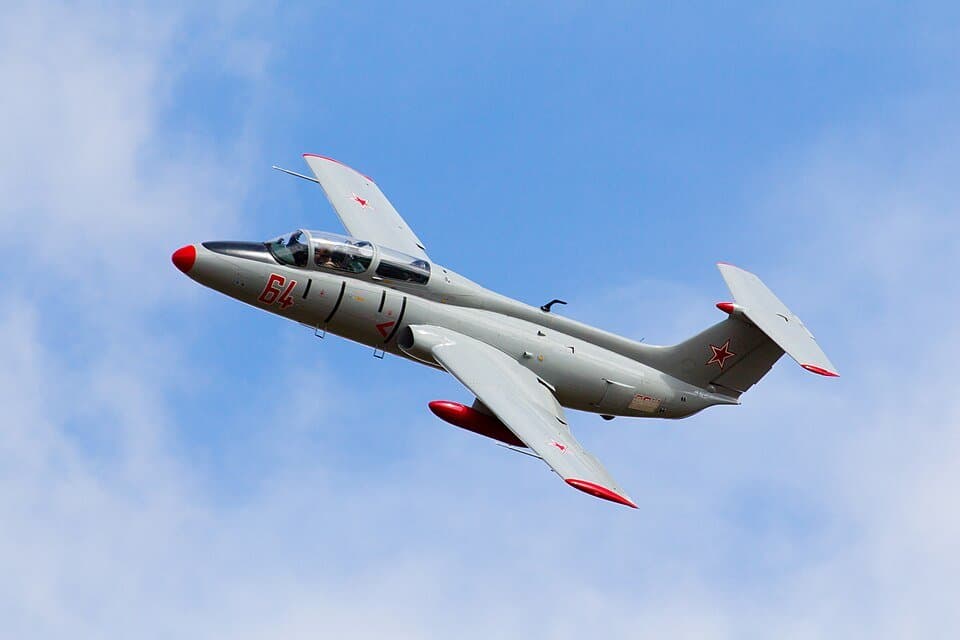
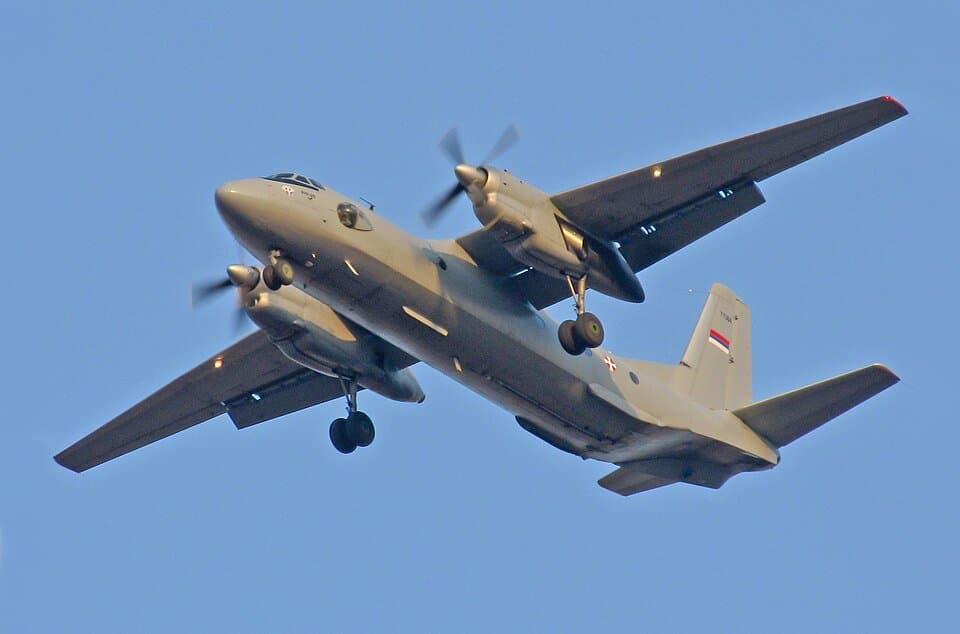
Credit
Oren Rozen · CC BY-SA 3.0 · Resized · CC BY-SA 3.0 · Source ↗ · Modified


Preparing your view.
At a glance
True scale
Side by side. From every angle. A human reference for perspective.
3.14 MB · Loads when you open it| Model | Length | Width / span | Height |
|---|---|---|---|
| Aero L-29 Delfín | ≈ 10.81 m | ≈ 10.29 m (Width) | ≈ 3.13 m |
| Antonov An-26 | ≈ 23.8 m | ≈ 29.3 m (Width) | ≈ 8.58 m |
Scaled uniformly to the sourced length of 10.81 m. The shape was turned square to the axes; the height was fitted to the sourced 3.13 m; the width was fitted to the sourced 10.29 m. Not an official model or a measured survey.
ForceTally · All rights reserved
Scaled uniformly to the sourced length of 23.8 m. The height was fitted to the sourced 8.58 m; the width was fitted to the sourced 29.3 m. Not an official model or a measured survey.
ForceTally · All rights reserved
The human reference is a generic 1.75 m figure. Models describe external size, not combat performance.
Measured figures
L-29 · Length
Single source10.81 m (35 ft 6 in)[source]
Length
Single sourceConfiguration
| Specification | Aero L-29 Delfín | Antonov An-26 |
|---|---|---|
| Type | Military trainer aircraft Light attack[source] | Transport aircraft / regional airliner[source] |
| Manufacturer | Aero Vodochody[source] | Antonov Serial Production Plant[source] |
| Designer | Ing. Zdeněk Rublič, Ing. Karel Tomáš and Ing. Jan Vlček[source] | Antonov[source] |
| Status | Limited service; popular civilian warbird[source] |
23.8 m (78 ft 1 in)[source]
2 × Progress AI-24VT Turboprop engines each
Single source2 × Progress AI-24VT Turboprop engines, 2,103 kW (2,820 hp) each[source]
L-29 · 1 × Motorlet M-701c 500 turbojet thrust
Single source1 × Motorlet M-701c 500 turbojet , 8.7 kN (1,960 lbf) thrust[source]
L-29 · Endurance
Single source2 hr 30 min[source]
Bars compare reported quantities only. A larger figure does not make a system better; configurations and test conditions differ.
In service[source]
| Primary users | Soviet Air Force (historical) Czechoslovak Air Force (historical) Bulgarian Air Force (historical) Egyptian Air Force (historical)[source] | Soviet Air Forces (former) Russian Aerospace Forces Ukrainian Air Force People's Liberation Army Air Force[source] |
|---|
| Number built | 3,665[source] | 1,403[source] |
|---|
| Manufactured | 1963–1974[source] | 1969–present (in China as Y-7)[source] |
|---|
| Introduction date | 1961[source] | 1972[source] |
|---|
| First flight | 5 April 1959[source] | 21 May 1969[source] |
|---|
| Aspect ratio | 5.36:1[source] | 11.7:1[source] |
|---|
| Airfoil | NACA63 2 A217 at root, NACA 64 2 A212 at tip[source] | — |
|---|
| Fuel capacity | 962 L (254 US gal; 212 imp gal), provision for 2× 150 L (40 US gal; 33 imp gal) external tanks[source] | — |
|---|
| Stall speed | 130 km/h (81 mph, 70 kn) (flaps down)[source] | — |
|---|
| Never exceed speed | 820 km/h (510 mph, 440 kn)[source] | — |
|---|
| Guns | 2x 7.62mm machine gun pods on hardpoints[source] | — |
|---|
| Hardpoints | — |
|---|
| Rockets | 8× air-to-ground rockets[source] | — |
|---|
| Bombs | 2× 100 kg (220 lb) bombs[source] | — |
|---|
| Country of origin | Czechoslovakia[source] | — |
|---|
| National origin | — | Soviet Union[source] |
|---|
| Developed from | — | Antonov An-24[source] |
|---|
| Developed into | — | Xi'an Y-7 Antonov An-32[source] |
|---|
| Capacity | — | 40 passengers / 5,500 kg (12,100 lb)[source] |
|---|
| Propellers | — | 4-bladed Constant speed metal bladed propellers, 3.90 m (12 ft 10 in) diameter[source] |
|---|
| Range with max payload | — | 1,100 km (680 mi)[source] |
|---|
| Role | — | military transport aircraft[source] |
|---|
| Source design development | — | While the An-24T tactical transport had proved successful in supporting Soviet troops in austere locations, its ventral loading hatch restricted the handling of cargo, and in particular vehicles, and made it less effective than hoped in parachuting men and supplies. As a result, interest in a version with a retractable cargo ramp increased, and the Antonov design bureau decided in 1966 to begin development on the new An-26 derivative, in advance of an official order. The cargo ramp was based on that design and allowed the cargo deck to be sealed and pressurised in flight. When loading cargo, it could either be lowered to allow vehicles to be driven in, or slid beneath the aircraft's fuselage, so that cargo could be loaded straight in off a truck bed. In March 1968, the OKB received official permission to begin development. Particular attention was given to the military mission, and the majority of early An-26 production was delivered to the VTA (voyenno-transportnaya aviatsiya) .[source] |
|---|