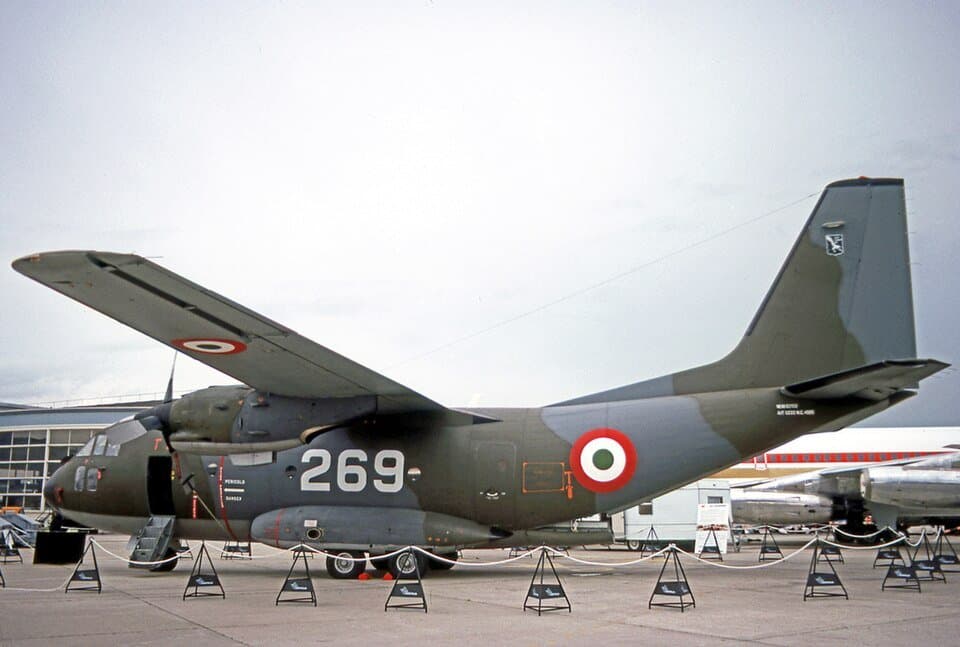

Credit
RuthAS · CC BY-SA 4.0 · Resized · CC BY-SA 4.0 · Source ↗ · Modified


Preparing your view.

At a glance
Measured figures
G.222 · Length
Single source22.7 m (74 ft 6 in)[source]
Configuration
| Specification | Aeritalia G.222 | Embraer C-390 Millennium |
|---|---|---|
| Type | Military transport aircraft[source] | Military transport , aerial refuelling aircraft[source] |
| Manufacturer | Fiat / Aeritalia / Alenia Aeronautica[source] | Embraer[source] |
| Status | Retired[source] | In service[source] |
| Primary users | Italian Air Force (historical) Nigerian Air Force Argentine Army Aviation (historical)[source] |
C-390 Millennium · Length
35.2 m (115 ft 6 in)[source]
Empty; G.222 · Empty weight
Single sourceMaximum take-off; G.222 · Max takeoff weight
Single source14,590 kg (32,165 lb)[source]
28,000 kg (61,729 lb)[source]
Empty; C-390 Millennium · Empty weight
Single sourceMaximum take-off; C-390 Millennium · Max takeoff weight
Single sourceCruise; G.222 · at 6,000 m (20,000 ft) at Max TO weight
Single sourceMaximum; G.222 · at 4,575 m (15,010 ft) at Max TO weight
Single source540 km/h (340 mph, 290 kn) at 4,575 m (15,010 ft) at Max TO weight[source]
439 km/h (273 mph, 237 kn) at 6,000 m (20,000 ft) at Max TO weight[source]
Cruise; C-390 Millennium · Mach 0.8
Single sourceMaximum; C-390 Millennium · Mach 0.93
Single sourceFerry; G.222 · with maximum fuel
Single sourceG.222 · with max. payload at optimum cruising speed and height
Single source1,371 km (852 mi, 740 nmi) with max. payload at optimum cruising speed and height[source]
4,633 km (2,879 mi, 2,502 nmi) with maximum fuel[source]
C-390 Millennium · Range · source measurement 2
Single sourceC-390 Millennium · Range · source measurement 4
Single sourceG.222 · 2 × General Electric T64-GE-P4D turboprop engines each at ISA + 25 °C (77 °F)
Single source2 × General Electric T64-GE-P4D turboprop engines, 2,535 kW (3,399 hp) each at ISA + 25 °C (77 °F)[source]
C-390 Millennium · 2 × IAE V2500 -E5 turbofan thrust each
Single source2 × IAE V2500 -E5 turbofan , 139.4 kN (31,330 lbf) thrust each[source]
G.222 · 1,706.1 ft/min
Single source8.667 m/s (1,706.1 ft/min)[source]
Bars compare reported quantities only. A larger figure does not make a system better; configurations and test conditions differ.
Brazilian Air Force Portuguese Air Force Hungarian Air Force Czech Air Force[source] |
| Number built | 111[source] | 16 (including 3 prototypes)[source] |
|---|
| Manufactured | 1970–1993[source] | 2014–present[source] |
|---|
| Introduction date | April 1978[source] | 2019[source] |
|---|
| First flight | 18 July 1970[source] | 3 February 2015[source] |
|---|
| Retired | 2012 ( Afghan Air Force )[source] | — |
|---|
| Developed into | Alenia C-27J Spartan[source] | — |
|---|
| Capacity | 53 fully-equipped troops / 40 fully-equipped paratroops / 9,000 kg (20,000 lb) max. payload[source] | 26,000 kg (57,000 lb) / 80 troops / 74 stretchers and 8 attendants / 66 paratroopers / 7 463L master pallets / 6 463L master pallets and 36 troops[source] |
|---|
| Aspect ratio | 9.15:1[source] | — |
|---|
| Airfoil | NACA 64A315.2[source] | — |
|---|
| Fuel capacity | 12,000 L (3,200 US gal; 2,600 imp gal) in four integral wing tanks[source] | 23,000 to 35,000 kg (50,700 to 77,160 lb) with 3 aux. fuel tanks[source] |
|---|
| Propellers | 3-bladed Hamilton Standard 63E60-27, 4.42 m (14 ft 6 in) diameter constant-speed fully reversilble-pitch constant-speed propellers[source] | — |
|---|
| Airdrop speed | 204–259 km/h (127–161 mph; 110–140 kn) (paratroops and cargo)[source] | — |
|---|
| Stall speed | 155 km/h (96 mph, 84 kn) flaps and landing speed down[source] | 193 km/h (120 mph, 104 kn) IAS[source] |
|---|
| Service ceiling, one engine out | 5,000 m (16,000 ft)[source] | — |
|---|
| Time to altitude | 4,500 m (14,800 ft) 8 minutes 35 seconds[source] | — |
|---|
| Wing loading | 341.5 kg/m 2 (69.9 lb/sq ft)[source] | — |
|---|
| Power/mass | 5.52 kg/kW (9.07 lb/hp)[source] | — |
|---|
| Take-off run | 662 m (2,172 ft)[source] | — |
|---|
| Take-off run to 15 m (49 ft) | 1,000 m (3,300 ft)[source] | — |
|---|
| Landing run at max landing weight | 545 m (1,788 ft)[source] | — |
|---|
| Landing run from 15 m (49 ft) | 775 m (2,543 ft)[source] | — |
|---|
| Role | medium-sized STOL military transport aircraft[source] | medium-size, twin-engine , jet-powered military transport aircraft[source] |
|---|
| Source measurement | Various export customers emerged for the type during the 1980s and 1990s. Libyan efforts to purchase 20 G.222s were initially vetoed by United States ; Libya later procured a version of the aircraft without US-made equipment present instead. The United States purchased 10 G.222s in the 1990s, designating the type C-27A Spartan . During the 2000s, as the Italian Air Force withdrew their original G.222s due to their advancing age, these aircraft were commonly refurbished and subsequently sold onto other nations; via this approach, several G.222s were dispatched to Afghanistan during the War in Afghanistan .[source]Aeritalia G.222 · Lead; only the objects and conditions stated in this passage On 18 July 1970, the first prototype performed the aircraft's maiden flight with test pilot Vittorio Sanseverino at the controls. By late April 1971, the prototype had reportedly conducted a total of 22 flights and accumulated 50 hours of flight time, during which its performance was claimed to have been highly close to predictions. In December 1971, the Italian Air Force, who had placed a provisional order for the developing type, formally began evaluating the G.222 and the performance of the two prototypes then in service. Following a successful testing period, the AMI contract for 44 aircraft was issued to Aeritalia (of which Fiat Aviazione had since become a part). In December 1975, the first production aircraft conducted its first flight. In April 1978, this same aircraft formally entered service with the AMI. Following on from its introduction by the AMI, the G.222 was procured as a tactical transport aircraft by various international customers, including Argentina , Nigeria , Somalia , Venezuela and Thailand .[source]Aeritalia G.222 · Development / Origins; only the objects and conditions stated in this passage In 1977, Libya sought the purchase of 20 G.222s; this was vetoed by the U.S. Government , who had imposed an embargo on military arms and equipment to Libya, which included the G.222's T64 engines. To get around this restriction, Aeritalia developed a version of the G.222 powered by the Rolls-Royce Tyne engine and other US supplied equipment was replaced by European equivalents; the more powerful Tyne engine also reportedly gave this variant superior "hot and high" performance. The provision of alternative powerplants was viewed by Aeritalia as a measure to widen the overall appeal of the G.222; the Tyne engine also reportedly possessed greater growth potential than the T64 engine. In May 1980, the first G.222 equipped with the Tyne engine performed its maiden flight . Libya placed an order for 20 Tyne-powered aircraft instead, with deliveries commencing from 1980.[source]Aeritalia G.222 · Development / Further development; only the objects and conditions stated in this passage In order to extend the effective operational lifespan of the type, some operators have carried out extensive upgrade programs of the G.222. In the aftermath of Italian humanitarian missions in Bosnia and Somalia , in 1996 the AMI began undertaking a major update program on their G.222 fleet; modifications include cockpit lighting changes for compatibility with Night Vision Goggles to enable night operations, increasing the aircraft's self-defense capabilities, new communications and navigation systems, and the removal of obsolete equipment. In July 2005, the Nigerian Air Force signed a $74.5 million contract with Alenia Aeronautica for the refurbishment of a total of five G.222s, as well as the purchase of a retired AMI G.222.[source]Aeritalia G.222 · Development / Further development; only the objects and conditions stated in this passage In 1990, the United States Air Force selected the G.222 as the basis of a "Rapid-Response Intra-Theater Airlifter" (RRITA). Operated under the designation C-27A Spartan , ten G.222s were purchased and underwent avionics upgrades by Chrysler Aerospace . These aircraft were stationed at Howard AFB , Panama . The USAF would later dispose of their C-27A fleet, partly due to shifting priorities between the Army and the Air Force and partly because of the impending introduction of a newer variant, the Alenia C-27J Spartan .[source]Aeritalia G.222 · Development / Further development; only the objects and conditions stated in this passage The G.222 is a twin turboprop -engine tactical military transport aircraft, and is designed to be capable of transporting equipment or troops in combat zones and operating with minimal ground support. Early production aircraft were exclusively fitted with the General Electric T64-GE-P4D turboprop engine, the licence-built Rolls-Royce Tyne was made available as an alternative powerplant for the type from 1980 onwards, while the Allison T56 was another proposed powerplant for the type. Due to features such as double-slotted flaps, stacked brakes, and reversible propellers, the G.222 has excellent short landing capabilities and is able to land in as little as 1,800 feet. It was designed to be integrated with the larger, commonplace Lockheed C-130 Hercules .[source]Aeritalia G.222 · Design; only the objects and conditions stated in this passage The G.222's cargo deck can carry up to 9,000 kg (19,840 lb) of cargo, or alternatively up to 53 troops, or 32 paratroopers, or a maximum of 36 stretchers with six attending medics in a medevac capacity. The cargo deck has a large rear ramp, allowing the loading of palletised goods and vehicles, as well as sliding doors on either side of the fuselage, which are capable of being used to deploy paratroopers . Various pallet-based special mission equipment could be readily installed to enhance the aircraft's capabilities for diverse roles such as VIP transport, maritime patrol , aerial firefighting , and calibration functions; this equipment could also be removed quickly in order for aircraft to be returned to conventional transport missions. To easily facilitate the loading of a wide range of cargos, the height of the landing gear can be manually controlled.[source]Aeritalia G.222 · Design; only the objects and conditions stated in this passage The G.222 has seen considerable service in air relief and military supply operations. From 1979 onwards, Italy, along with other Western nations, provided considerable military aid to Somalia , part of the Italian contribution was four G.222s. In 1982, three Ejército Argentino G.222s were operational during the Falklands War , and may have participated in a logistical capacity. In 1983, a single Italian Air Force G.222 was outfitted for fire suppression duties, alongside an existing C-130 in the same role.[source]Aeritalia G.222 · Operational history; only the objects and conditions stated in this passage On 3 September 1992, an Italian Air Force ( Aeronautica Militare Italiana ) G.222 was shot down when approaching Sarajevo airfield while conducting a United Nations relief mission. It crashed 18 miles (29 km) from the airfield; a NATO rescue mission was aborted when 2 USMC CH-53 helicopters came under small arms fire. The cause of the crash was determined to be a surface-to-air missile, but it was not clear who shot it. Everyone on board – four Italian crew members and four French passengers – died in the crash.[source]Aeritalia G.222 · Operational history; only the objects and conditions stated in this passage In November 1999, the Italian Air Force placed an initial order for twelve new-build aircraft of an upgraded G.222 derivative, designated as the C-27J, as a replacement for their existing G.222s. In December 2002, Alenia Aermacchi agreed to purchase a total of 39 G.222s that had been previously operated by the Italian Air Forces under a trade-in arrangement as part of the agreed C-27J purchase. In 2005, the Italian Air Force started the phased retirement of their G.222 fleet. Several of the former Italian Air Force G.222s have been refurbished to operational conditions and resold by Alenia Aermacchi, the Nigerian Air Force became the first customer for these refurbished aircraft.[source]Aeritalia G.222 · Operational history; only the objects and conditions stated in this passage In September 2008, Alenia North America was awarded a USAF contract to upgrade and refurbish 18 G.222s, to be transferred to and used by the Afghan Air Force . Ballistic protection, adaptations for serving in the conditions of Afghanistan, and many new avionics systems, including a digital auto-pilot, were installed; two aircraft were also configured for VIP transport duties. On 28 April 2010, the first two of the Afghan Air Force's recently delivered G.222s made their first public display during the Mujahideen Victory Day . In January 2013, the USAF decided not to renew the support contract for the Afghan fleet due to claimed serviceability issues and operational difficulties; Alenia responded, stating that the fleet was exceeding the requirements laid out by the USAF, with 10–12 aircraft available for operations against the requirement for six.[source]Aeritalia G.222 · Operational history; only the objects and conditions stated in this passage The 16 G.222s delivered to Afghanistan were scrapped in the summer of 2014 by the Defense Logistics Agency . After the U.S. spent $486 million to buy 20 C-27As, 16 were sold as scrap to an Afghan construction company for about $32,000; the planes were reportedly scrapped "to minimize impact on drawdown of U.S. forces in Afghanistan." The four remaining aircraft are stored at Ramstein Air Base , Germany, with the U.S. seeking other interested buyers. From January to September 2012, the Afghan C-27A fleet flew only 234 out of 4,500 required hours. The C-17A fleet had been procured for their keep attributes to enable them to operate in Afghanistan terrain, they were former Italian G.222. However, they ended up being replaced by C-130H after maintenance difficulties.[source]Aeritalia G.222 · Operational history; only the objects and conditions stated in this passage Ten G.222s purchased for the United States Air Force .[source]Aeritalia G.222 · Variants; only the objects and conditions stated in this passage Italian Air Force operated 56 aircraft (44 G.222A, 4 G.222RM, 4 G.222SAA, 2 G.222TCM and 2 G.222VS). Officially retired in September 2005, but at least 1 G.222VS aircraft remained operational as of 2019.[source]Aeritalia G.222 · Operators; only the objects and conditions stated in this passage Capacity: 53 fully-equipped troops / 40 fully-equipped paratroops / 9,000 kg (20,000 lb) max. payload[source]Aeritalia G.222 · Specifications (G.222); only the objects and conditions stated in this passage Length: 22.7 m (74 ft 6 in)[source]Aeritalia G.222 · Specifications (G.222); only the objects and conditions stated in this passage Wingspan: 28.7 m (94 ft 2 in)[source]Aeritalia G.222 · Specifications (G.222); only the objects and conditions stated in this passage Height: 9.8 m (32 ft 2 in)[source]Aeritalia G.222 · Specifications (G.222); only the objects and conditions stated in this passage Empty weight: 14,590 kg (32,165 lb)[source]Aeritalia G.222 · Specifications (G.222); only the objects and conditions stated in this passage Max takeoff weight: 28,000 kg (61,729 lb)[source]Aeritalia G.222 · Specifications (G.222); only the objects and conditions stated in this passage Powerplant: 2 × General Electric T64-GE-P4D turboprop engines, 2,535 kW (3,399 hp) each at ISA + 25 °C (77 °F)[source]Aeritalia G.222 · Specifications (G.222); only the objects and conditions stated in this passage Propellers: 3-bladed Hamilton Standard 63E60-27, 4.42 m (14 ft 6 in) diameter constant-speed fully reversilble-pitch constant-speed propellers[source]Aeritalia G.222 · Specifications (G.222); only the objects and conditions stated in this passage Maximum speed: 540 km/h (340 mph, 290 kn) at 4,575 m (15,010 ft) at Max TO weight[source]Aeritalia G.222 · Specifications (G.222); only the objects and conditions stated in this passage Cruise speed: 439 km/h (273 mph, 237 kn) at 6,000 m (20,000 ft) at Max TO weight[source]Aeritalia G.222 · Specifications (G.222); only the objects and conditions stated in this passage Airdrop speed: 204–259 km/h (127–161 mph; 110–140 kn) (paratroops and cargo)[source]Aeritalia G.222 · Specifications (G.222); only the objects and conditions stated in this passage Stall speed: 155 km/h (96 mph, 84 kn) flaps and landing speed down[source]Aeritalia G.222 · Specifications (G.222); only the objects and conditions stated in this passage Range: 1,371 km (852 mi, 740 nmi) with max. payload at optimum cruising speed and height[source]Aeritalia G.222 · Specifications (G.222); only the objects and conditions stated in this passage Ferry range: 4,633 km (2,879 mi, 2,502 nmi) with maximum fuel[source]Aeritalia G.222 · Specifications (G.222); only the objects and conditions stated in this passage Service ceiling: 7,620 m (25,000 ft)[source]Aeritalia G.222 · Specifications (G.222); only the objects and conditions stated in this passage Service ceiling, one engine out: 5,000 m (16,000 ft)[source]Aeritalia G.222 · Specifications (G.222); only the objects and conditions stated in this passage Rate of climb: 8.667 m/s (1,706.1 ft/min)[source]Aeritalia G.222 · Specifications (G.222); only the objects and conditions stated in this passage Time to altitude: 4,500 m (14,800 ft) 8 minutes 35 seconds[source]Aeritalia G.222 · Specifications (G.222); only the objects and conditions stated in this passage Take-off run: 662 m (2,172 ft)[source]Aeritalia G.222 · Specifications (G.222); only the objects and conditions stated in this passage Take-off run to 15 m (49 ft): 1,000 m (3,300 ft)[source]Aeritalia G.222 · Specifications (G.222); only the objects and conditions stated in this passage Landing run at max landing weight: 545 m (1,788 ft)[source]Aeritalia G.222 · Specifications (G.222); only the objects and conditions stated in this passage Landing run from 15 m (49 ft): 775 m (2,543 ft)[source]Aeritalia G.222 · Specifications (G.222); only the objects and conditions stated in this passage | Work on the project began at Embraer during the mid-2000s, with early efforts centred around a conceptual derivative of the E190 jetliner of a similar size to the Lockheed C-130 Hercules . In May 2008, the Brazilian government invested R$ 800 million ( US$ 440M) in the project's development. In April 2009, Embraer received a $1.5 billion contract from the Brazilian Air Force for two prototypes. The aircraft was initially designated C-390 before changing to KC-390 in early 2011. At the 2011 Paris Air Show , Embraer announced plans to launch a stretched version of the aircraft as a civilian freighter. Partnerships were promptly formed with various other aerospace companies, including FAdeA , ENAER , OGMA , and Boeing . Major subcontractors in the aircraft's manufacturing include Aero Vodochody , BAE Systems , and Rockwell Collins .[source]Embraer C-390 Millennium · Lead; only the objects and conditions stated in this passage Utilizing turbofan jet engines, the C-390 can be configured to perform various conventional operations such as troop, VIP and cargo transportation, and more specialised logistical operations such as aerial refuelling as a tanker. It can carry payloads of up to 26 t (57,000 lb)—such as two fully-tracked M113 armored personnel carriers , one Boxer armoured vehicle, a Sikorsky H-60 helicopter, 74 litters with life-support equipment, up to 80 soldiers or 66 paratroopers with full gear—and loads of up to 42,000 lb (19 t) can be air dropped . Each aircraft costs around € 80 million as of 2024.[source]Embraer C-390 Millennium · Lead; only the objects and conditions stated in this passage By 2006, Embraer was studying a military tactical transport design of a similar size to the Lockheed C-130 Hercules , to be powered by 17,000–22,000 lbf (75.6–98 kN) jet engines, such as the Pratt & Whitney PW6000 and Rolls-Royce BR715 . In April 2007, Embraer publicly stated that it was studying a medium-size airlifter. Referred to by the company designation C-390 , this transport aircraft was said to incorporate many of the technological solutions present on the Embraer E-Jet series and feature a rear ramp for the loading and unloading of a wide range of cargo.[source]Embraer C-390 Millennium · Development / Studies; only the objects and conditions stated in this passage |
|---|
| Country of origin | Italy[source]Inventory Origin column; table 29, row 15, cell 3; revision 1364221460 | — |
|---|
| National origin | — | Brazil[source] |
|---|
| Hardpoints | — | 3 with a capacity of POD Optical / IR Rafael Litening II / IFR Cobham 900E[source] |
|---|
| Useful lift | — | 26,000 kg (57,320 lb)[source] |
|---|
| Cargo hold length × height × width | — | 18.5 m × 3.0 m × 3.4 m (60.6 ft × 9.8 ft × 11.3 ft)[source] |
|---|
C-390 Millennium · with 14,000 kg (31,000 lb) payload
Single sourceC-390 Millennium · with 23,000 kg (51,000 lb) payload
Single sourceC-390 Millennium · with 26,000 kg (57,000 lb) payload
Single sourceFerry; C-390 Millennium · Ferry range
Single sourceFerry; C-390 Millennium · max. with aux. fuel tanks
Single source5,020 km (3,120 mi, 2,710 nmi) ; with 14,000 kg (31,000 lb) payload 2,720 km; 1,690 mi (1,470 nmi) with 23,000 kg (51,000 lb) payload 2,000 km; 1,240 mi (1,080 nmi) with 26,000 kg (57,000 lb) payload[source]
6,240 km (3,880 mi, 3,370 nmi) – 8,460 km; 5,260 mi (4,570 nmi) max. with aux. fuel tanks[source]
5,020 km (3,120 mi, 2,710 nmi) ; with 14,000 kg (31,000 lb) payload[source]
In March 2008, the Brazilian government planned to invest about R$ 60 million (equivalent to US$ 33 million ) in the aircraft's initial development. Simultaneously, the Brazilian Air Force was in the process of finalizing an initial purchase contract for between 22 and 30 aircraft, while Embraer was negotiating with possible partners on the programme. Two months later, the Brazilian Congress released R$800 million (US$440M) to be invested in the project and fund the aircraft's development. Around this time, the media claimed that the aircraft would be operated by the Brazilian Air Force and the Army and Navy , and that there were unconfirmed sales to other government agencies in the works.[source]Embraer C-390 Millennium · Development / Studies; only the objects and conditions stated in this passage
In March 2010, Embraer drew up a development schedule, upon which the first prototype aircraft was scheduled to be delivered in late 2014. In July 2010, at the Farnborough Airshow , the Brazilian Air Force announced its intent to order 28 C-390s, while Embraer announced an increase in the aircraft's cargo capacity to 21 t (46,000 lb). At the 2011 Paris Air Show , Embraer announced plans to launch a stretched version of the C-390 focused on the civil market for freighters sometime around 2018. It estimated that the company would receive 200–250 orders over a 10-year period. To increase internal capacity, two plugs will be added fore and aft of the centre fuselage section, which would also provide a new side cargo door.[source]Embraer C-390 Millennium · Development / Program launch; only the objects and conditions stated in this passage
In April 2012, the American aerospace giant Boeing and Embraer signed a cooperation agreement. Two months later, an agreement was signed by the two companies to collaborate on the development of the C-390, and possibly extending to sales as well. In June 2013, Boeing agreed to market the C-390 in the US, UK, and Middle East, building on the June 2012 MoU. In November 2019, it was announced that Boeing and Embraer were to form a new joint venture company to promote and develop new markets for the C-390 Millennium . This new company, Boeing Embraer – Defense , was to have its ownership divided between a 51% stake held by Embraer and 49% by Boeing. It was to begin operations following the granting of regulatory approvals and the satisfaction of closing conditions. However, in April 2020, Boeing terminated the planned joint ventures with Embraer.[source]Embraer C-390 Millennium · Development / Partnerships; only the objects and conditions stated in this passage
In July 2015, the company announced a two-year delay in the flight test program, citing the devaluation of the Brazilian currency and government spending cuts. However, a second test flight took place at Gavião Peixoto on 26 October 2015. By February 2016, the first prototype had logged more than 100 hours of flight. Following the resumption of flight-testing, the manufacturer expected to certify the C-390 sometime in 2017 and begin deliveries in 2018. The eight months between test flights were used to conduct ground vibration tests to validate aeroelastic models , as well as avionics , mission, landing gear and electric and hydraulic flight control system testing. Embraer reported good availability for testing, sometimes conducting two flights per day. The aircraft was tested to the limits of speed, Mach number , and altitude, as well as all slats , flaps and landing gear positions.[source]Embraer C-390 Millennium · Development / Flight testing; only the objects and conditions stated in this passage
On 17 October 2017, the first prototype (PT-ZNF) made an uncommanded descent from 20,000 ft to 3,100 ft at 4,500 ft/min. In December 2017, as the two prototypes accumulated over 1,500 flight hours and laboratory testing over 40,000 hours, initial operating capability was reached, while full operational capability was expected in 2018. On 5 May 2018, the first prototype (PT-ZNF) ran off the runway during a ground test in Gaviao Peixoto, Brazil. The first production C-390, which was the third aircraft to be built including the prototypes, made its first flight on 6 October 2018.[source]Embraer C-390 Millennium · Development / Flight testing; only the objects and conditions stated in this passage
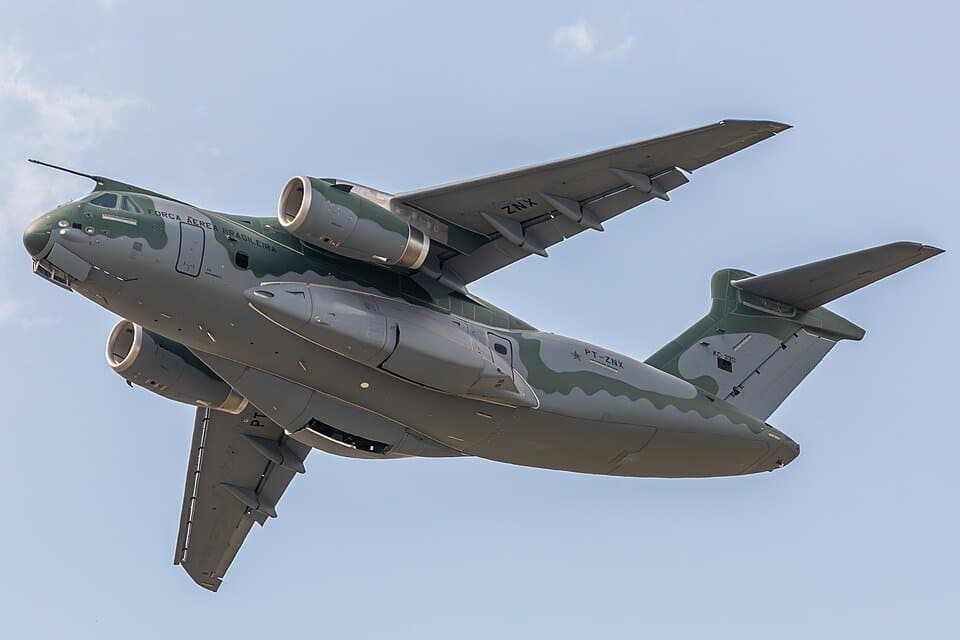
The Embraer C-390 Millennium is a mid-sized utility transport aircraft. Its design permits flexible operations. Both the internal and external configuration of the aircraft can be rapidly interchanged to accommodate different mission roles due the modular design adopted since the aircraft concept for all missions systems. It incorporates modern technology and mission software to aid crews in carrying out operations. The cockpit has head-up displays for the enhanced vision system with four cameras and Rockwell Collins Pro Line Fusion commercial avionics. The C-390 can provide inflight refueling to other aircraft through two wing-mounted probe and drogue pods from Cobham plc . These can deliver fuel at up to 1,500 L (400 US gal) per minute from a 35 t (77,000 lb) total fuel capacity, between 120 and 300 kn (220 and 560 km/h) and from 2,000 to 32,000 ft (610 to 9,750 m).[source]Embraer C-390 Millennium · Design; only the objects and conditions stated in this passage
The aircraft is powered by a pair of IAE V2500 -E5 turbofan engines, which are mounted forward on the high wing . This wing features an anhedral angle , slats , and High-lift devices able to deflect up to 40°. The landing gear is equipped with low-pressure tires, two 5.9 bar (85 psi) on the nose and four 7.2 bar (105 psi) on either side bogies , which facilitate the aircraft's use upon soft, unpaved ground, such as austere airstrips, or damaged runways. The C-390 has a cruising speed of Mach 0.8 which, according to Embraer, enables payloads to be transported faster than any other airplane in the medium airlift market. It can attain a controlled descend rate of 9,000 ft/min (2,700 m/min) at its 300 kn (560 km/h) maximum IAS through a combination of extended slats, idle thrust, and flight spoilers extended to 40°. When its flaps are fully deployed at 40 degrees, it has a stall speed of 104 kn (193 km/h) IAS.[source]Embraer C-390 Millennium · Design; only the objects and conditions stated in this passage
The aircraft is equipped with fully fly-by-wire flight controls combined with active sidesticks , which reduces the crew's workload over conventional counterparts and permits load factors up to 3g. An autothrottle system is installed. The navigation systems, which were largely supplied by Thales Group , include an Inertial Navigation System (INS), GPS , and Collision Avoidance System (TCAS) transponder. It is fitted with SELEX Galileo 's Gabbiano tactical radar, capable of GMTI , SAR , ISAR , SART modes amongst others. For self-defense purposes, an Elbit Systems -supplied directional infrared countermeasures suite is typically installed. An integrated onboard maintenance system actively monitors the health of the overall aircraft and various subsystems at all times.[source]Embraer C-390 Millennium · Design; only the objects and conditions stated in this passage
The hold of the C-390 has a length of 18.5 m (61 ft), width of 3.45 m (11.3 ft), and height of 2.95 m (9 ft 8 in), and is primarily accessed via a large rear ramp built into the tail. It can carry payloads of up to 26 t (57,000 lb). This allows for the carriage of either two fully-tracked M113 armored personnel carriers , one Boxer or Brazilian VBTP-MR Guarani wheeled armoured vehicle, a Sikorsky H-60 helicopter, 74 litters with life-support equipment, up to 80 soldiers or 66 paratroopers with full gear. Loads of up to 42,000 lb (19 t) can be air dropped . A cargo handling and aerial delivery system, produced by DRS Defense Solutions, is incorporated. Typical amenities present in the hold include a galley , an accessibility-friendly toilet, automatic temperature control, and noise/vibration mitigation measures. Embraer have stated that considerable attention was paid to passenger comfort.[source]Embraer C-390 Millennium · Design; only the objects and conditions stated in this passage
In the first 3.5 years of operation, the C-390 in the FAB totaled more than 8,200 flight hours with 6,000 flights, the technical availability was around 80% and the mission completion rate was 99.5%, according to Embraer data and the FAB.[source]Embraer C-390 Millennium · Operational history / Brazil; only the objects and conditions stated in this passage
Following the 2020 Beirut explosion , a C-390 and an Embraer 190 VC-2 were sent with around six tons of medicines, food and health equipment to provide emergency care. It was the first international mission of the aircraft in FAB service.[source]Embraer C-390 Millennium · Operational history / Brazil; only the objects and conditions stated in this passage
A single C-390 flew to Ushuaia carrying spare parts in support of a FAB C-130 that was on an Antarctic operation. In the 2022 Russian invasion of Ukraine , a KC-390 and a VC-99B Legacy were sent with a mission to rescue Brazilian nationals and other countries. The mission also brought around 12 tons of humanitarian aid to Ukraine. The mission rescued national, Ukrainian, Argentine and Colombian citizens, all of whom were taken to Brazil.[source]Embraer C-390 Millennium · Operational history / Brazil; only the objects and conditions stated in this passage
As of June 2022, a C-390 from the Fat Squadron (1st/1st GT) of the FAB participated for the first time in the Brazilian Antarctic Campaign, dropping supply loads for the Comandante Ferraz Antarctic Station . The C-390 participated in 2022 in Operation Cooperation VII in Colombia, operating on runways of up to 2,100 meters, at altitudes simulating missions of humanitarian assistance and paratrooper launches.[source]Embraer C-390 Millennium · Operational history / Brazil; only the objects and conditions stated in this passage
Slovakia: The Slovak Air Force selected the C-390 in December 2024. Negotiations for the purchase of three aircraft are to begin.[source]Embraer C-390 Millennium · Marketing and potential orders; only the objects and conditions stated in this passage
Colombian Aerospace Force – On 30 March 2026, Colombian President Gustavo Petro ordered the purchase for two C-390 aircraft to replace two C-130H aircraft which were out of service. Petro also named the C-390, along with Airbus A400 Atlas and the Lockheed Martin C-130J Super Hercules, as contenders to replace the entirety of the C-130H Hercules fleet. In August 2026, the order for two KC-390s was confirmed with orders expected between 2029 and 2030.[source]Embraer C-390 Millennium · Operators / Future operators; only the objects and conditions stated in this passage
Hellenic Air Force – three C-390s ordered in 2026, through a bilateral agreement with Portugal . Greece is to receive the first C-390 in 2027. These aircraft are to operate as mobile hospitals, personnel carriers, and tanker aircraft. This is the first time Greece has acquired aerial refuelling aircraft.[source]Embraer C-390 Millennium · Operators / Future operators; only the objects and conditions stated in this passage
Royal Netherlands Air and Space Force – selected the C-390 in 2022 with five airlifters ordered to replace its C-130H . Contract signed in July 2024 with deliveries to begin at the end of 2027. During the 2025 Paris Air Show, it was announced that the Netherlands ordered one aeromedical module unit, a self-contained, air-transportable and fully compatible with the C-390 cargo handling system roll-on/roll-off system. It will enhance the Netherlands' (and its partners Austria and Sweden) ability to conduct humanitarian, disaster relief and military medical operations abroad. The contract allows for potentially seven more of these modules for the three C-390 partners.[source]Embraer C-390 Millennium · Operators / Future operators; only the objects and conditions stated in this passage
Swedish Air Force – selected in November 2024, four units ordered plus an additional seven in option. The order is part of a trilateral agreement between Sweden, Austria and the Netherlands, including an option for seven additional aircraft.[source]Embraer C-390 Millennium · Operators / Future operators; only the objects and conditions stated in this passage
Capacity: 26,000 kg (57,000 lb) / 80 troops / 74 stretchers and 8 attendants / 66 paratroopers / 7 463L master pallets / 6 463L master pallets and 36 troops[source]Embraer C-390 Millennium · Specifications (C-390 Millennium); only the objects and conditions stated in this passage
Length: 35.2 m (115 ft 6 in)[source]Embraer C-390 Millennium · Specifications (C-390 Millennium); only the objects and conditions stated in this passage
Wingspan: 35.05 m (115 ft 0 in)[source]Embraer C-390 Millennium · Specifications (C-390 Millennium); only the objects and conditions stated in this passage
Height: 11.84 m (38 ft 10 in)[source]Embraer C-390 Millennium · Specifications (C-390 Millennium); only the objects and conditions stated in this passage
Empty weight: 35,000 kg (77,162 lb)[source]Embraer C-390 Millennium · Specifications (C-390 Millennium); only the objects and conditions stated in this passage
Max takeoff weight: 86,999 kg (191,800 lb)[source]Embraer C-390 Millennium · Specifications (C-390 Millennium); only the objects and conditions stated in this passage
Fuel capacity: 23,000 to 35,000 kg (50,700 to 77,160 lb) with 3 aux. fuel tanks[source]Embraer C-390 Millennium · Specifications (C-390 Millennium); only the objects and conditions stated in this passage
Useful lift: 26,000 kg (57,320 lb)[source]Embraer C-390 Millennium · Specifications (C-390 Millennium); only the objects and conditions stated in this passage
Cargo hold length × height × width : 18.5 m × 3.0 m × 3.4 m (60.6 ft × 9.8 ft × 11.3 ft)[source]Embraer C-390 Millennium · Specifications (C-390 Millennium); only the objects and conditions stated in this passage
Powerplant: 2 × IAE V2500 -E5 turbofan , 139.4 kN (31,330 lbf) thrust each[source]Embraer C-390 Millennium · Specifications (C-390 Millennium); only the objects and conditions stated in this passage
Maximum speed: 988 km/h (614 mph, 533 kn) Mach 0.93[source]Embraer C-390 Millennium · Specifications (C-390 Millennium); only the objects and conditions stated in this passage
Cruise speed: 870 km/h (540 mph, 470 kn) Mach 0.8[source]Embraer C-390 Millennium · Specifications (C-390 Millennium); only the objects and conditions stated in this passage
Stall speed: 193 km/h (120 mph, 104 kn) IAS[source]Embraer C-390 Millennium · Specifications (C-390 Millennium); only the objects and conditions stated in this passage
Range: 5,020 km (3,120 mi, 2,710 nmi) ; with 14,000 kg (31,000 lb) payload 2,720 km; 1,690 mi (1,470 nmi) with 23,000 kg (51,000 lb) payload 2,000 km; 1,240 mi (1,080 nmi) with 26,000 kg (57,000 lb) payload[source]Embraer C-390 Millennium · Specifications (C-390 Millennium); only the objects and conditions stated in this passage
Ferry range: 6,240 km (3,880 mi, 3,370 nmi) – 8,460 km; 5,260 mi (4,570 nmi) max. with aux. fuel tanks[source]Embraer C-390 Millennium · Specifications (C-390 Millennium); only the objects and conditions stated in this passage
Service ceiling: 11,000 m (36,000 ft)[source]Embraer C-390 Millennium · Specifications (C-390 Millennium); only the objects and conditions stated in this passage