
Credit
RuthAS · CC BY-SA 4.0 · Resized · CC BY-SA 4.0 · Source ↗ · Modified


Preparing your view.
At a glance
True scale
Side by side. From every angle. A human reference for perspective.
3.34 MB · Loads when you open it| Model | Length | Width / span | Height |
|---|---|---|---|
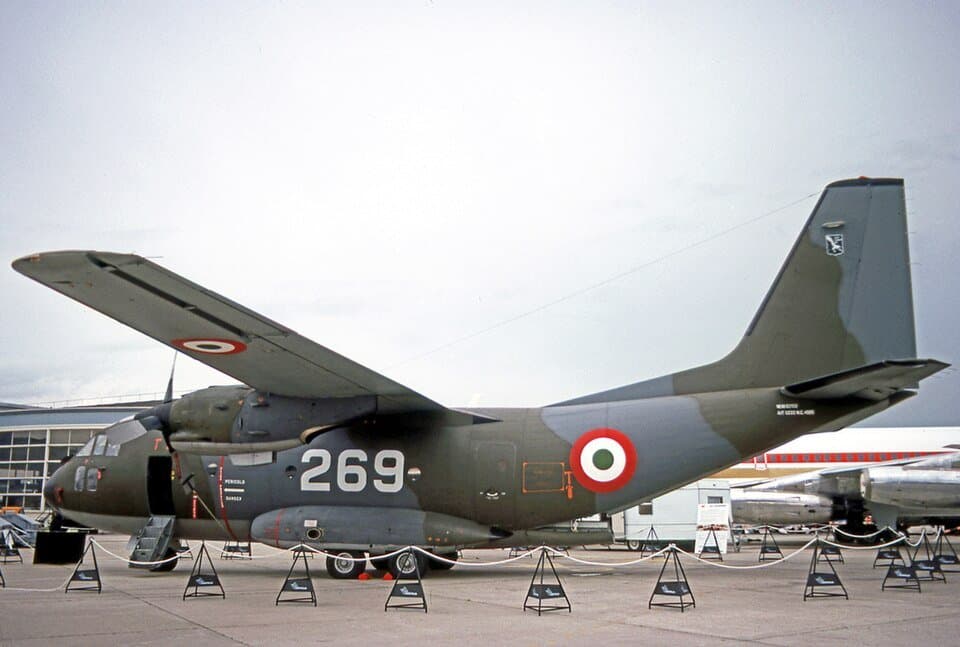
| Aeritalia G.222 | ≈ 22.7 m | ≈ 28.7 m (Width) | ≈ 9.8 m |
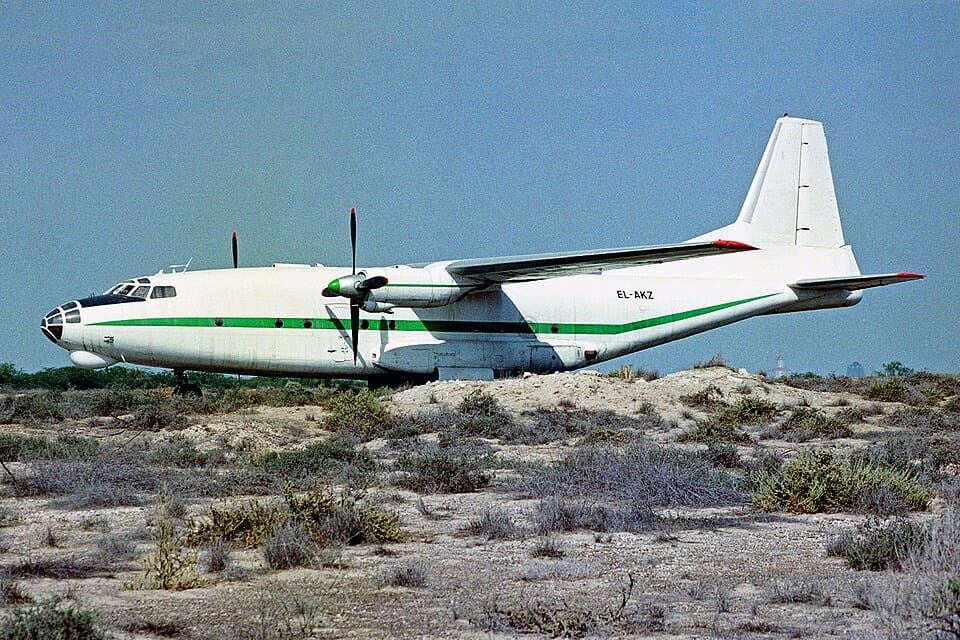
| Antonov An-8 | ≈ 26 m | ≈ 30 m (Width) | ≈ 9.7 m |
Scaled uniformly to the sourced length of 22.7 m. The shape was turned square to the axes; the height was fitted to the sourced 9.8 m; the width was fitted to the sourced 28.7 m. Not an official model or a measured survey.
ForceTally · All rights reserved
Scaled uniformly to the sourced length of 26 m. The shape was turned square to the axes; the height was fitted to the sourced 9.7 m; the width was fitted to the sourced 30 m. Not an official model or a measured survey.
ForceTally · All rights reserved
The human reference is a generic 1.75 m figure. Models describe external size, not combat performance.
Measured figures
G.222 · Length
Single source22.7 m (74 ft 6 in)[source]
Length
Single sourceConfiguration
| Specification | Aeritalia G.222 | Antonov An-8 |
|---|---|---|
| Type | Military transport aircraft[source] | Military transport aircraft[source] |
| Manufacturer | Fiat / Aeritalia / Alenia Aeronautica[source] | Antonov[source] |
| Status | Retired[source] | One in service with Uhuru Airlines[source] |
| Primary users | Italian Air Force (historical) Nigerian Air Force Argentine Army Aviation (historical)[source] |
26 m (85 ft 4 in)[source]
Cruise; G.222 · at 6,000 m (20,000 ft) at Max TO weight
Single sourceMaximum; G.222 · at 4,575 m (15,010 ft) at Max TO weight
Single source540 km/h (340 mph, 290 kn) at 4,575 m (15,010 ft) at Max TO weight[source]
439 km/h (273 mph, 237 kn) at 6,000 m (20,000 ft) at Max TO weight[source]
Cruise; Cruise speed
Single sourceMaximum; Maximum speed
Single sourceFerry; G.222 · with maximum fuel
Single sourceG.222 · with max. payload at optimum cruising speed and height
Single source1,371 km (852 mi, 740 nmi) with max. payload at optimum cruising speed and height[source]
4,633 km (2,879 mi, 2,502 nmi) with maximum fuel[source]
Range
Single source2,780 km (1,730 mi, 1,500 nmi)[source]
G.222 · 2 × General Electric T64-GE-P4D turboprop engines each at ISA + 25 °C (77 °F)
Single source2 × General Electric T64-GE-P4D turboprop engines, 2,535 kW (3,399 hp) each at ISA + 25 °C (77 °F)[source]
2 × Ivchenko AI-20D turboprop engines (5,180 shp) each
Single source2 × Ivchenko AI-20D turboprop engines, 3,860 kW (5,180 shp) each[source]
Wing area
Single source117.2 m 2 (1,262 sq ft)[source]
Bars compare reported quantities only. A larger figure does not make a system better; configurations and test conditions differ.
Soviet Air Force Aeroflot[source] |
| Number built | 111[source] | ~151[source] |
|---|
| Manufactured | 1970–1993[source] | 1956-1961[source] |
|---|
| Introduction date | April 1978[source] | 1958[source] |
|---|
| First flight | 18 July 1970[source] | 11 February 1956[source] |
|---|
| Retired | 2012 ( Afghan Air Force )[source] | — |
|---|
| Developed into | Alenia C-27J Spartan[source] | Antonov An-10[source] |
|---|
| Capacity | 53 fully-equipped troops / 40 fully-equipped paratroops / 9,000 kg (20,000 lb) max. payload[source] | 48 persons / 11,000 kg (24,000 lb) max payload[source] |
|---|
| Aspect ratio | 9.15:1[source] | 11.7[source] |
|---|
| Airfoil | NACA 64A315.2[source] | — |
|---|
| Fuel capacity | 12,000 L (3,200 US gal; 2,600 imp gal) in four integral wing tanks[source] | — |
|---|
| Propellers | 3-bladed Hamilton Standard 63E60-27, 4.42 m (14 ft 6 in) diameter constant-speed fully reversilble-pitch constant-speed propellers[source] | 4-bladed constant-speed propellers[source] |
|---|
| Airdrop speed | 204–259 km/h (127–161 mph; 110–140 kn) (paratroops and cargo)[source] | — |
|---|
| Stall speed | 155 km/h (96 mph, 84 kn) flaps and landing speed down[source] | — |
|---|
| Service ceiling, one engine out | 5,000 m (16,000 ft)[source] | — |
|---|
| Time to altitude | 4,500 m (14,800 ft) 8 minutes 35 seconds[source] | — |
|---|
| Wing loading | 341.5 kg/m 2 (69.9 lb/sq ft)[source] | — |
|---|
| Power/mass | 5.52 kg/kW (9.07 lb/hp)[source] | — |
|---|
| Take-off run | 662 m (2,172 ft)[source] | — |
|---|
| Take-off run to 15 m (49 ft) | 1,000 m (3,300 ft)[source] | — |
|---|
| Landing run at max landing weight | 545 m (1,788 ft)[source] | — |
|---|
| Landing run from 15 m (49 ft) | 775 m (2,543 ft)[source] | — |
|---|
| Role | medium-sized STOL military transport aircraft[source] | — |
|---|
| Source measurement | Various export customers emerged for the type during the 1980s and 1990s. Libyan efforts to purchase 20 G.222s were initially vetoed by United States ; Libya later procured a version of the aircraft without US-made equipment present instead. The United States purchased 10 G.222s in the 1990s, designating the type C-27A Spartan . During the 2000s, as the Italian Air Force withdrew their original G.222s due to their advancing age, these aircraft were commonly refurbished and subsequently sold onto other nations; via this approach, several G.222s were dispatched to Afghanistan during the War in Afghanistan .[source]Aeritalia G.222 · Lead; only the objects and conditions stated in this passage On 18 July 1970, the first prototype performed the aircraft's maiden flight with test pilot Vittorio Sanseverino at the controls. By late April 1971, the prototype had reportedly conducted a total of 22 flights and accumulated 50 hours of flight time, during which its performance was claimed to have been highly close to predictions. In December 1971, the Italian Air Force, who had placed a provisional order for the developing type, formally began evaluating the G.222 and the performance of the two prototypes then in service. Following a successful testing period, the AMI contract for 44 aircraft was issued to Aeritalia (of which Fiat Aviazione had since become a part). In December 1975, the first production aircraft conducted its first flight. In April 1978, this same aircraft formally entered service with the AMI. Following on from its introduction by the AMI, the G.222 was procured as a tactical transport aircraft by various international customers, including Argentina , Nigeria , Somalia , Venezuela and Thailand .[source]Aeritalia G.222 · Development / Origins; only the objects and conditions stated in this passage In 1977, Libya sought the purchase of 20 G.222s; this was vetoed by the U.S. Government , who had imposed an embargo on military arms and equipment to Libya, which included the G.222's T64 engines. To get around this restriction, Aeritalia developed a version of the G.222 powered by the Rolls-Royce Tyne engine and other US supplied equipment was replaced by European equivalents; the more powerful Tyne engine also reportedly gave this variant superior "hot and high" performance. The provision of alternative powerplants was viewed by Aeritalia as a measure to widen the overall appeal of the G.222; the Tyne engine also reportedly possessed greater growth potential than the T64 engine. In May 1980, the first G.222 equipped with the Tyne engine performed its maiden flight . Libya placed an order for 20 Tyne-powered aircraft instead, with deliveries commencing from 1980.[source]Aeritalia G.222 · Development / Further development; only the objects and conditions stated in this passage In order to extend the effective operational lifespan of the type, some operators have carried out extensive upgrade programs of the G.222. In the aftermath of Italian humanitarian missions in Bosnia and Somalia , in 1996 the AMI began undertaking a major update program on their G.222 fleet; modifications include cockpit lighting changes for compatibility with Night Vision Goggles to enable night operations, increasing the aircraft's self-defense capabilities, new communications and navigation systems, and the removal of obsolete equipment. In July 2005, the Nigerian Air Force signed a $74.5 million contract with Alenia Aeronautica for the refurbishment of a total of five G.222s, as well as the purchase of a retired AMI G.222.[source]Aeritalia G.222 · Development / Further development; only the objects and conditions stated in this passage In 1990, the United States Air Force selected the G.222 as the basis of a "Rapid-Response Intra-Theater Airlifter" (RRITA). Operated under the designation C-27A Spartan , ten G.222s were purchased and underwent avionics upgrades by Chrysler Aerospace . These aircraft were stationed at Howard AFB , Panama . The USAF would later dispose of their C-27A fleet, partly due to shifting priorities between the Army and the Air Force and partly because of the impending introduction of a newer variant, the Alenia C-27J Spartan .[source]Aeritalia G.222 · Development / Further development; only the objects and conditions stated in this passage The G.222 is a twin turboprop -engine tactical military transport aircraft, and is designed to be capable of transporting equipment or troops in combat zones and operating with minimal ground support. Early production aircraft were exclusively fitted with the General Electric T64-GE-P4D turboprop engine, the licence-built Rolls-Royce Tyne was made available as an alternative powerplant for the type from 1980 onwards, while the Allison T56 was another proposed powerplant for the type. Due to features such as double-slotted flaps, stacked brakes, and reversible propellers, the G.222 has excellent short landing capabilities and is able to land in as little as 1,800 feet. It was designed to be integrated with the larger, commonplace Lockheed C-130 Hercules .[source]Aeritalia G.222 · Design; only the objects and conditions stated in this passage The G.222's cargo deck can carry up to 9,000 kg (19,840 lb) of cargo, or alternatively up to 53 troops, or 32 paratroopers, or a maximum of 36 stretchers with six attending medics in a medevac capacity. The cargo deck has a large rear ramp, allowing the loading of palletised goods and vehicles, as well as sliding doors on either side of the fuselage, which are capable of being used to deploy paratroopers . Various pallet-based special mission equipment could be readily installed to enhance the aircraft's capabilities for diverse roles such as VIP transport, maritime patrol , aerial firefighting , and calibration functions; this equipment could also be removed quickly in order for aircraft to be returned to conventional transport missions. To easily facilitate the loading of a wide range of cargos, the height of the landing gear can be manually controlled.[source]Aeritalia G.222 · Design; only the objects and conditions stated in this passage The G.222 has seen considerable service in air relief and military supply operations. From 1979 onwards, Italy, along with other Western nations, provided considerable military aid to Somalia , part of the Italian contribution was four G.222s. In 1982, three Ejército Argentino G.222s were operational during the Falklands War , and may have participated in a logistical capacity. In 1983, a single Italian Air Force G.222 was outfitted for fire suppression duties, alongside an existing C-130 in the same role.[source]Aeritalia G.222 · Operational history; only the objects and conditions stated in this passage On 3 September 1992, an Italian Air Force ( Aeronautica Militare Italiana ) G.222 was shot down when approaching Sarajevo airfield while conducting a United Nations relief mission. It crashed 18 miles (29 km) from the airfield; a NATO rescue mission was aborted when 2 USMC CH-53 helicopters came under small arms fire. The cause of the crash was determined to be a surface-to-air missile, but it was not clear who shot it. Everyone on board – four Italian crew members and four French passengers – died in the crash.[source]Aeritalia G.222 · Operational history; only the objects and conditions stated in this passage In November 1999, the Italian Air Force placed an initial order for twelve new-build aircraft of an upgraded G.222 derivative, designated as the C-27J, as a replacement for their existing G.222s. In December 2002, Alenia Aermacchi agreed to purchase a total of 39 G.222s that had been previously operated by the Italian Air Forces under a trade-in arrangement as part of the agreed C-27J purchase. In 2005, the Italian Air Force started the phased retirement of their G.222 fleet. Several of the former Italian Air Force G.222s have been refurbished to operational conditions and resold by Alenia Aermacchi, the Nigerian Air Force became the first customer for these refurbished aircraft.[source]Aeritalia G.222 · Operational history; only the objects and conditions stated in this passage In September 2008, Alenia North America was awarded a USAF contract to upgrade and refurbish 18 G.222s, to be transferred to and used by the Afghan Air Force . Ballistic protection, adaptations for serving in the conditions of Afghanistan, and many new avionics systems, including a digital auto-pilot, were installed; two aircraft were also configured for VIP transport duties. On 28 April 2010, the first two of the Afghan Air Force's recently delivered G.222s made their first public display during the Mujahideen Victory Day . In January 2013, the USAF decided not to renew the support contract for the Afghan fleet due to claimed serviceability issues and operational difficulties; Alenia responded, stating that the fleet was exceeding the requirements laid out by the USAF, with 10–12 aircraft available for operations against the requirement for six.[source]Aeritalia G.222 · Operational history; only the objects and conditions stated in this passage The 16 G.222s delivered to Afghanistan were scrapped in the summer of 2014 by the Defense Logistics Agency . After the U.S. spent $486 million to buy 20 C-27As, 16 were sold as scrap to an Afghan construction company for about $32,000; the planes were reportedly scrapped "to minimize impact on drawdown of U.S. forces in Afghanistan." The four remaining aircraft are stored at Ramstein Air Base , Germany, with the U.S. seeking other interested buyers. From January to September 2012, the Afghan C-27A fleet flew only 234 out of 4,500 required hours. The C-17A fleet had been procured for their keep attributes to enable them to operate in Afghanistan terrain, they were former Italian G.222. However, they ended up being replaced by C-130H after maintenance difficulties.[source]Aeritalia G.222 · Operational history; only the objects and conditions stated in this passage Ten G.222s purchased for the United States Air Force .[source]Aeritalia G.222 · Variants; only the objects and conditions stated in this passage Italian Air Force operated 56 aircraft (44 G.222A, 4 G.222RM, 4 G.222SAA, 2 G.222TCM and 2 G.222VS). Officially retired in September 2005, but at least 1 G.222VS aircraft remained operational as of 2019.[source]Aeritalia G.222 · Operators; only the objects and conditions stated in this passage Capacity: 53 fully-equipped troops / 40 fully-equipped paratroops / 9,000 kg (20,000 lb) max. payload[source]Aeritalia G.222 · Specifications (G.222); only the objects and conditions stated in this passage Length: 22.7 m (74 ft 6 in)[source]Aeritalia G.222 · Specifications (G.222); only the objects and conditions stated in this passage Wingspan: 28.7 m (94 ft 2 in)[source]Aeritalia G.222 · Specifications (G.222); only the objects and conditions stated in this passage Height: 9.8 m (32 ft 2 in)[source]Aeritalia G.222 · Specifications (G.222); only the objects and conditions stated in this passage Empty weight: 14,590 kg (32,165 lb)[source]Aeritalia G.222 · Specifications (G.222); only the objects and conditions stated in this passage Max takeoff weight: 28,000 kg (61,729 lb)[source]Aeritalia G.222 · Specifications (G.222); only the objects and conditions stated in this passage Powerplant: 2 × General Electric T64-GE-P4D turboprop engines, 2,535 kW (3,399 hp) each at ISA + 25 °C (77 °F)[source]Aeritalia G.222 · Specifications (G.222); only the objects and conditions stated in this passage Propellers: 3-bladed Hamilton Standard 63E60-27, 4.42 m (14 ft 6 in) diameter constant-speed fully reversilble-pitch constant-speed propellers[source]Aeritalia G.222 · Specifications (G.222); only the objects and conditions stated in this passage Maximum speed: 540 km/h (340 mph, 290 kn) at 4,575 m (15,010 ft) at Max TO weight[source]Aeritalia G.222 · Specifications (G.222); only the objects and conditions stated in this passage Cruise speed: 439 km/h (273 mph, 237 kn) at 6,000 m (20,000 ft) at Max TO weight[source]Aeritalia G.222 · Specifications (G.222); only the objects and conditions stated in this passage Airdrop speed: 204–259 km/h (127–161 mph; 110–140 kn) (paratroops and cargo)[source]Aeritalia G.222 · Specifications (G.222); only the objects and conditions stated in this passage Stall speed: 155 km/h (96 mph, 84 kn) flaps and landing speed down[source]Aeritalia G.222 · Specifications (G.222); only the objects and conditions stated in this passage Range: 1,371 km (852 mi, 740 nmi) with max. payload at optimum cruising speed and height[source]Aeritalia G.222 · Specifications (G.222); only the objects and conditions stated in this passage Ferry range: 4,633 km (2,879 mi, 2,502 nmi) with maximum fuel[source]Aeritalia G.222 · Specifications (G.222); only the objects and conditions stated in this passage Service ceiling: 7,620 m (25,000 ft)[source]Aeritalia G.222 · Specifications (G.222); only the objects and conditions stated in this passage Service ceiling, one engine out: 5,000 m (16,000 ft)[source]Aeritalia G.222 · Specifications (G.222); only the objects and conditions stated in this passage Rate of climb: 8.667 m/s (1,706.1 ft/min)[source]Aeritalia G.222 · Specifications (G.222); only the objects and conditions stated in this passage Time to altitude: 4,500 m (14,800 ft) 8 minutes 35 seconds[source]Aeritalia G.222 · Specifications (G.222); only the objects and conditions stated in this passage Take-off run: 662 m (2,172 ft)[source]Aeritalia G.222 · Specifications (G.222); only the objects and conditions stated in this passage Take-off run to 15 m (49 ft): 1,000 m (3,300 ft)[source]Aeritalia G.222 · Specifications (G.222); only the objects and conditions stated in this passage Landing run at max landing weight: 545 m (1,788 ft)[source]Aeritalia G.222 · Specifications (G.222); only the objects and conditions stated in this passage Landing run from 15 m (49 ft): 775 m (2,543 ft)[source]Aeritalia G.222 · Specifications (G.222); only the objects and conditions stated in this passage | — |
|---|
| Country of origin | Italy[source]Inventory Origin column; table 29, row 15, cell 3; revision 1364221460 | Soviet Union[source] Soviet Union[source] |
|---|
| Guns | — | One 23 mm cannon in the tail turret.[source] |
|---|
| National origin | — | Soviet Union[source] |
|---|