

AI-generated illustration · Not a photograph
Credit
ForceTally · AI-generated illustration · Not a photograph · AI-generated · OpenAI output terms · Source ↗ · Modified


Preparing your view.

At a glance
A-100 (multiple rocket launcher)larger figure on 5 of 8
True scale
Side by side. From every angle. A human reference for perspective.
3.61 MB · Loads when you open it| Model | Length | Width / span | Height |
|---|---|---|---|
| A-100 (multiple rocket launcher) | ≈ 9 m | ≈ 3.3 m (Width) | ≈ 2.98 m |
| Astros II | ≈ 7 m | ≈ 2.74 m (Width) | ≈ 2.68 m |
Scaled uniformly to the sourced length of 9 m. Not an official model or a measured survey.
ForceTally · All rights reserved
Scaled uniformly to the sourced length of 7 m. The shape was turned square to the axes. Not an official model or a measured survey.
ForceTally · All rights reserved
The human reference is a generic 1.75 m figure. Models describe external size, not combat performance.
Measured figures
Length
Single source9 m (29 ft 6 in)[source]
Length
Single sourceConfiguration
| Specification | A-100 (multiple rocket launcher) | Astros II |
|---|---|---|
| Type | Multiple rocket launcher[source] | Multiple rocket launcher[source] |
| Place of origin | China[source] | Brazil[source] |
| In service | 2000-present[source] | 1983-present[source] |
| Wars | Operation Marg Bar Sarmachar[source] | Iran–Iraq War Gulf War Angolan Civil War Yemeni Civil War (2015–present) Military Intervention in Yemen |
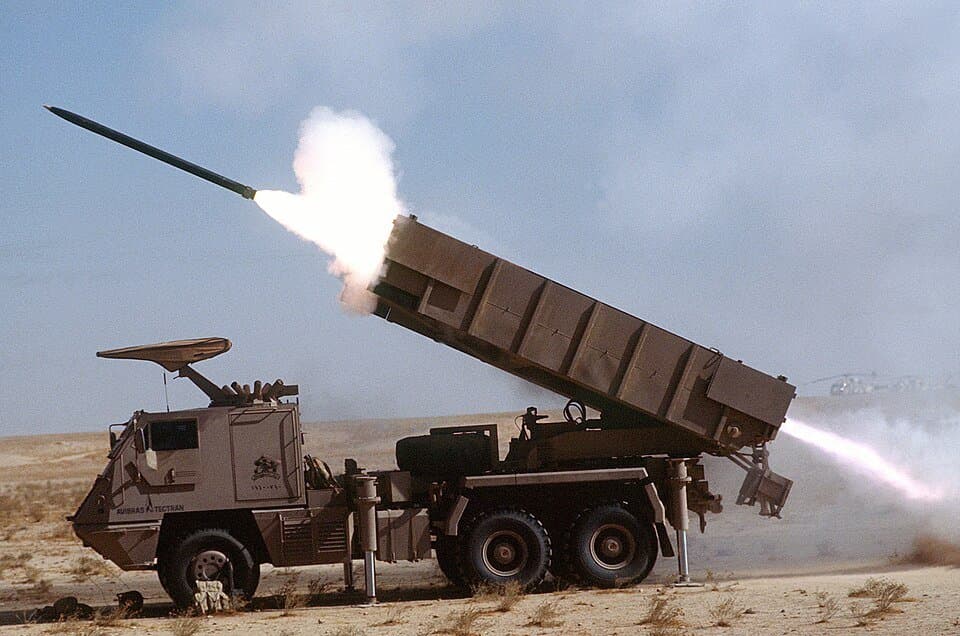
Astros IIlarger figure on 3 of 8
Counts only measures both sources give with the same scope. A larger figure is not a better system.
7 m (20 ft)[source]
Bars compare reported quantities only. A larger figure does not make a system better; configurations and test conditions differ.
| Designer | China Academy of Launch Vehicle Technology[source] | — |
|---|
| Designed | 1997-2000[source] | — |
|---|
| Manufacturer | China Academy of Launch Vehicle Technology[source] | Avibras[source] |
|---|
| Barrels | 10[source] | — |
|---|
| Main armament | Rockets[source] | Universal Multiple Launcher Module 127–450 mm[source] |
|---|
| Suspension | 8×8 wheeled[source] | 6×6[source] |
|---|
| Used by | — | See Operators[source] |
|---|
| No. built | — | 270+[source] |
|---|
| Shell | — | Rocket length: 4.20 m (13 ft 9 in) Rocket weight: 152 kg (335 lb)[source] |
|---|
| Secondary armament | — | 1 × 12.7 mm M2 Browning machine gun[source] |
|---|
| Armament | — | one battery of 2, 4, 16 or 32 rocket-launcher tubes[source] |
|---|
| Role | — | self-propelled multiple rocket launcher[source] |
|---|
| Source measurement | — | Astros II ( A rtillery S a T uration RO cket S ystem) is a self-propelled multiple rocket launcher produced in Brazil by the Avibras company. It features modular design and employs rockets with calibers ranging from 127 to 450 mm (5–17.72 inches). It was developed on the basis of a Tectran VBT-2028 6×6 all-terrain vehicle for enhanced mobility based on Mercedes-Benz 2028 truck chassis while later versions use Tatra 815-7 chassis.[source]Astros II · Lead; only the objects and conditions stated in this passage In the 1980s and early 1990s, Avibrás manufactured almost exclusively rockets and multiple-launch rocket systems (MLRS), such as the Astros II, in addition to developing antitank and antiship missiles. At its peak, Avibrás employed 6,000 people; later it would be reduced to 900 people in the early 1990s as the arms industry demand fell. Even so, in the first Gulf War in 1991, the Astros II was successfully used by Saudi Arabia against Iraq. The Astros II system was also procured by Angola during the 1990s, for use against UNITA guerillas.[source]Astros II · Service history; only the objects and conditions stated in this passage It will be integrated with the cruise missile AVMT-300 with 300-km range during the stage of testing and certification.[source]Astros II · New generation; only the objects and conditions stated in this passage The Astros 2020 will also be equipped with a 180 mm GPS -guided rocket called the SS-AV-40G with a range of 40 km (25 mi) and SS-150 newly developed rockets with a claimed maximum range of 150 km.[source]Astros II · New generation; only the objects and conditions stated in this passage SS-09TS – fires 70 mm rockets – Loads 40[source]Astros II · Rocket variants; only the objects and conditions stated in this passage SS-30 – fires 127 mm rockets – Loads 32[source]Astros II · Rocket variants; only the objects and conditions stated in this passage SS-40 – fires 180 mm rockets – Loads 16[source]Astros II · Rocket variants; only the objects and conditions stated in this passage SS-40G – fires 180 mm rockets – Loads 16 (GPS Guided)[source]Astros II · Rocket variants; only the objects and conditions stated in this passage SS-60 – fires 300 mm rockets – Loads 4[source]Astros II · Rocket variants; only the objects and conditions stated in this passage SS-80 – fires 300 mm rockets – Loads 4[source]Astros II · Rocket variants; only the objects and conditions stated in this passage SS-80G – fires 300 mm rockets – Loads 4 (GPS Guided)[source]Astros II · Rocket variants; only the objects and conditions stated in this passage SS-150 – fires 450 mm rockets – Loads 4 (GPS Guided)[source]Astros II · Rocket variants; only the objects and conditions stated in this passage MANSUP – fires 330 mm anti-ship missile – Loads 2[source]Astros II · Rocket variants; only the objects and conditions stated in this passage AV-TM 300 – fires 450 mm cruise missile – Loads 2[source]Astros II · Rocket variants; only the objects and conditions stated in this passage Range in indirect fire mode (first figure is minimum range): SS-09TS: 4–10 km SS-30: 9–30 km SS-40: 15–40 km SS-40G: 15–40 km SS-60: 20–60 km SS-80: 22–90 km SS-80G: 22–90 km SS-150: 29–150 km MANSUP : 70–200 km AV-TM 300 : 30–300 km FOG MPM: 5–60 km[source]Astros II · Specifications; only the objects and conditions stated in this passage Performance: fording 1.1 m vertical obstacle 1 m trench 2.29 m[source]Astros II · Specifications; only the objects and conditions stated in this passage |
|---|
| Reported operators |
|
|---|