
Credit
Photographer's Mate 1st Class Richard J. Brunson · Public domain · Resized · Public domain · Source ↗ · Modified


Preparing your view.

At a glance
5-inch/54-caliber Mark 45 gunlarger figure on 0 of 1
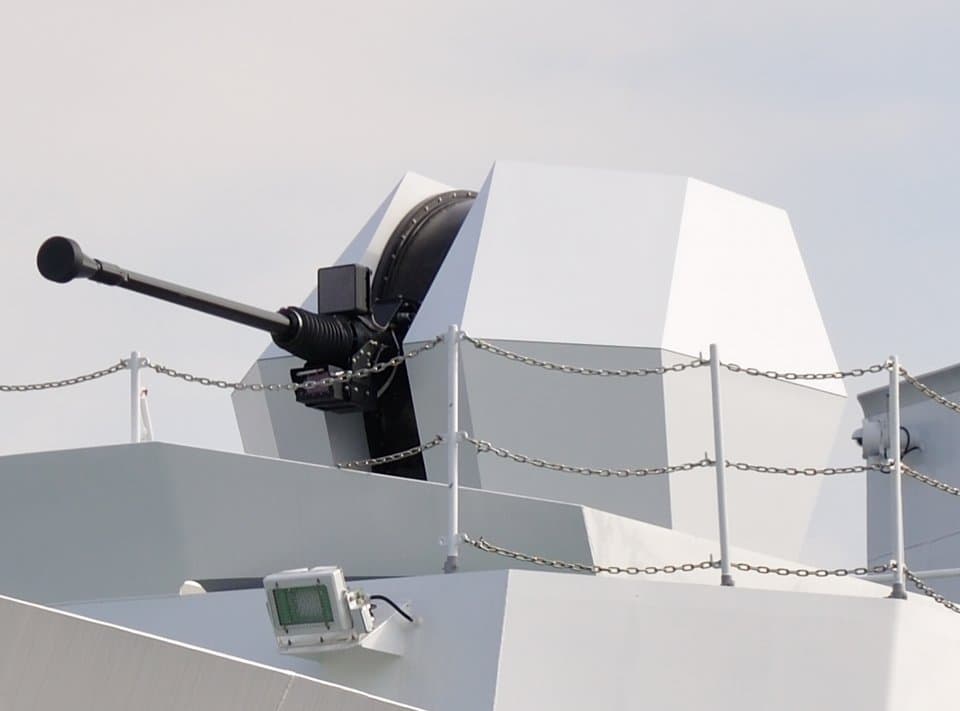
Bofors 40 Mk4larger figure on 1 of 1
Counts only measures both sources give with the same scope. A larger figure is not a better system.
Measured figures
Configuration
| Specification | 5-inch/54-caliber Mark 45 gun | Bofors 40 Mk4 |
|---|---|---|
| Crew | — | remote controlled with gyro-stabilised local control back-up[source] |
| Type | Naval gun[source] | Naval gun[source] |
| Place of origin | United States[source] | Sweden[source] |
| In service | 1971–present Mod 0: 1971 Mod 1: 1980 Mod 2: 1988 Mod 4: 2000[source] | 2012–present |
Barrel length
Single sourceMod 4
Single sourceRifling
Single source6.858 m (22 ft 6.0 in) Rifling: 5.82 m (19 ft 1 in) Mod 4: 7.874 m (25 ft 10.0 in)[source]
Bars compare reported quantities only. A larger figure does not make a system better; configurations and test conditions differ.
| Used by | See Operators[source] | See operators[source] |
|---|
| Designed | 1968[source] | — |
|---|
| Manufacturer | United Defense (now BAE Systems Land & Armaments )[source] | BAE Systems AB[source] |
|---|
| Produced | 1971[source] | 2009–present[source] |
|---|
| Shell | 127 × 835 mm .R Conventional: 31.75 kg (70.0 lb)[source] | 40 × 365 cartridge weight 2.5 kilograms (5.5 lb ) shell weight 0.975 kilograms (2.15 lb )[source] |
|---|
| Elevation | −15° to +65° Max. elevation rate: 20°/s[source] | −20°/+80°[source] |
|---|
| Traverse | ±170° from centerline Max. traversing rate: 30°/s[source] | 360°[source] |
|---|
| Source measurement | The 5-inch (127 mm)/54-caliber (Mk 45) lightweight gun is a U.S. naval artillery gun mount consisting of a 5 in (127 mm) L54 Mark 19 gun on the Mark 45 mount. The later 62-calibre-long version consists of a longer-barrel L62 Mark 36 gun fitted on the same Mark 45 mount. The gun is designed for use against surface warships, anti-aircraft and shore bombardment to support amphibious operations. The gun mount features an automatic loader with a capacity of 20 rounds which can be fired under full automatic control, taking a little over a minute at maximum fire rate. For sustained use, the gun mount would be occupied by a six-person crew (gun captain, panel operator, and four ammunition loaders) below deck to keep the gun continuously supplied with ammunition.[source]5-inch/54-caliber Mark 45 gun · Lead; only the objects and conditions stated in this passage Development started in the 1960s as a replacement for the 5-inch (127 mm)/54-caliber Mark 42 gun system that had debuted in 1953, with a new, lighter, and easier-to-maintain gun mounting . The United States Navy uses the Mark 45 with either the Mk 86 Gun Fire Control System or the Mk 34 Gun Weapon System .[source]5-inch/54-caliber Mark 45 gun · History; only the objects and conditions stated in this passage Since before World War II, 5 inches (127 mm) has been the standard gun caliber for U.S. Naval ships. Its rate of fire is lower than the British 4.5 in (114 mm) gun , but it fires a heavier 5-inch (127 mm) shell which carries a larger burst charge that increases its effectiveness against aircraft.[source]5-inch/54-caliber Mark 45 gun · History; only the objects and conditions stated in this passage In sustained firing operations (Mode III), the gun is operated by a six-person crew: a gun captain, a panel operator, and four ammunition loaders, all located below decks. In fully automatic non-sustained firing operations (Mode IV), 20 rounds can be fired without any personnel inside the mount, using an autoloader .[source]5-inch/54-caliber Mark 45 gun · Variants / Mod 4; only the objects and conditions stated in this passage Weight – 68.5 lb (31.1 kg)[source]5-inch/54-caliber Mark 45 gun · Ammunition; only the objects and conditions stated in this passage Projectile Length – 26.1 in (66.3 cm)[source]5-inch/54-caliber Mark 45 gun · Ammunition; only the objects and conditions stated in this passage Weight – 67.6 lb (30.7 kg)[source]5-inch/54-caliber Mark 45 gun · Ammunition; only the objects and conditions stated in this passage Projectile Length – 26 in (66 cm)[source]5-inch/54-caliber Mark 45 gun · Ammunition; only the objects and conditions stated in this passage Explosive filler: 8.2 lb (3.7 kg) Composition B[source]5-inch/54-caliber Mark 45 gun · Ammunition; only the objects and conditions stated in this passage Weight – 63.9 lb (29.0 kg)[source]5-inch/54-caliber Mark 45 gun · Ammunition; only the objects and conditions stated in this passage Weight – 69.7 lb (31.6 kg)[source]5-inch/54-caliber Mark 45 gun · Ammunition; only the objects and conditions stated in this passage Weight – 68.6 lb (31.1 kg)[source]5-inch/54-caliber Mark 45 gun · Ammunition; only the objects and conditions stated in this passage Weight – 69.0 lb (31.3 kg)[source]5-inch/54-caliber Mark 45 gun · Ammunition; only the objects and conditions stated in this passage In May 2014, the U.S. Navy issued a request for information (RFI) for a guided 5-inch (127 mm) projectile capable of being fired from Mark 45 guns aboard Navy destroyers and cruisers. This RFI followed the cancellation of the Raytheon Extended Range Guided Munition program approximately six years earlier. The proposed munition was required to achieve at least twice the range of conventional unguided shells and support missions including Naval Surface Fire Support (NSFS)/land attack and enhanced anti-surface warfare (ASuW) against fast attack craft (FAC) and fast inshore attack craft (FIAC). A primary objective was to defeat swarming small-boat threats at extended ranges using a proximity fuse airburst fragmentation warhead capable of dispersing shrapnel over a wide area.[source]5-inch/54-caliber Mark 45 gun · Ammunition / Guided shell; only the objects and conditions stated in this passage By 2015, Naval Sea Systems Command was investigating the feasibility of firing a version of the hyper-velocity projectile (HVP), originally developed for Navy electromagnetic railgun systems, from conventional 5-inch deck guns. Employing HVP from existing platforms was intended to enhance engagement capability against land, air, and missile threats while allowing additional time for railgun development. The HVP concept also offered a potentially lower-cost alternative to missile interceptors, which can cost hundreds of thousands to millions of dollars per engagement. As of 2015, adapting HVP for conventional guns was not a formal program of record .[source]5-inch/54-caliber Mark 45 gun · Ammunition / Guided shell; only the objects and conditions stated in this passage When fired from conventional 5-inch guns, HVP rounds were expected to achieve velocities of approximately Mach 3—about half the velocity attained when fired from a railgun, but roughly twice that of standard naval gun projectiles. Although more expensive than unguided shells, HVPs were projected to be significantly less costly than missile interceptors, while providing engagement ranges against air and missile threats of approximately 10–30 nautical miles (12–35 mi; 19–56 km).[source]5-inch/54-caliber Mark 45 gun · Ammunition / Guided shell; only the objects and conditions stated in this passage In 2024, the Navy resumed developmental testing of the Hypervelocity Projectile, manufactured by BAE Systems USA. The HVP is a saboted projectile also being developed under a U.S. Army contract. While the Army variant uses a larger 155 mm sabot, the projectile body is common to both services; the Navy version employs a smaller 5-inch (127 mm) sabot compatible with Mk 45 guns.[source]5-inch/54-caliber Mark 45 gun · Ammunition / Guided shell; only the objects and conditions stated in this passage Indian Navy : The mod 4 variant was planned to be deployed on 7 Nilgiri-class frigate and 4 Visakhapatnam-class destroyer . The procurement of 13 guns was cleared by the Indian Ministry of Defence in April 2018. Of the guns, 11 would be deployed on the above-mentioned ships while 2 would be in the INS Dronacharya missile and gunnery school, and the INS Valsura electrical and weapons engineering school. The US Defense Security Cooperation Agency cleared under the Foreign Military Sales for the same deal in 2019. The deal would be worth over $1 billion. In 2021, India moved on to the development of an indigenous gun of similar calibre due to cost and logistics factor. Till the completion of the development, the 11 destroyers and frigates would be fitted with already operational OTO Melara 76 mm naval gun . The 13 gun deal for the Indian Navy did not go through.[source]5-inch/54-caliber Mark 45 gun · Operators / Cancelled deals; only the objects and conditions stated in this passage | — |
|---|
| Designer | — | BAE Systems AB[source] |
|---|
| Feed system | — | Magazine capacity : 100 ready rounds[source] |
|---|
| Reported operators | — |
|
|---|