FORCETALLY
Loading the evidence…
Preparing your view.


Preparing your view.
At a glance
37 mm gun M3larger figure on 0 of 6
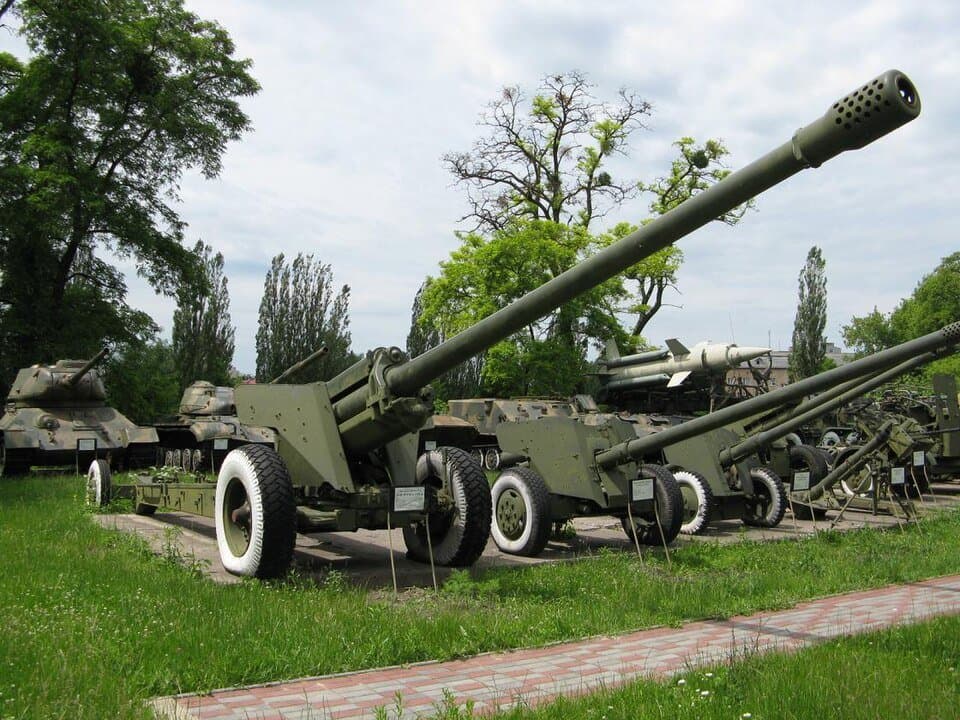
M-46 field gunlarger figure on 6 of 6
Measured figures
Length
Single source3.92 m (12 ft 10.3 in)[source]
Length
Single sourceConfiguration
| Specification | 37 mm gun M3 | M-46 field gun |
|---|---|---|
| Type | Anti-tank gun[source] | Towed field gun[source] |
| Place of origin | United States[source] | Soviet Union[source] |
| Used by | United States National Revolutionary Army Brazil French Indochina Viet Minh National Guard of Nicaragua[source] | — |
| Wars | World War II Second Sino-Japanese War First Indochina War Nicaraguan Revolution[source] | Vietnam War Cambodian Civil War Eritrean War of Independence South African Border War Six-Day War Yom Kippur War Ethiopian Civil War Angolan Civil War Uganda–Tanzania War Sino-Vietnamese conflicts (1979–1991) Lebanese Civil War Iran–Iraq War Sri Lankan Civil War First Nagorno-Karabakh War Yugoslav Wars Kosovo War Syrian Civil War Yemeni Civil War (2014–present) Second Nagorno-Karabakh War Tigray War Israeli–Lebanese conflict Russo-Ukrainian War |
Counts only measures both sources give with the same scope. A larger figure is not a better system.
11.73 m (38 ft 6 in)[source]
Bars compare reported quantities only. A larger figure does not make a system better; configurations and test conditions differ.
| Designed | 1938[source] | 1946–1950[source] |
|---|
| Manufacturer | Gun: Watervliet Arsenal , Carriage: Rock Island Arsenal[source] | MOTZ[source] |
|---|
| Produced | 1940–1943[source] | 1951–1971[source] |
|---|
| No. built | 18,702[source] | — |
|---|
| Shell | 37×223 mm. R[source] | 130 x 845 mm R (R/184.6mm) separate-loading charge and projectile[source] |
|---|
| Breech | Vertical sliding-block[source] | Horizontal sliding-wedge[source] |
|---|
| Recoil | Hydro-spring[source] | hydro-pneumatic[source] |
|---|
| Carriage | Split trail[source] | Split-trail[source] |
|---|
| Elevation | -10° to +15°[source] | −2.5° to 45°[source] |
|---|
| Traverse | 60°[source] | 50°[source] |
|---|
| Sights | telescopic, M6[source] | — |
|---|
| Role | first dedicated anti-tank gun fielded[source] | — |
|---|
| Source measurement | The 37 mm gun M3 is the first dedicated anti-tank gun fielded by United States forces in numbers. Introduced in 1940, it became the standard anti-tank gun of the U.S. infantry with its size enabling it to be pulled by a jeep . However, the continuing improvement of German tanks quickly rendered the 37 mm ineffective and, by 1943, it was being gradually replaced in the European and Mediterranean theaters by the more powerful British-developed 57 mm gun M1 . In the Pacific , where the Japanese tank threat was less significant, the M3 remained in service until the end of the war, but some 57mm guns were issued.[source]37 mm gun M3 · Lead; only the objects and conditions stated in this passage The inability of the 37 mm round to penetrate the frontal armor of mid-war tanks severely restricted the anti-armor capabilities of units armed with them.[source]37 mm gun M3 · Lead; only the objects and conditions stated in this passage In the mid-1930s, the United States Army had yet to field a dedicated anti-tank artillery piece; anti-tank companies of infantry regiments were armed with .50 in (12.7 mm) machine guns . Although some consideration had been given to replacing the machine guns with a more powerful anti-tank gun , the situation began to change only after the outbreak of the Spanish Civil War . Combat experience from Spain suggested that a light anti-tank gun, such as the German 37 mm PaK 35/36 , was capable of neutralizing the growing threat posed by tanks.[source]37 mm gun M3 · Development history; only the objects and conditions stated in this passage In January 1937, the Ordnance Committee recommended development of such a weapon; two PaK 36 guns were acquired for study. As the projected main user of the weapon, the Infantry Branch was chosen to oversee the work. They wanted a lightweight gun that could be moved around by the crew, so any ideas of using a larger caliber than that of the German gun were discarded. The 37 mm was a popular caliber of anti-tank guns in the 1930s; other anti-tank guns of the same caliber included Swedish Bofors gun , Czechoslovak vz. 34 and vz. 37 , Japanese Type 94 and Type 1 .[source]37 mm gun M3 · Development history; only the objects and conditions stated in this passage Development and testing continued until late 1938. Several variants of gun and carriage were proposed until on 15 December a combination of the T10 gun and T5 carriage was officially adopted as the 37 mm gun M3 and carriage M4. Although the weapon followed the concept of the PaK 36 and was often referred to as a copy of it, the M3 differed significantly from the German design and used different ammunition.[source]37 mm gun M3 · Development history; only the objects and conditions stated in this passage The gun was manufactured by Watervliet Arsenal and the carriage by Rock Island Arsenal . The first production examples of the M3 were delivered in July 1940. It took until August 1941 for production to accelerate, and some infantry antitank units were forced to use wooden mock-ups of the new gun or their original weapons ( 37 mm gun M1916 ) during the Louisiana Maneuvers and Carolina Maneuvers , and did not get their first weapons until late 1941. Production continued until October 1943.[source]37 mm gun M3 · Development history; only the objects and conditions stated in this passage In an attempt to increase the armor penetration of the M3, several squeeze bore adapters (including the British Littlejohn adaptor ) were tested; none was adopted. Experiments with rocket launchers on the M4 carriage (e.g. 4.5 in (110 mm) rocket projector T3) did not produce anything practical either.[source]37 mm gun M3 · Development history; only the objects and conditions stated in this passage Under the April 1942 organization, each infantry battalion had an anti-tank platoon with four 37 mm guns ( 1/4 ton trucks , better known as jeeps, were authorized as prime movers) and each regiment an anti-tank company with twelve (towed by 3/4 ton trucks ). Each of the four divisional artillery battalions possessed six anti-tank guns, the combat engineering battalion had nine pieces (towed by M2 halftracks ); in addition, the division's headquarters company had four (towed by 3/4 ton trucks) and the divisional maintenance company two.[source]37 mm gun M3 · Organization / US Army; only the objects and conditions stated in this passage In 1941, provisional antitank battalions had been formed from divisional or brigade anti-tank weapons (producing companies armed with 37 mm guns and 75 mm guns ), in December 1941, these battalions became permanent and were reorganized as independent tank destroyer battalions . The towed guns of many battalions were replaced with self-propelled ones as soon as the latter became available.[source]37 mm gun M3 · Organization / US Army; only the objects and conditions stated in this passage In 1942, the first airborne divisions were formed. According to their October 1942 organizational structure, an airborne division had 44 37 mm anti-tank guns: four in divisional artillery (AA/AT battery of parachute field artillery battalion), 24 in the AA/AT battalion, and eight in each of two glider infantry regiments; parachute infantry regiments did not have anti-tank guns. In practice, airborne divisions often had only one glider infantry regiment and therefore 36 guns.[source]37 mm gun M3 · Organization / US Army; only the objects and conditions stated in this passage 37 mm guns were also issued to the infantry regiments of the only mountain division formed in the U.S.: the 10th Mountain Division .[source]37 mm gun M3 · Organization / US Army; only the objects and conditions stated in this passage Finally, U.S. armored divisions under the March 1942 organization possessed 68 37 mm anti-tank guns. Of these, 37 belonged to the armored infantry regiment (four in each company and one in regiment HQ); 27 to the armored engineer battalion; three to the divisional train and one to division HQ.[source]37 mm gun M3 · Organization / US Army; only the objects and conditions stated in this passage Under the D-series Tables of Organization (TO) from 1 July 1942, the role of AT weapons in Marine Corps service was officially entrusted to 20 mm automatic guns, which were in the regimental weapons company (three platoons) and the battalion weapons company (one platoon). In practice, units used the World War I-era 37 mm M1916 for training. They were equipped with the M3 (four in each platoon) before being sent to the frontline. Additionally, a divisional special weapons battalion was equipped with self-propelled 37 mm GMC M6 .[source]37 mm gun M3 · Organization / US Marine Corps; only the objects and conditions stated in this passage Under the E-series TO from 15 April 1943, self-propelled guns in the divisional special weapons battalion were replaced with eighteen 37 mm towed guns in three batteries of six; an infantry regiment had a weapons company with 12, in three platoons of four. The battalion-level AT guns were removed. In total, a division possessed 54 pieces. The F-series TO from 5 May 1944 removed the special weapons battalion from the divisional organization, resulting in a total of 36 guns per division. The subsequent G-series TO reduced regimental weapons companies to two platoons, meaning 24 pieces per division. Although the G-series TO was only adopted on 4 September 1945, in practice in some divisions this change was introduced early in 1945.[source]37 mm gun M3 · Organization / US Marine Corps; only the objects and conditions stated in this passage The light weight of the gun made it easy to move through difficult terrain; for example, when attacked by Japanese tanks on Betio during the Battle of Tarawa , Marines were able to heave the M3 over the 5 ft (1.5 m)-high seawall.[source]37 mm gun M3 · Combat service / As an infantry anti-tank gun; only the objects and conditions stated in this passage The experience of the M3 in the North African Campaign was completely different. The gun was not powerful enough to deal with late production German Panzer III and IV tanks. After the nearly disastrous Battle of Kasserine Pass in February 1943, reports from some of the involved units mentioned 37 mm projectiles "bouncing off like marbles" from the turret and front armor of German medium tanks and proclaimed the gun "useless unless you have gun crews with the guts to stand and shoot from 100 yards". The Army was initially uncertain if these reports reflected the obsolescence of the weapon, or whether unrefined tactics and lack of experience were to blame. Yet, on 26 May 1943, a new organization had the M3 replaced by the 57 mm Gun M1 (the U.S.-produced version of the British 6-pounder gun ), with Dodge 1½ ton trucks as prime movers. Only by spring 1944 did the 57 mm gun reach the battlefield in large numbers.[source]37 mm gun M3 · Combat service / As an infantry anti-tank gun; only the objects and conditions stated in this passage Meanwhile, the Italian campaign was launched, and M3 guns saw action from the day of the Sicily landing on 10 July 1943. That day the 37 mm guns demonstrated once again both their effectiveness against pre-war tanks—when they helped to repel an attack by Italian Renault R 35s —and inability to cope with modern threats in a subsequent encounter with Tiger Is from the Hermann Göring division . The Italian theater had a lower priority for reequipment than Northwest Europe, and some M3s were still in use in Italy in late 1944.[source]37 mm gun M3 · Combat service / As an infantry anti-tank gun; only the objects and conditions stated in this passage By mid-1944, the M3 had fallen out of favor even with airborne troops, despite their strong preference for compact and lightweight weapon systems. The Airborne Command had rejected the 57 mm M1 in the summer of 1943 claiming its unfitness for airlifting and the Table of Organisation and Equipment (TO&E) of February 1944 still had airborne divisions keeping their 37 mm guns. Nevertheless, the 82nd and 101st Airborne Divisions were reequipped with British-manufactured 6-pounder gun (57 mm) on carriage Mk III (designed to fit into the British Horsa glider ) for the Normandy airdrops . This change was officially introduced in the TO&E of December 1944.[source]37 mm gun M3 · Combat service / As an infantry anti-tank gun; only the objects and conditions stated in this passage The 37mm gun is essentially an antimechanized weapon... 37mm guns will be disposed to protect the flanks and rear of the (Cavalry Reconnaissance) Squadron against mechanized attack and also, in the base of fire, to support the attack. Armor-piercing ammunition is effective against mechanized vehicles, matérial, and weapons. High Explosive ammunition is effective against personnel, light matérial, automatic weapons, and mortars.[source]37 mm gun M3 · Combat service / As a tank gun; only the objects and conditions stated in this passage The 37 mm gun was used as the primary armament for M3/M5 Stuart light tanks and M8 Greyhound armored cars. AP rounds from these guns could defeat light enemy armor, including all Japanese and Italian armor, German half-tracks and armored cars, and most surfaces of tanks and early self-propelled guns based on the German Panzer II, Panzer III, and early Panzer IV chassis, but were useless against later Panzer IV, Panzer VI (Tiger) tanks and the frontal armor of Panzer V (Panther) tanks. It was also similarly useless against later, more heavily armored self-propelled guns and Jagdpanzer tank destroyers. The HE rounds were not powerful enough for effective infantry support in most situations. The rounds were enough, however, to attack enemy light reconnaissance units, and both the M3/M5 Stuart and M8 Greyhound were restricted to reconnaissance for the majority of the war in Europe. Canister rounds were often used to good effect against Japanese infantry in many battles, such as Bloody Ridge.[source]37 mm gun M3 · Combat service / As a tank gun; only the objects and conditions stated in this passage There were also serious issues with the gun's ability to function effectively in the infantry support role. The 37mm HE round had 39 grams (0.085 lb) of TNT, producing an explosive power of 161 Kilojoules. By way of contrast, the HE round from a Sherman 75mm gun had 667 grams (1.47 lb) of TNT, producing 2790 Kilojoules, while the modern 40mm shell from M203 grenade launchers has 32 grams (0.07 lb) of Comp B, producing an explosive power of 134 Kilojoules.[source]37 mm gun M3 · Combat service / As a tank gun; only the objects and conditions stated in this passage At least in one case, Fifth Army Ordnance in Italy fitted the gun experimentally with fifteen 4.5 in (110 mm) aircraft rockets, in five clusters of three, mounted above the shield.[source]37 mm gun M3 · Variants; only the objects and conditions stated in this passage Variants of the M3 should not be confused with other 37 mm guns in the U.S. service. Those other pieces included the M1916 infantry gun of French design (these were later used extensively as subcaliber devices for heavy artillery.), M1 antiaircraft autocannon, M4/M9/M10 aircraft-mounted autocannons, M12/M13/M14/M15 subcaliber guns.[source]37 mm gun M3 · Variants; only the objects and conditions stated in this passage Two tank gun variants were developed based on the barrel of the M3. The first, initially designated M3A1 but renamed M5 on 13 October 1939, was shortened by 5.1 in (130 mm) to avoid damage to the tube in wooded areas. Later, a variant with a semi-automatic breech (with empty cartridge ejection) was developed. This variant—initially designated M5E1 , adopted as M6 on 14 November 1940—received a full length barrel. The tubes were interchangeable, but replacing M5 with M6 and vice versa would result in an unbalanced mount and was therefore prohibited. These guns were mounted on several models of tanks and other armored vehicles:[source]37 mm gun M3 · Self-propelled mounts; only the objects and conditions stated in this passage 37 mm gun motor carriage T22 – eventually light armored car M8 : M6 in mount M23A1; the competing designs 37 mm gun motor carriage T43 / light armored car T21 and 37 mm gun motor carriage T23 / light armored car T23 mounted the same weapon.[source]37 mm gun M3 · Self-propelled mounts; only the objects and conditions stated in this passage The first pilot of the armored car T18 : M6. The production variant T18E2 received the 57 mm M1.[source]37 mm gun M3 · Self-propelled mounts; only the objects and conditions stated in this passage Versions of the gun in turret mounts were also used in the Medium Tank T5 Phase III (T3 barrel, mount T1), in the Medium Tank M2 / M2A1 (M3 barrel, M2A1: mount M19), and in the 37 mm gun motor carriage T42 (mount M22).[source]37 mm gun M3 · Self-propelled mounts; only the objects and conditions stated in this passage In addition, the M3 on different pedestal mounts was mated to a number of other vehicles, resulting in an assortment of 37 mm gun motor carriages. Only the M6 reached mass production.[source]37 mm gun M3 · Self-propelled mounts; only the objects and conditions stated in this passage 37 mm gun motor carriage T2 ( Bantam jeep ).[source]37 mm gun M3 · Self-propelled mounts; only the objects and conditions stated in this passage 37 mm gun motor carriage T8 (Ford 4x4 "Swamp Buggy").[source]37 mm gun M3 · Self-propelled mounts; only the objects and conditions stated in this passage 37 mm gun motor carriage T13, T14 (Willys 6x6 "Super Jeep").[source]37 mm gun M3 · Self-propelled mounts; only the objects and conditions stated in this passage 37 mm gun motor carriage T21 / M4 / M6 (Fargo 3/4 ton 4x4 truck).[source]37 mm gun M3 · Self-propelled mounts; only the objects and conditions stated in this passage 37 mm gun motor carriage T33 (Ford 3/4 ton 4x4 cargo carrier).[source]37 mm gun M3 · Self-propelled mounts; only the objects and conditions stated in this passage The gun was sometimes mounted on M2 half-track , M29 Weasel and on the 1/4 ton Willys MB / Ford GPW jeep (see photo on the right).[source]37 mm gun M3 · Self-propelled mounts; only the objects and conditions stated in this passage Armor penetration of the M5 was about 3 mm less at all ranges.[source]37 mm gun M3 · Ammunition; only the objects and conditions stated in this passage Dodge WC-4 prime movers with 37mm gun.[source]37 mm gun M3 · Gallery; only the objects and conditions stated in this passage 37mm with its prime mover ready for inspection.[source]37 mm gun M3 · Gallery; only the objects and conditions stated in this passage 37mm and Dodge WC-4 in action.[source]37 mm gun M3 · Gallery; only the objects and conditions stated in this passage Philippine Scouts at Fort William McKinley firing a 37 mm gun in training. Note the lowered wheel segments.[source]37 mm gun M3 · Gallery; only the objects and conditions stated in this passage A dug in 37 mm gun at Camp Carson .[source]37 mm gun M3 · Gallery; only the objects and conditions stated in this passage U.S. 37 mm gun crew in action, Saipan , 1944. From left to right are two ammunition carriers, gunner and assistant gunner. Note extended shield.[source]37 mm gun M3 · Gallery; only the objects and conditions stated in this passage | — |
|---|
| Country of origin | United States[source]Inventory Origin column; table 6, row 6, cell 4; revision 1372378584; retrieved 2026-10-02 | — |
|---|
| Reported operators | — |
|
|---|