
Credit
Vitaly V. Kuzmin · CC BY-SA 4.0 · Resized · CC BY-SA 4.0 · Source ↗ · Modified


Preparing your view.

At a glance
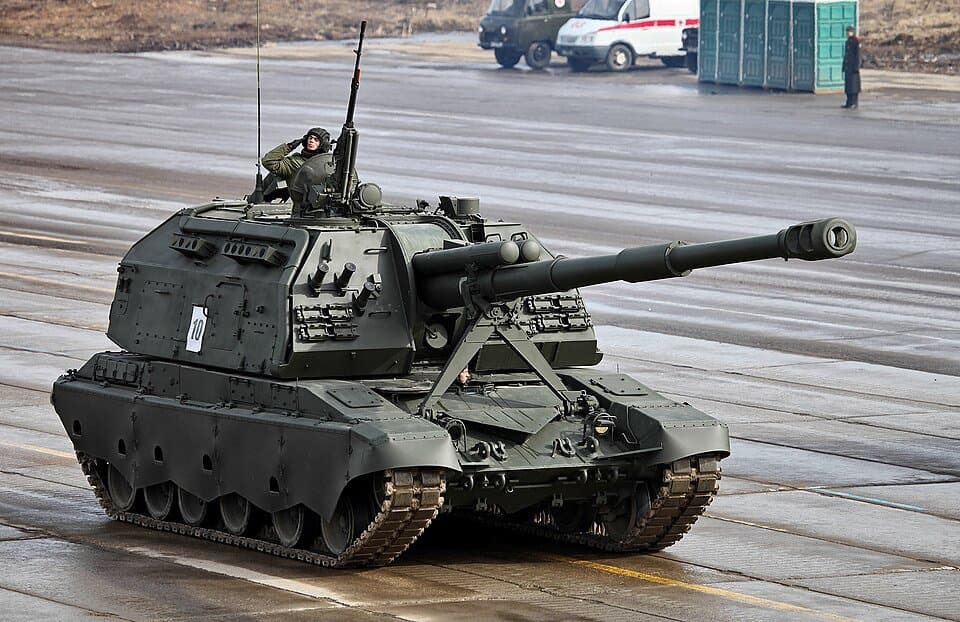
2S19 Msta-Slarger figure on 3 of 7
True scale
Side by side. From every angle. A human reference for perspective.
3.29 MB · Loads when you open it| Model | Length | Width / span | Height |
|---|---|---|---|
| 2S19 Msta-S | ≈ 7.15 m | ≈ 3.38 m (Width) | ≈ 3.35 m |
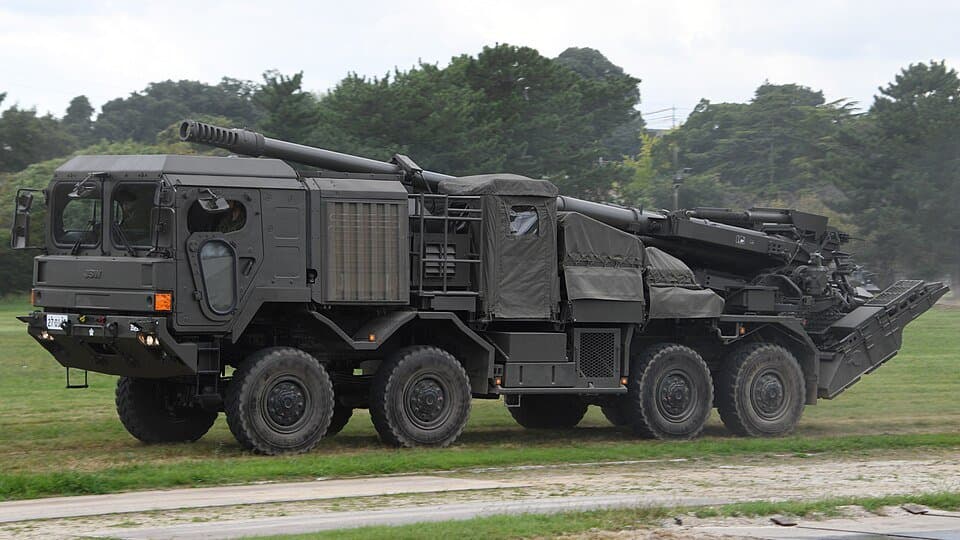
| Type 19 155 mm wheeled self-propelled howitzer | ≈ 11.21 m | ≈ 2.5 m (Width) | ≈ 3.89 m |
Scaled uniformly to the sourced length of 7.15 m. The width was fitted to the sourced 3.38 m. Not an official model or a measured survey.
ForceTally · All rights reserved
Scaled uniformly to the sourced length of 11.21 m. The width was fitted to the sourced 2.5 m. Not an official model or a measured survey.
ForceTally · All rights reserved
The human reference is a generic 1.75 m figure. Models describe external size, not combat performance.
Measured figures
Length
Single source7.15 m (23 ft 5 in)[source]
Length
Single sourceConfiguration
| Specification | 2S19 Msta-S | Type 19 155 mm wheeled self-propelled howitzer |
|---|---|---|
| Type | Self-propelled howitzer[source] | Self-propelled howitzer[source] |
| Place of origin | Soviet Union/Russia[source] | Japan[source] |
| In service | 1989–present[source] | 2020–…[source] |
| Used by | See § Operators |
Type 19 155 mm wheeled self-propelled howitzerlarger figure on 4 of 7
Counts only measures both sources give with the same scope. A larger figure is not a better system.
11.21 m (36.8 ft)[source]
Operational; Operational range
Single sourcebase-bleed
Single sourceMaximum; Base bleed
Single sourceMaximum; RAP
Single sourceMaximum; Standard round
Single sourceRange
Single sourcerocket-assisted
Single sourcestandard round
Single sourceStandard round: 24.7 km (15.3 mi) Base bleed : 29 km (18 mi) RAP : 36 km (22 mi)[source]
500 km (310 mi)[source]
24.7 km (15.3 mi) standard round 28.9 km (18.0 mi) base-bleed 36 km (22 mi) rocket-assisted[source]
Range: 24.7 km (15.3 mi)[source]2S19 Msta-S · Specifications · Range: 24.7 km (15.3 mi) standard round 28.9 km (18.0 mi) base-bleed 36 km (22 mi) rocket-assisted
Operational; Operational range
Single sourceEffective; base bleed
Single sourceRate of fire
Single source2S19
Single source2S19M2
Single source2S19: 6–8 rounds/min 2S19M2: 10 rounds/min[source]
Rate of fire: 6–8 rounds per minute[source]2S19 Msta-S · Specifications · Rate of fire: 6–8 rounds per minute
Rate of fire
Single source6 rpm[source]
Bars compare reported quantities only. A larger figure does not make a system better; configurations and test conditions differ.
Japan[source] |
| Wars | Eritrean–Ethiopian War Second Chechen War Russo-Ukrainian War Second Nagorno-Karabakh War[source] | — |
|---|
| Designer | Uraltransmash[source] | Acquisition, Technology & Logistics Agency[source] |
|---|
| Designed | 1980[source] | 2013–2018[source] |
|---|
| Manufacturer | Uraltransmash[source] | Japan Steel Works[source] |
|---|
| Produced | 1988–present[source] | 2019–…[source] |
|---|
| No. built | ~1,130 (est. 1988–2019, inc. prototypes)[source] | 70 (2026)[source] |
|---|
| Elevation | −4° to +68°[source] | — |
|---|
| Traverse | 360°[source] | — |
|---|
| Armour | 15 mm all-around[source] | — |
|---|
| Main armament | 152 mm 2A64 L47-caliber howitzer[source] | 155 mm/L52 howitzer gun[source] |
|---|
| Secondary armament | 12.7 mm NSVT anti-aircraft machine gun[source] | — |
|---|
| Power/weight | 20 hp/tonne[source] | 17.6 hp/t (13.1 kW/t)[source] |
|---|
| Suspension | Torsion bar[source] | — |
|---|
| Weapon elevation | −4° to +68°[source] | — |
|---|
| Weapon traverse | 360°[source] | — |
|---|
| Deployment time | 22 minutes[source] | — |
|---|
| Unit of fire | 50 rounds[source] | — |
|---|
| Former operator · Belarus | Belarus[source] | — |
|---|
| Former operator · Soviet Union | Soviet Union[source] | — |
|---|
| Role | 152.4 mm self-propelled howitzer[source] | Japanese wheeled 155 mm self-propelled howitzer[source] |
|---|
| Source measurement | The 2S19 Msta-S is a 152.4 mm self-propelled howitzer designed and manufactured by Uraltransmash in the Soviet Union and later in Russia, which entered service in 1989 as the successor to the 2S3 Akatsiya . The vehicle has the running gear of the T-80 , but is powered by the T-72 's diesel engine.[source]2S19 Msta-S · Lead; only the objects and conditions stated in this passage Development of the 2S19 started in 1980 under the project name Ferma . The prototype was known as Obiekt 316 . The 2S19's standard equipment consists of a semi-automatic laying system 1P22, an automatic loader, an NBC protection system, passive night-vision device for the driver, a vehicle snorkel , a dozer blade, a smoke generator and 81 mm smoke launchers, 1V116 intercom system and a 16 kW generator AP-18D. In 2008, the Russian Armed Forces ordered an improved model with an automated fire-control system .[source]2S19 Msta-S · Development; only the objects and conditions stated in this passage Russia offered its Msta-S 152 mm howitzer to foreign countries, particularly in the Middle East. A demonstration was organised in 2020 by Rosoboronexport , the country's nodal agency for arms export, for representatives from various Middle Eastern countries.[source]2S19 Msta-S · Development; only the objects and conditions stated in this passage Range: 24.7 km (15.3 mi) standard round 28.9 km (18.0 mi) base-bleed 36 km (22 mi) rocket-assisted[source]2S19 Msta-S · Specifications; only the objects and conditions stated in this passage Rate of fire: 6–8 rounds per minute[source]2S19 Msta-S · Specifications; only the objects and conditions stated in this passage Weapon elevation: −4° to +68°[source]2S19 Msta-S · Specifications; only the objects and conditions stated in this passage Weapon traverse: 360°[source]2S19 Msta-S · Specifications; only the objects and conditions stated in this passage Deployment time: 22 minutes[source]2S19 Msta-S · Specifications; only the objects and conditions stated in this passage 2S19M2 or 2S33 Msta-SM2 (2013) – Improved version currently in production equipped with a new automatic fire-control system which increases the rate of fire to 10 rounds per minute. Digital electronic maps are now available which significantly speeds up the terrain orientation in difficult geographical conditions and allows performing faster and more efficiently firing missions. The 2S33 Msta-SM2 howitzer is fitted with a new 2A79 152 mm/L60 ordnance that has improved ballistics. It can fire ammunition with more propellant charges and with a higher breech pressure than the original 2S19 Msta-S. The gun is longer and has a heavier barrel. As a result, it has a greater range of fire. Maximum range of fire with standard HE-FRAG shells is 30 km (19 mi) and 40 km (25 mi) with rocket-assisted shells.[source]2S19 Msta-S · Variants; only the objects and conditions stated in this passage 2S19M1-155 (2006) – 155 mm export version of the 2S19M1, fitted with an L/52 gun with a range of more than 40 km (25 mi). Modernised in 2020.[source]2S19 Msta-S · Variants; only the objects and conditions stated in this passage 2S35 Koalitsiya-SV – Project for a new artillery system for the Russian Ground Forces (SV stands for "sukhoputniye voyska"). Early prototypes consisted of a 2S19 chassis with modified turret, fitted with an over-and-under dual autoloaded 152 mm howitzer. Development of this variant was abandoned in favour of an entirely new artillery system using the same designation.[source]2S19 Msta-S · Variants; only the objects and conditions stated in this passage Msta-S howitzers have been used in the Russo-Ukrainian War by the pro-Russian separatists who captured one machine during the conflict. Both Msta-B and Msta-S were used by the Ukrainian Ground Forces in the Battle of Bakhmut . With their vehicles wearing out from continued combat use since 2014, and the 152 mm caliber gradually becoming obsolete, the Ukrainian Armed Forces has refitted some non-operational units with T-72 turrets or converted them into armoured personnel carriers .[source]2S19 Msta-S · Operational use; only the objects and conditions stated in this passage | The Type 19 155 mm wheeled self-propelled howitzer ( 19式装輪自走155mmりゅう弾砲 , Hitokyuu-shiki-sourin-jisou-155mm-ryuudan-hou ) is a Japanese wheeled 155 mm self-propelled howitzer . The vehicle is designed to replace Japan's inventory of FH70 towed howitzers. The Type 19 continues to serve exclusively in the Japan Ground Self-Defense Force as a more affordable counterpart of the Type 99 155 mm self-propelled howitzer .[source]Type 19 155 mm wheeled self-propelled howitzer · Lead; only the objects and conditions stated in this passage In 2011, the Japanese Ministry of Defence evaluated a proposal to develop a vehicle capable of networking with other systems and performing shoot-and-scoot tactics to replace the FH70 towed 155 mm howitzer. The evaluation concluded in 2012 and the ministry requested 6.4 billion yen to be invested into the development of the vehicle in the fiscal year (FY) 2012 defence budget. The initial request was declined, only to be approved the following year. Research and development funds for the 155 mm wheeled howitzer were granted in the FY 2013 defence budget, although the budget was lowered to 1.4 billion yen. That marks the official beginning for the development of the Type 19 155 mm self-propelled howitzer.[source]Type 19 155 mm wheeled self-propelled howitzer · Development; only the objects and conditions stated in this passage The new self-propelled howitzer was to make use of off-the-shelf technologies. To reduce development costs, the initial plan was to mount the howitzer gun from the Type 99 155 mm self-propelled howitzer on a heavy recovery vehicle chassis. As the limitations of that option became clear during development and Japan had no other suitable chassis available – developing a proprietary chassis was deemed financially unfeasible –, an existing foreign 8×8 chassis was chosen instead. Rheinmetall MAN Military Vehicles ' HX44M became the chassis of the Type 19, which was produced under licence by Japan Steel Works .[source]Type 19 155 mm wheeled self-propelled howitzer · Development; only the objects and conditions stated in this passage On 31 May 2018, the Acquisition, Technology & Logistics Agency (ATLA) received 5 prototypes from Japan Steel Works for testing and evaluation. Testing concluded in 2019, when the Type 19 155 mm wheeled self-propelled howitzer was accepted into Japan Ground Self-Defense Force Service. Seven wheeled howitzers were procured for training purpose in the FY 2019 defence budget for a total of 5.1 billion yen. |
|---|
| Unit cost | — | see Operators[source] |
|---|
| Breech | — | interrupted screw[source] |
|---|
| Transmission | — | ZF 12 AS 23010D AS-Tronic ( AMT ) (12 front/ 2 rear) MAN G172 transfer case (high/low range) with engageable front axles[source] |
|---|
| Reported operators | — |
|---|
Effective; standard
Single sourceThe Type 19 155 mm self-propelled howitzer uses Rheinmetall MAN Military Vehicles' HX44M 8×8 chassis from the company's HX2 series of tactical military trucks. Japan Steel Works produces the chassis under licence domestically.[source]Type 19 155 mm wheeled self-propelled howitzer · Design / Chassis; only the objects and conditions stated in this passage
The howitzer gun is a modified version of the 155 mm 52- calibre gun used on the Type 99 155 mm self-propelled howitzer. As the gun is externally mounted, it was modified to remove the smoke extractor of the propellant gasses (present on the Type 99).[source]Type 19 155 mm wheeled self-propelled howitzer · Design / Gun; only the objects and conditions stated in this passage
The Type 19 uses the same shells and propellant charges as the Type 99. Having the same howitzer gun also implies that the effective firing range is very similar – 30 km (19 mi) using standard shells and 40 km (25 mi) when using base bleed shells. In September 2024, Japan placed an order for Leonardo 's guided long-range Vulcano 155 GLR shells, received the first batch in December, and began the integration process into the Type 19.[source]Type 19 155 mm wheeled self-propelled howitzer · Design / Ammunition; only the objects and conditions stated in this passage
HE shell: Range: ≤ 30 km (19 mi)[source]Type 19 155 mm wheeled self-propelled howitzer · Design / Ammunition; only the objects and conditions stated in this passage
Type 93 base bleed shell: Range: ≤ 40 km (25 mi)[source]Type 19 155 mm wheeled self-propelled howitzer · Design / Ammunition; only the objects and conditions stated in this passage
Vulcano GLR : Range: ≤ 70 km (43 mi) Guidance: autonomous IMU + GPS Combined with a quadcopter drone for targeting in Japan Ground Self-Defense Force service.[source]Type 19 155 mm wheeled self-propelled howitzer · Design / Ammunition; only the objects and conditions stated in this passage
Procurement of the Type 19 155 mm self-propelled howitzer started in 2019. Prototypes were first revealed to the public in 2019 during the annual live fire exercises held at the East Fuji Maneuver Area. The first production vehicle belonging to an artillery training unit appeared a year later during the 2020 live fire exercises. Type 19s are expected to arm units that operate the FH70 towed howitzer, as the latter are gradually phased out of service.[source]Type 19 155 mm wheeled self-propelled howitzer · Operational history; only the objects and conditions stated in this passage
In 2025, the Japan Ground Self-Defense Force tested long-range shells and propellant charges for the Type 19 in the Yuma Proving Ground . It was not possible to test the long-range ammunition in Japan. For the same reason, Japan is going to dispatch Type 19s to the United Kingdom for testing Vulcano GLR shells in QinetiQ 's MOD Aberporth testing range.[source]Type 19 155 mm wheeled self-propelled howitzer · Operational history; only the objects and conditions stated in this passage