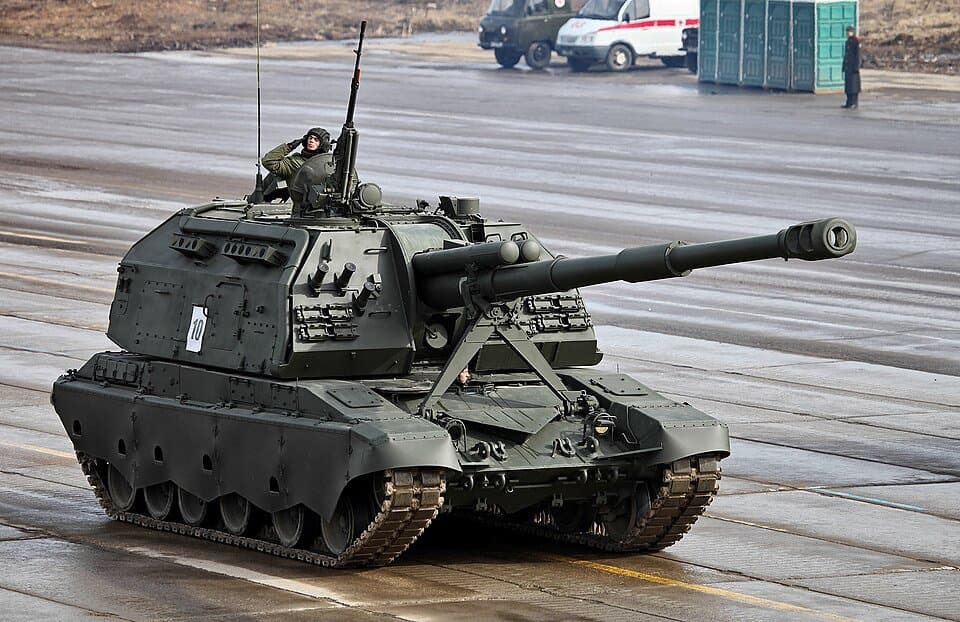

Credit
Vitaly V. Kuzmin · CC BY-SA 4.0 · Resized · CC BY-SA 4.0 · Source ↗ · Modified


Preparing your view.

At a glance
2S19 Msta-Slarger figure on 3 of 5
Measured figures
Length
Single source7.15 m (23 ft 5 in)[source]
Length
Single sourceConfiguration
| Specification | 2S19 Msta-S | Palmaria (artillery) |
|---|---|---|
| Type | Self-propelled howitzer[source] | Self-propelled howitzer[source] |
| Place of origin | Soviet Union/Russia[source] | Italy[source] |
| In service | 1989–present[source] | — |
| Used by | See § Operators[source] | See Operators[source] |
Palmaria (artillery)larger figure on 2 of 5
Counts only measures both sources give with the same scope. A larger figure is not a better system.
11.474 m (37 ft 8 in)[source]
Operational; Operational range
Single sourcebase-bleed
Single sourceMaximum; Base bleed
Single sourceMaximum; RAP
Single sourceMaximum; Standard round
Single sourceRange
Single sourcerocket-assisted
Single sourcestandard round
Single sourceStandard round: 24.7 km (15.3 mi) Base bleed : 29 km (18 mi) RAP : 36 km (22 mi)[source]
500 km (310 mi)[source]
24.7 km (15.3 mi) standard round 28.9 km (18.0 mi) base-bleed 36 km (22 mi) rocket-assisted[source]
Range: 24.7 km (15.3 mi)[source]2S19 Msta-S · Specifications · Range: 24.7 km (15.3 mi) standard round 28.9 km (18.0 mi) base-bleed 36 km (22 mi) rocket-assisted
Operational; Operational range
Single source400 km (250 miles)[source]
Bars compare reported quantities only. A larger figure does not make a system better; configurations and test conditions differ.
| Wars | Eritrean–Ethiopian War Second Chechen War Russo-Ukrainian War Second Nagorno-Karabakh War[source] | Chadian–Libyan War First Libyan Civil War Second Libyan Civil War[source] |
|---|
| Designer | Uraltransmash[source] | — |
|---|
| Designed | 1980[source] | — |
|---|
| Manufacturer | Uraltransmash[source] | OTO Melara[source] |
|---|
| Produced | 1988–present[source] | 1977–1986[source] |
|---|
| No. built | ~1,130 (est. 1988–2019, inc. prototypes)[source] | 235[source] |
|---|
| Elevation | −4° to +68°[source] | — |
|---|
| Traverse | 360°[source] | — |
|---|
| Armour | 15 mm all-around[source] | — |
|---|
| Main armament | 152 mm 2A64 L47-caliber howitzer[source] | 155 mm L/41 howitzer (30 rounds)[source] |
|---|
| Secondary armament | 12.7 mm NSVT anti-aircraft machine gun[source] | 1x 7.62 mm or 12.7 mm machine gun in pintle mount[source] |
|---|
| Power/weight | 20 hp/tonne[source] | 16.1 PS/tonne[source] |
|---|
| Suspension | Torsion bar[source] | torsion bar[source] |
|---|
| Weapon elevation | −4° to +68°[source] | — |
|---|
| Weapon traverse | 360°[source] | — |
|---|
| Deployment time | 22 minutes[source] | — |
|---|
| Unit of fire | 50 rounds[source] | — |
|---|
| Former operator · Belarus | Belarus[source] | — |
|---|
| Former operator · Soviet Union | Soviet Union[source] | — |
|---|
| Role | 152.4 mm self-propelled howitzer[source] | — |
|---|
| Source measurement | The 2S19 Msta-S is a 152.4 mm self-propelled howitzer designed and manufactured by Uraltransmash in the Soviet Union and later in Russia, which entered service in 1989 as the successor to the 2S3 Akatsiya . The vehicle has the running gear of the T-80 , but is powered by the T-72 's diesel engine.[source]2S19 Msta-S · Lead; only the objects and conditions stated in this passage Development of the 2S19 started in 1980 under the project name Ferma . The prototype was known as Obiekt 316 . The 2S19's standard equipment consists of a semi-automatic laying system 1P22, an automatic loader, an NBC protection system, passive night-vision device for the driver, a vehicle snorkel , a dozer blade, a smoke generator and 81 mm smoke launchers, 1V116 intercom system and a 16 kW generator AP-18D. In 2008, the Russian Armed Forces ordered an improved model with an automated fire-control system .[source]2S19 Msta-S · Development; only the objects and conditions stated in this passage Russia offered its Msta-S 152 mm howitzer to foreign countries, particularly in the Middle East. A demonstration was organised in 2020 by Rosoboronexport , the country's nodal agency for arms export, for representatives from various Middle Eastern countries.[source]2S19 Msta-S · Development; only the objects and conditions stated in this passage Range: 24.7 km (15.3 mi) standard round 28.9 km (18.0 mi) base-bleed 36 km (22 mi) rocket-assisted[source]2S19 Msta-S · Specifications; only the objects and conditions stated in this passage Rate of fire: 6–8 rounds per minute[source]2S19 Msta-S · Specifications; only the objects and conditions stated in this passage Weapon elevation: −4° to +68°[source]2S19 Msta-S · Specifications; only the objects and conditions stated in this passage Weapon traverse: 360°[source]2S19 Msta-S · Specifications; only the objects and conditions stated in this passage Deployment time: 22 minutes[source]2S19 Msta-S · Specifications; only the objects and conditions stated in this passage 2S19M2 or 2S33 Msta-SM2 (2013) – Improved version currently in production equipped with a new automatic fire-control system which increases the rate of fire to 10 rounds per minute. Digital electronic maps are now available which significantly speeds up the terrain orientation in difficult geographical conditions and allows performing faster and more efficiently firing missions. The 2S33 Msta-SM2 howitzer is fitted with a new 2A79 152 mm/L60 ordnance that has improved ballistics. It can fire ammunition with more propellant charges and with a higher breech pressure than the original 2S19 Msta-S. The gun is longer and has a heavier barrel. As a result, it has a greater range of fire. Maximum range of fire with standard HE-FRAG shells is 30 km (19 mi) and 40 km (25 mi) with rocket-assisted shells.[source]2S19 Msta-S · Variants; only the objects and conditions stated in this passage 2S19M1-155 (2006) – 155 mm export version of the 2S19M1, fitted with an L/52 gun with a range of more than 40 km (25 mi). Modernised in 2020.[source]2S19 Msta-S · Variants; only the objects and conditions stated in this passage 2S35 Koalitsiya-SV – Project for a new artillery system for the Russian Ground Forces (SV stands for "sukhoputniye voyska"). Early prototypes consisted of a 2S19 chassis with modified turret, fitted with an over-and-under dual autoloaded 152 mm howitzer. Development of this variant was abandoned in favour of an entirely new artillery system using the same designation.[source]2S19 Msta-S · Variants; only the objects and conditions stated in this passage Msta-S howitzers have been used in the Russo-Ukrainian War by the pro-Russian separatists who captured one machine during the conflict. Both Msta-B and Msta-S were used by the Ukrainian Ground Forces in the Battle of Bakhmut . With their vehicles wearing out from continued combat use since 2014, and the 152 mm caliber gradually becoming obsolete, the Ukrainian Armed Forces has refitted some non-operational units with T-72 turrets or converted them into armoured personnel carriers .[source]2S19 Msta-S · Operational use; only the objects and conditions stated in this passage | The Palmaria is an Italian self-propelled howitzer using the 155 mm (6.1″) NATO -standard artillery calibre.[source]Palmaria (artillery) · Lead; only the objects and conditions stated in this passage The primary armament is a 155 mm howitzer, with a secondary 7.62 mm machine gun or 12.7 mm machine gun on anti-aircraft mount and four 76 mm forward-facing smoke grenade dischargers on either side of the turret. The howitzer has an automatic loading system, providing a rate of fire of one round every 15 seconds or a burst-fire rate of three rounds every 25 seconds. The loader has 23 ready rounds, with seven more rounds stored in the hull. Including manual reloading of the charge, the overall firing rate is normally one round per minute for one hour. Intense firing is four rounds in one minute. Sustained fire is one round every three minutes for an indefinite period. A wide variety of 155 mm munitions are available, including specially developed Simmel rounds with a range of 24.7 km and rocket-assisted ones with a range of 30 km.[source]Palmaria (artillery) · Design; only the objects and conditions stated in this passage The turret is hydraulic with manual backup, and has 360 degree rotation with elevation limits of -4 to +70 degrees. It has its own auxiliary power supply which conserves fuel for the main engine.[source]Palmaria (artillery) · Design; only the objects and conditions stated in this passage The Palmaria is powered by a 750 hp MTU MB 837 Ea-500 (or 1,000 hp Ka-500) 4-stroke, turbocharged, 8-cylinder multifuel engine coupled to a Renk RK 304 transmission. The Palmaria has torsion bar suspension with seven roadwheels and five return rollers on either side. The drive sprocket is located at the rear while the adjustable idler sprocket is at the front.[source]Palmaria (artillery) · Design; only the objects and conditions stated in this passage |
|---|
| Name | — | Palmaria[source]Palmaria (artillery) · literal own first infobox identity; no named upgrade or fitted configuration inferred |
|---|
| Reported operators |
|---|
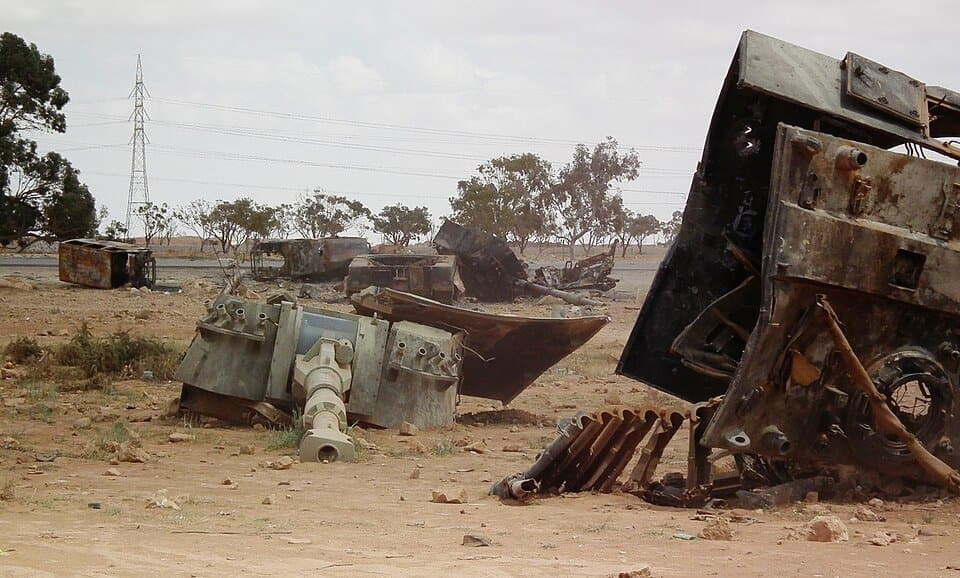
Libya was the first country outside Italy to adopt the Palmaria, initially ordering 210 in 1982. Their army's artillery strength in 2004 included 160 Palmaria. Several were destroyed during the First Libyan civil war as a result of multinational military intervention .[source]Palmaria (artillery) · Operational history; only the objects and conditions stated in this passage