AArtillery
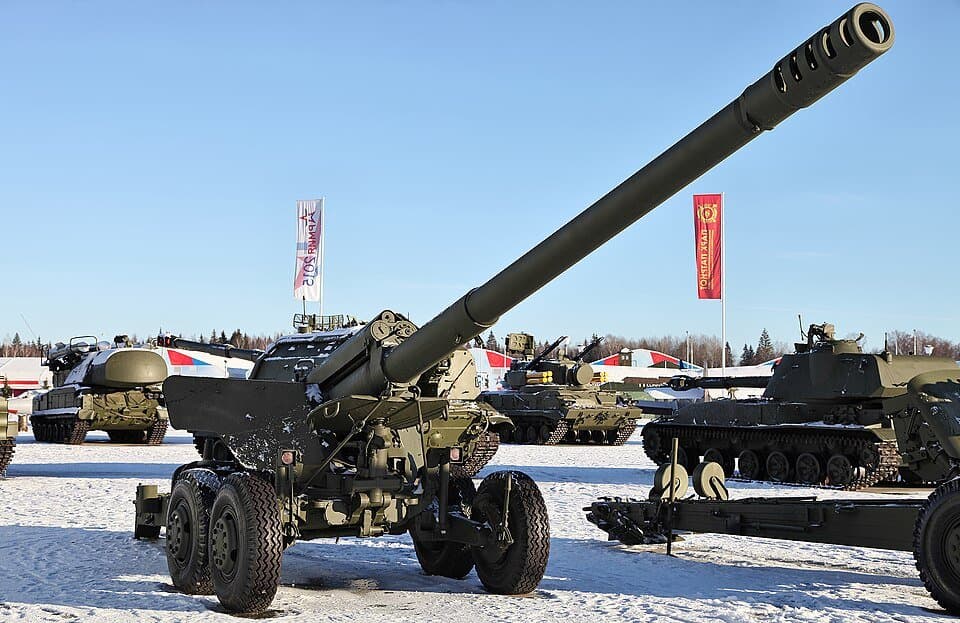
2A36 Giatsint-B
Credit
Vitaly V. Kuzmin · CC BY-SA 4.0 · Resized · CC BY-SA 4.0 · Source ↗ · Modified


Preparing your view.
AArtillery

At a glance
2A36 Giatsint-Blarger figure on 3 of 3
L118 light gunlarger figure on 0 of 3
Counts only measures both sources give with the same scope. A larger figure is not a better system.
Measured figures
Length
Single source12.3 m (40 ft)[source]
firing
Single sourceConfiguration
| Specification | 2A36 Giatsint-B | L118 light gun |
|---|---|---|
| Place of origin | Soviet Union[source] | United Kingdom[source] |
| In service | 1976−present[source] | 1974–present[source] |
| Used by | See operators[source] | See Operators[source] |
| Wars | Gulf War Second Nagorno-Karabakh War Russo-Ukrainian War[source] | Western Sahara War Falklands War Yugoslav Wars Sierra Leone Civil War Iraq War War in Afghanistan (2001–2021) Russo-Ukrainian War Russian invasion of Ukraine 2025 Cambodia-Thailand conflict |
travelling
Single source7.01 m (23 ft) firing 4.876 m (16 ft) travelling[source]
travelling
Single source1.371 m (4 ft 6 in) travelling[source]
Bars compare reported quantities only. A larger figure does not make a system better; configurations and test conditions differ.
| Designer | Yuri Kalachnikov[source] | Royal Armament Research and Development Establishment[source] |
|---|
| Designed | 1968−1975[source] | 1966–1973[source] |
|---|
| Manufacturer | Motovilikha Plants[source] | Royal Ordnance Factory (later BAE Systems Land and Armaments )[source] |
|---|
| Unit cost | US$ 500,000−600,000 (export price, 1995)[source] | — |
|---|
| Produced | 1976−1980s[source] | 1974–2016[source] |
|---|
| No. built | 1,500[source] | Over 1,100[source] |
|---|
| Shell | 152.4 mm (6.00 in)[source] | Separate loading cased charge 105 x 326 mm R[source] |
|---|
| Breech | Horizontal sliding-block[source] | Vertical sliding block[source] |
|---|
| Carriage | Split trail[source] | L17 box trail carriage with circular firing platform[source] |
|---|
| Elevation | 57°[source] | +1244 mils (+70 °) –98 mils (–5.5 °)[source] |
|---|
| Traverse | 25°[source] | 200 mils (11.25 °) fine 6400 mils (360 °) on turntable[source] |
|---|
| Type | — | Towed field gun[source] |
|---|
| Variants | — | L119 M119[source] |
|---|
| Shell weight | — | L31 HE (16.1 kg (35 lb)) L50 HE‐ IM ER ( base bleed ) L42 HESH (10.49 kg (23 lb)) L43 Illuminating L45 Smoke (15.89 kg (35 lb)) L37 Smoke, red L38 Smoke, orange[source] |
|---|
| Barrels | — | L19 ordnance[source] |
|---|
| Recoil | — | Hydro-pneumatic[source] |
|---|
| Sights | — | Hall & Watts artillery sighting system Selex ES LINAPS Direct fire telescope[source] |
|---|
| References | — | Janes & BAE Systems[source] |
|---|
| Former operator · Australia | — | Australia[source] |
|---|
| Former operator · Netherlands | — | Netherlands[source] |
|---|
| Former operator · South Korea | — | South Korea[source] |
|---|
| Former operator · Switzerland | — | Switzerland[source] |
|---|
| Role | — | 105 mm towed howitzer[source] |
|---|
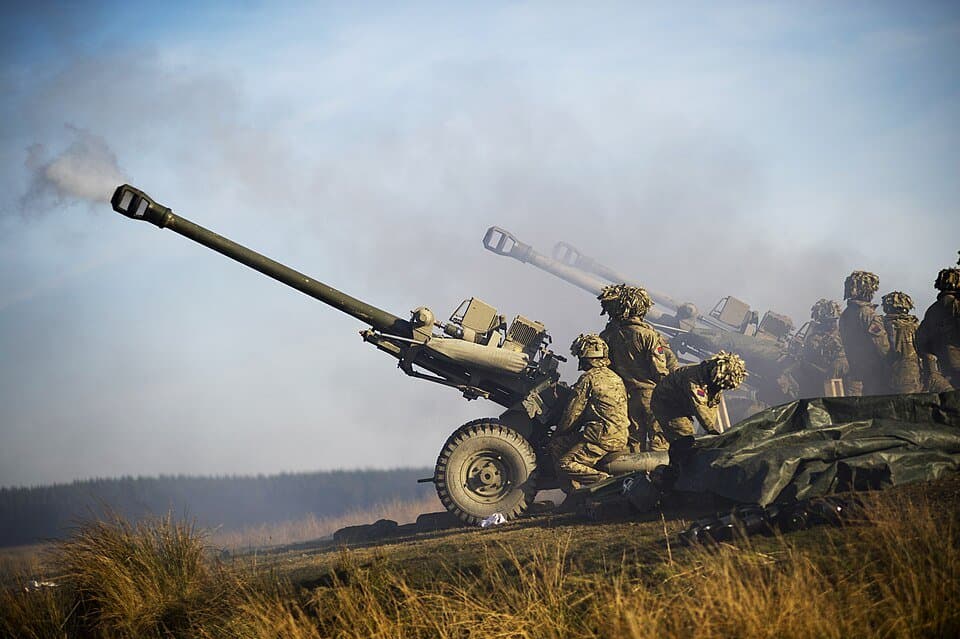
| Source measurement | — | The L118 light gun is a 105 mm towed howitzer . It was originally designed and produced in the United Kingdom for the British Army in the 1970s. It has since been widely exported. The L119 and the United States Army's M119 are variants that use a different type of ammunition.[source]L118 light gun · Lead; only the objects and conditions stated in this passage From 1961 to 1975, the British Army used the 105 mm pack howitzer L5 with L10 ordnance ( OTO Melara Mod 56 ) as its light artillery weapon, replacing the 75 mm howitzer , 4.2 inch mortar , and 25-pounder gun in eight regular artillery regiments. It fires the US M1 type ammunition (called "105 mm How" in the UK). The Mod 56 was originally designed in Italy for its mountain artillery units. It was light enough to be lifted by Westland Wessex helicopters or towed by Land Rovers . It could also be dismantled, with no piece heavier than 128 kg (282 lb) to be transported by mules or horses. It lacked range (making it potentially vulnerable to counter-battery fire), was not notably robust, and had poor sights. Nor were its rate of fire and time to prepare for opening fire satisfactory.[source]L118 light gun · History / Development; only the objects and conditions stated in this passage In 1965, a general staff requirement was approved for a new 105 mm weapon system because the L5 pack howitzer "lacked range and lethality". Key characteristics included 6400 mil (360°) traverse by one soldier, maximum weight of 3,500 pounds (1,600 kg), small enough size to be carried inside new Chinook helicopters and Andover transport aircraft , and ability to fire immediately after being under water for 30 minutes. The ammunition to be used was the 105 mm Fd Mk 2 ammunition used in the L13 ordnance of the gun equipment 105 mm L109 (better known as the " Abbot self-propelled gun "). This ammunition uses electrical instead of percussion primers and is an entirely different design from the US M1 type ammunition as used in the L5 pack howitzer. The two types are not interchangeable. An early requirement was for the new weapon to use 105 mm Fd Mk 1 ammunition, which uses the M1 shell, in training. However, in 1968, this was changed to allow a different version of the weapon, which subsequently became the L119, to fire US 1935 pattern (i.e. M1) ammunition.[source]L118 light gun · History / Development; only the objects and conditions stated in this passage The light gun entered service with the British Army in 1976. It was heavier than its predecessor, but helicopters that could carry it, such as the Puma and Westland Sea King , were entering service at the same time. A new vehicle, the Land Rover 101 Forward Control ("Land Rover, one-ton"), was designed as its prime mover in the field (and also for the Rapier air-defence missile launcher). Since the end of the 1990s, the British Army has used Pinzgauer ATVs as their gun tractors. In Arctic service, and elsewhere, the gun is towed by the Hägglunds Bv 206 and is fitted with skis when over snow.[source]L118 light gun · History / In British service; only the objects and conditions stated in this passage The narrow wheelbase prevents the ordnance rotating the 3200 mil (180°) required to 'unfold' the gun. Because of this, the gun features a knock-off hub on one side, allowing the ordnance to be rotated by removing one wheel. With a well-trained gun crew, this contributes approximately 30 seconds to the time required to deploy the gun. In British service, rotating the barrel for towing is optional.[source]L118 light gun · Design; only the objects and conditions stated in this passage When being towed in the unfolded position, the A-frame is fitted to the front transom in order to support the elevating mass. A recent modification makes it possible to keep the gun in this position indefinitely at speeds up to 40 mph (64 km/h). For long-distance transport or traversing rough terrain, the barrel is reversed and clamped to the end of the trail. For storage, the gun is in the unfolded position with the barrel elevated to an angle that balances the elevated mass on the yoke and therefore relieves pressure on the elevating gears.[source]L118 light gun · Design; only the objects and conditions stated in this passage The 105 mm Fd Mk 2 ammunition has two propelling cartridges and a blank cartridge (for saluting purposes). The normal cartridge has six propellant increments (charges 1, 2, 3, 4, 4½, and 5). Charge 4½, which is charge 5 with the blue charge three bag removed, is peculiar to the light gun and is used only for high-angle fire . A separate "charge super" cartridge is used for firing to maximum range.[source]L118 light gun · Design / Ammunition; only the objects and conditions stated in this passage Both charge five and charge super project beyond the end of the metal cartridge case. The 105 mm Fd is "separate, cased"; the shell is loaded and rammed by hand, then the cartridge with propellant is loaded. By the time the L118 entered service, propellant sub-zones A and B originally used with the Abbot had been replaced by an aerodynamic spoiler (a ring slipped over the nose of shell to lodge on the ogive) to reduce the minimum range at high-angle fire when this was required.[source]L118 light gun · Design / Ammunition; only the objects and conditions stated in this passage The 105 mm Fd Mk 2 rounds were the same as used with Abbot when the L118 was first introduced. The ammunition types originally or subsequently in UK service include:[source]L118 light gun · Design / Ammunition; only the objects and conditions stated in this passage L31 HE ( high explosive ) series is a series of 105 mm rounds which are claimed to have a 25% greater lethal area than the US 105 mm M1 HE shells.[source]L118 light gun · Design / Ammunition; only the objects and conditions stated in this passage L31A1 HE round is made from forged or cold‐extruded high‐tensile steel with a single copper band and a nominal fuzed weight of 16.103 kg (35.50 lb).[source]L118 light gun · Design / Ammunition; only the objects and conditions stated in this passage The L31A1 has two main fillings both weighing 2.431 kg (5.36 lb), Type A is 60:40 RDX / TNT , Type B is 55:45 RDX/TNT.[source]L118 light gun · Design / Ammunition; only the objects and conditions stated in this passage L31A2 HE has a nominal fuzed weight of 15.984 kg (35.24 lb) and its main filling is 2.3123 kg (5.098 lb) of creamed TNT.[source]L118 light gun · Design / Ammunition; only the objects and conditions stated in this passage L31A3 HE has a nominal fuzed weight of 16.089 kg (35.47 lb) and its main filling is 2.3123 kg (5.098 lb) of Bridgewater produced Type A 60:40 RDX/TNT and topped with TNT.[source]L118 light gun · Design / Ammunition; only the objects and conditions stated in this passage The IM-compliant shell was originally designated the L50A2, its explosive filling is 2.9 kg (6.4 lb) of ROWANEX 1100.[source]L118 light gun · Design / Ammunition; only the objects and conditions stated in this passage L45 smoke base ejection. This contains three canisters filled with hexachloroethane , which are ejected from the base of the shell in flight by a mechanical (L92) or electronic time fuze (L132 being replaced by L163). On falling to the ground, they generate dense white smoke for 60 seconds.[source]L118 light gun · Design / Ammunition; only the objects and conditions stated in this passage L43 illuminating. Provides a parachute flare base ejected by time fuze (L81) at about 400 m (1,300 ft) above the ground and burns for 30 seconds.[source]L118 light gun · Design / Ammunition; only the objects and conditions stated in this passage L50A2 HE‐IM ER (high explosive, insensitive munition , extended range) features a base bleed unit, extending the range of the projectile to 20.6 km (12.8 mi). The round's explosive fill is 2.5 kg (5.5 lb) of ROWANEX 1100. Fusing is as with the L31A4.[source]L118 light gun · Design / Ammunition; only the objects and conditions stated in this passage A white phosphorus smoke shell has never been adopted by the UK for L118. A base bleed insensitive HE shell, with a maximum range of 20.6 kilometres (12.8 mi) has been developed.[source]L118 light gun · Design / Ammunition; only the objects and conditions stated in this passage The L119 variant has a different barrel (a slightly shorter L30 ordnance with a percussion firing mechanism) for firing the ubiquitous US M1 type ammunition (UK 105 mm How), giving the gun a max range of 11,400 metres (12,500 yd). When the " semi-fixed " M1 ammunition is prepared for firing, any propellant charge bags that are not going to be used are removed from the cartridge case, then the projectile is fitted into the top of the case. The shell is then loaded into the gun as a complete round, unlike the L118 ammunition, where the projectile and cartridge case are loaded separately.[source]L118 light gun · Variants / L119; only the objects and conditions stated in this passage In British service, the L119 was used only for training at the Royal School of Artillery while stocks of 105 mm How lasted, and the last British L119s were retired in 2005. However, the L119 is popular with many export customers who still rely on M1 ammunition. In 2022, the New Zealand Army sent 30 soldiers to the United Kingdom to train Ukrainian soldiers on the L119 light gun, as military assistance to Ukraine. They were to be stationed in the United Kingdom from May to July, with each course to take a week. New Zealand also donated approximately 40 dial sights to Ukraine.[source]L118 light gun · Variants / L119; only the objects and conditions stated in this passage During the 1970s, a third variant with the L21 ordnance, was developed and prototypes produced. This was for Switzerland and used Swiss pattern 105 mm ammunition. It did not enter service.[source]L118 light gun · Variants / Other variants; only the objects and conditions stated in this passage The Indian Field Gun appears to share many features with the UK equipment. In the late 1960s India introduced the Value Engineered Abbot variant with the 105 mm Fd ammunition; this led to the 105 mm field gun (India), which appears to have some light gun features in its elevating mass, although its platform is similar to a Ordnance QF 25-pounder field gun. The 105 mm light field gun is much more like L118, although somewhat heavier.[source]L118 light gun · Variants / Other variants; only the objects and conditions stated in this passage In 1984, the L119 entered service with the Australian Army named the "Hamel gun" to replace the M2A2 . The gun was manufactured under licence in Australia for the Australian and New Zealand armies using mostly Australian produced components. Plans to produce 105 mm field ammunition were postponed.[source]L118 light gun · Variants / Other variants; only the objects and conditions stated in this passage The 105 mm saluting gun: The British Army has a number of dedicated saluting guns for ceremonial purposes. Based on the standard L118, these saluting guns are modified to exclusively fire blank cartridges, are not fitted with the APS system and are easily distinguished from the field gun variant by their distinctive bronze green paintwork, chromed muzzle brake, and chromed breech.[source]L118 light gun · Variants / Other variants; only the objects and conditions stated in this passage |
|---|
| Reported operators |
|
|
|---|