Credit
ShinePhantom · CC BY-SA 3.0 · Resized · CC BY-SA 3.0 · Source ↗ · Modified


Preparing your view.


At a glance
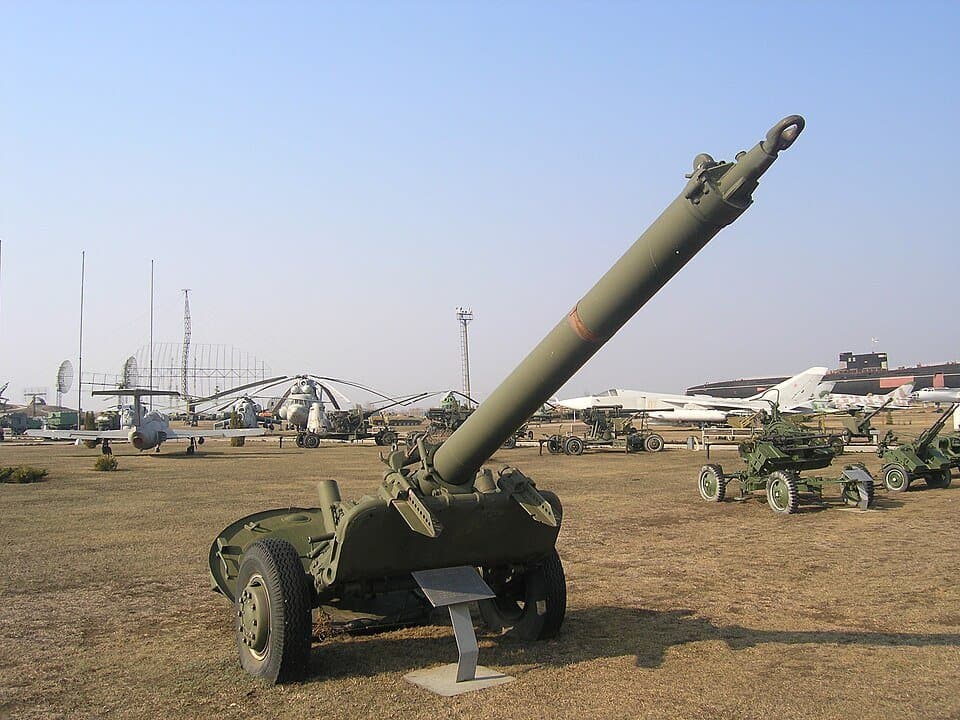
240 mm mortar M240larger figure on 3 of 3
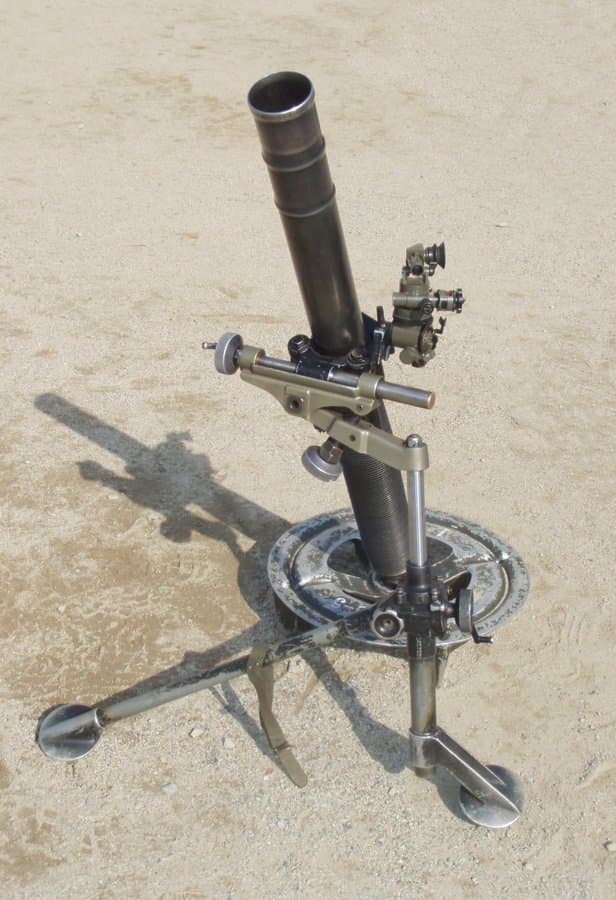
L16 81mm mortarlarger figure on 0 of 3
Counts only measures both sources give with the same scope. A larger figure is not a better system.
Measured figures
Combat
Single sourceStatic
Single sourceConfiguration
| Specification | 240 mm mortar M240 | L16 81mm mortar |
|---|---|---|
| Type | Towed mortar[source] | Mortar[source] |
| Place of origin | Soviet Union[source] | United Kingdom Canada[source] |
| In service | 1953–present[source] | — |
| Wars | Yom Kippur War Lebanese Civil War Soviet–Afghan War Iran–Iraq War First Chechen War Second Chechen War Syrian Civil War Russian invasion of Ukraine[source] | Rhodesian Bush War Lebanese Civil War Nepalese civil war Borneo, South Arabia, Oman Vietnam War Falklands War Indo-Pakistani War of 1971 Balkans, Kuwait, Iraq, Afghanistan, Mali. Syrian Civil War |
Static: 3,610 kg (7,960 lb) Combat: 4,150 kg (9,150 lb)[source]
Mass
Single source35.3 kg (78 lb)[source]
Maximum; Maximum firing range
Single sourceMaximum; with rocket-assisted
Single source9.7 km (6.0 mi) 20 km (12 mi) (with rocket-assisted)[source]
Maximum; Maximum firing range
Single sourceEffective; HE
Single sourceMuzzle velocity
Single source225 m/s (740 ft/s)[source]
Bars compare reported quantities only. A larger figure does not make a system better; configurations and test conditions differ.
| Shell | (HE) 130 kg (286 lbs)[source] | — |
|---|
| Elevation | +45° to +65°[source] | — |
|---|
| Traverse | 17°[source] | — |
|---|
| Manufacturer | Yurga Machine-Building Plant[source] | Royal Ordnance (barrel and bipod)[source] |
|---|
| Used by | — | See Users[source] |
|---|
| Designer | — | Royal Armament Research and Development Establishment, Fort Halstead (barrel and bipod)[source] |
|---|
| Designed | — | 1956[source] |
|---|
| Produced | — | 1965[source] |
|---|
| Shell weight | — | 4.2 kilograms (9.3 lb) (L3682).[source] |
|---|
| Action | — | muzzle loading[source] |
|---|
| Breech | — | none[source] |
|---|
| Recoil | — | baseplate and spring buffered mounting clamp[source] |
|---|
| Feed system | — | Manual[source] |
|---|
| Sights | — | Optical (C2) with Trilux illumination[source] |
|---|
| Former operator · Australia | — | Australia[source] |
|---|
| Former operator · Rhodesia | — | Rhodesia[source] |
|---|
| Source measurement | — | The L16 81mm mortar is a British and Canadian standard mortar used by the Canadian Army , British Army , and many other armed forces. It originated as a joint design by the UK and Canada. The U.S. armed forces version is the M252 .[source]L16 81mm mortar · Lead; only the objects and conditions stated in this passage It was introduced in 1965–66, replacing the Ordnance ML 3 inch Mortar in UK service, where it is used by the British Army , the Royal Marines and the RAF Regiment .[source]L16 81mm mortar · Description; only the objects and conditions stated in this passage In UK armoured/mechanised infantry battalions, the L16 mortar is mounted in an FV 432 AFV (six per battalion mortar platoon). British army light role infantry battalions and the Royal Marines may transport their mortars in BvS 10 vehicles (the replacement for the Bv 206 ). Otherwise, it is carried disassembled in three loads, (barrel, baseplate and bipod with sights, each approximately 11 kg), normally carried by a vehicle or helicopter and assembled for firing from the ground.[source]L16 81mm mortar · Description; only the objects and conditions stated in this passage Video of L16 81mm mortar fired by JGSDF soldiers during Orient Shield 2012[source]L16 81mm mortar · Gallery; only the objects and conditions stated in this passage |
|---|
| Reported operators |
|
|
|---|
Effective; Illumination
Single sourceEffective; Smoke
Single source