Credit
Torin · Public domain · Resized · Public domain · Source ↗ · Modified


Preparing your view.

At a glance
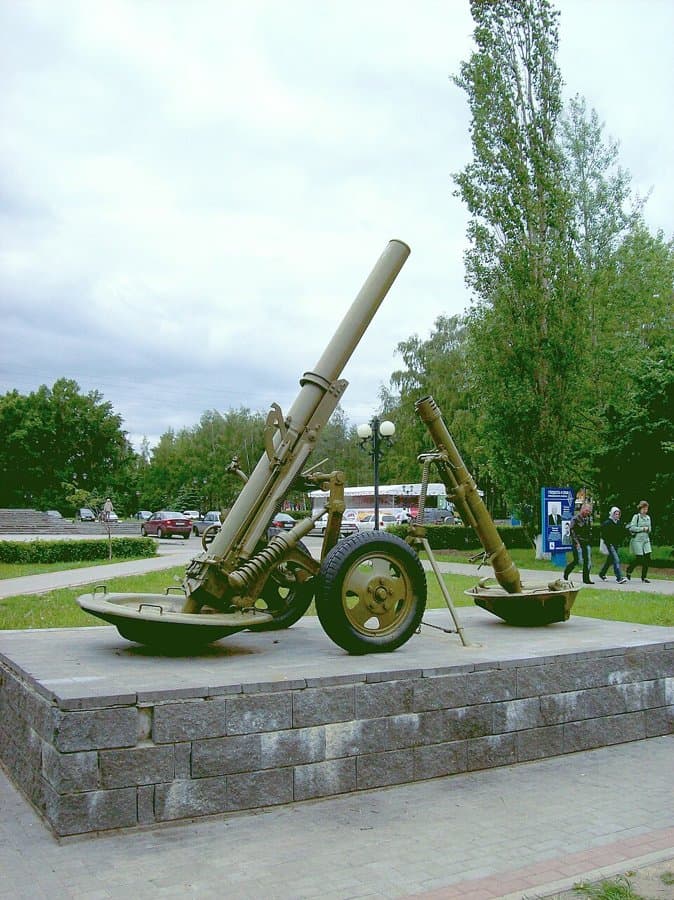
160 mm mortar M1943larger figure on 4 of 4
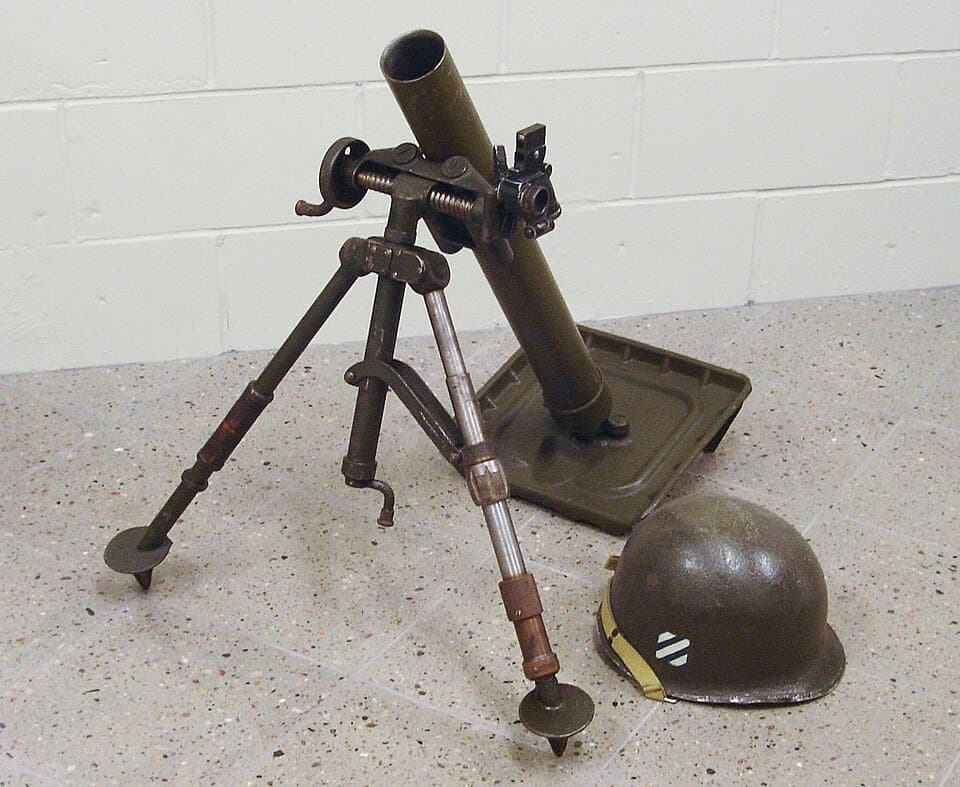
M2 mortarlarger figure on 0 of 4
Counts only measures both sources give with the same scope. A larger figure is not a better system.
Measured figures
Mass
Single source1,170 kg (2,580 lb)[source]
Mass
Single sourceConfiguration
| Specification | 160 mm mortar M1943 | M2 mortar |
|---|---|---|
| Type | Heavy mortar[source] | Infantry mortar[source] |
| Place of origin | Soviet Union[source] | United States[source] |
| In service | 1943–present[source] | — |
| Wars | World War II Korean War Six-Day War Vietnam War Yom Kippur War Lebanese Civil War 1978 South Lebanon conflict South Lebanon conflict (1985–2000)[source] | World War II Chinese Civil War First Indochina War Korean War Algerian War Portuguese Colonial War Rhodesian Bush War Vietnam War Soviet–Afghan War Iran–Iraq War Lebanese Civil War Nicaraguan Revolution Guatemalan Civil War |
42 lb (19 kg)[source]
squad leader, gunner, assistant gunner, two ammunition carriers
Single source5 (squad leader, gunner, assistant gunner, two ammunition carriers)[source]
Bars compare reported quantities only. A larger figure does not make a system better; configurations and test conditions differ.
| Shell | 40.8 kg (90 lb) bomb[source] | 3 lb (1.4 kg)[source] |
|---|
| Elevation | +45° to +80°[source] | +40° to +85°[source] |
|---|
| Traverse | 25°[source] | 7°[source] |
|---|
| Role | smoothbore breech loading heavy mortar[source] | — |
|---|
| Source measurement | The Soviet 160 mm mortar M1943 is a smoothbore breech loading heavy mortar that fired a 160 mm (6.3 in) bomb. The M1943 (also called the MT-13 ) was one of the heaviest mortar used by Soviet troops in World War II . Around 535 of these weapons were fielded with Soviet forces during the war. It was replaced in Soviet service after World War II by the M-160 mortar of the same caliber.[source]160 mm mortar M1943 · Lead; only the objects and conditions stated in this passage Originally a simple scaling-up of the 120 mm (4.7 in) M1938 mortar , it soon became apparent that drop-loading a 40.8 kg (90 lb) bomb into a 3.03 m (9.9 ft) long tube would be too difficult for any man to do. It was redesigned into a breech loading weapon , and contains a substantial recoil system to soak up the massive shock of firing a 160 mm (6.3 in) bomb and prevent the baseplate from burying itself too deeply.[source]160 mm mortar M1943 · Description; only the objects and conditions stated in this passage | — |
|---|
| Used by | — | United States France Israel South Korea Republic of China China Turkey North Vietnam South Vietnam Vietnam[source] |
|---|
| Designer | — | Edgar Brandt[source] |
|---|
| Variants | — | Type 31[source] |
|---|
| Manufacturer | — | Read Machinery Company[source]M2 mortar · original production contract, January 1940 Kennedy-Van Saun Engineering Company[source]M2 mortar · wartime production contractor Firestone Tire and Rubber Company[source]M2 mortar · wartime production contractor, 1945 Pakistan Machine Tool Factory Limited[source]M2-derived Type 63-1 · licensed variant production in Pakistan Helwan Machine Tools Company[source]M2-derived Type 63-1 · licensed variant production in Egypt |
|---|
| Reported operators |
|
|
|---|