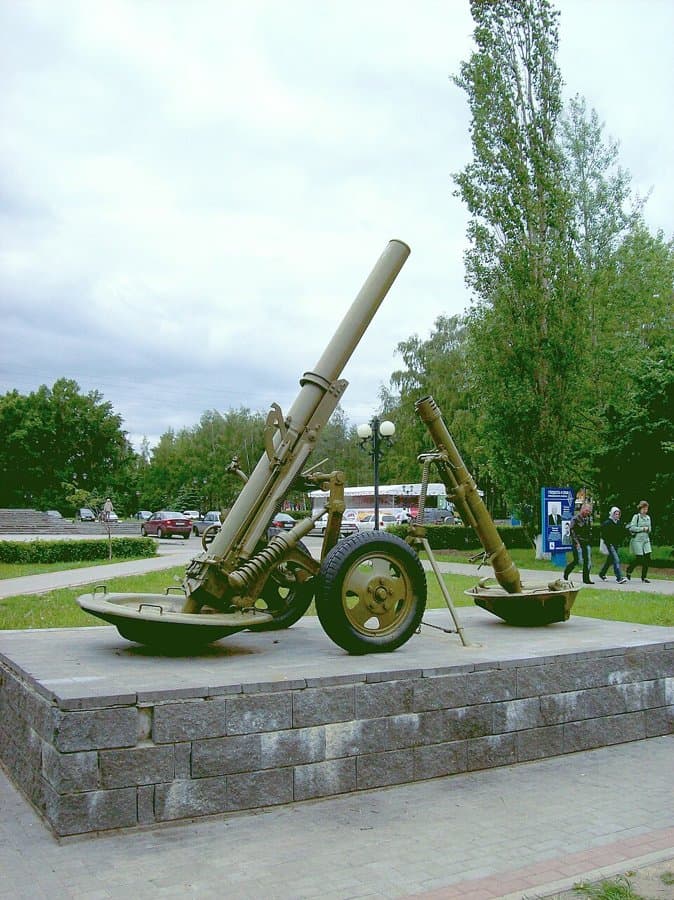
Credit
Torin · Public domain · Resized · Public domain · Source ↗ · Modified


Preparing your view.
At a glance
160 mm mortar M1943larger figure on 4 of 4
82-BM-37larger figure on 0 of 4
Counts only measures both sources give with the same scope. A larger figure is not a better system.
Measured figures
Mass
Single source1,170 kg (2,580 lb)[source]
Mass
Single sourceConfiguration
| Specification | 160 mm mortar M1943 | 82-BM-37 |
|---|---|---|
| Type | Heavy mortar[source] | Infantry mortar[source] |
| Place of origin | Soviet Union[source] | Soviet Union[source] |
| In service | 1943–present[source] | 1937–present[source] |
| Wars | World War II Korean War Six-Day War Vietnam War Yom Kippur War Lebanese Civil War 1978 South Lebanon conflict South Lebanon conflict (1985–2000)[source] |
56 kilograms (123 lb)[source]
Bars compare reported quantities only. A larger figure does not make a system better; configurations and test conditions differ.
World War II Kosovo War Korean War Vietnam War Cambodian Civil War Rhodesian Bush War Portuguese Colonial War Uganda-Tanzania War Afghan Wars Gulf War Syrian Civil War Russo-Ukrainian War[source] |
| Shell | 40.8 kg (90 lb) bomb[source] | — |
|---|
| Elevation | +45° to +80°[source] | +45° to +75°[source] |
|---|
| Traverse | 25°[source] | 6° to 15°[source] |
|---|
| Role | smoothbore breech loading heavy mortar[source] | Soviet 82 millimeter calibre mortar[source] |
|---|
| Source measurement | The Soviet 160 mm mortar M1943 is a smoothbore breech loading heavy mortar that fired a 160 mm (6.3 in) bomb. The M1943 (also called the MT-13 ) was one of the heaviest mortar used by Soviet troops in World War II . Around 535 of these weapons were fielded with Soviet forces during the war. It was replaced in Soviet service after World War II by the M-160 mortar of the same caliber.[source]160 mm mortar M1943 · Lead; only the objects and conditions stated in this passage Originally a simple scaling-up of the 120 mm (4.7 in) M1938 mortar , it soon became apparent that drop-loading a 40.8 kg (90 lb) bomb into a 3.03 m (9.9 ft) long tube would be too difficult for any man to do. It was redesigned into a breech loading weapon , and contains a substantial recoil system to soak up the massive shock of firing a 160 mm (6.3 in) bomb and prevent the baseplate from burying itself too deeply.[source]160 mm mortar M1943 · Description; only the objects and conditions stated in this passage | The M-37 or 82-BM-37 (батальонный миномёт, battalion mortar) is a Soviet 82 millimeter calibre mortar designed by B.I. Shavyrin and accepted into service in 1937. The design of the M-37 is based on the earlier French Brandt mle 27/31 mortar with Russian modifications. The main difference between the 82-PM-37 and the earlier 82-PM-36 was the adoption of a round base plate, revised traverse/elevation controls, simplified sights and spring-loaded shock absorbers on the bi-pod to reduce the amount of relaying needed between shots. It was designed to be able to fire western 81 mm captured ammunition whilst not permitting the enemy the same advantage The German designation for captured M-37 mortars was 8.2 cm GrW 274/2(r) .[source]82-BM-37 · Lead; only the objects and conditions stated in this passage The M-37M is an improved version with a lighter base plate and a device to prevent double loading.[source]82-BM-37 · Lead; only the objects and conditions stated in this passage |
|---|
| Used by | — | Soviet Union[source] |
|---|
| Shell weight | — | 3.05 kg (6 lb 12 oz)[source] |
|---|
| Country of origin | — | Soviet Union[source]Inventory Origin column; table 4, row 12, cell 4; revision 1347912314; retrieved 2026-10-02 |
|---|
| Reported operators |
|
|
|---|