Credit
Torin · Public domain · Resized · Public domain · Source ↗ · Modified


Preparing your view.
At a glance
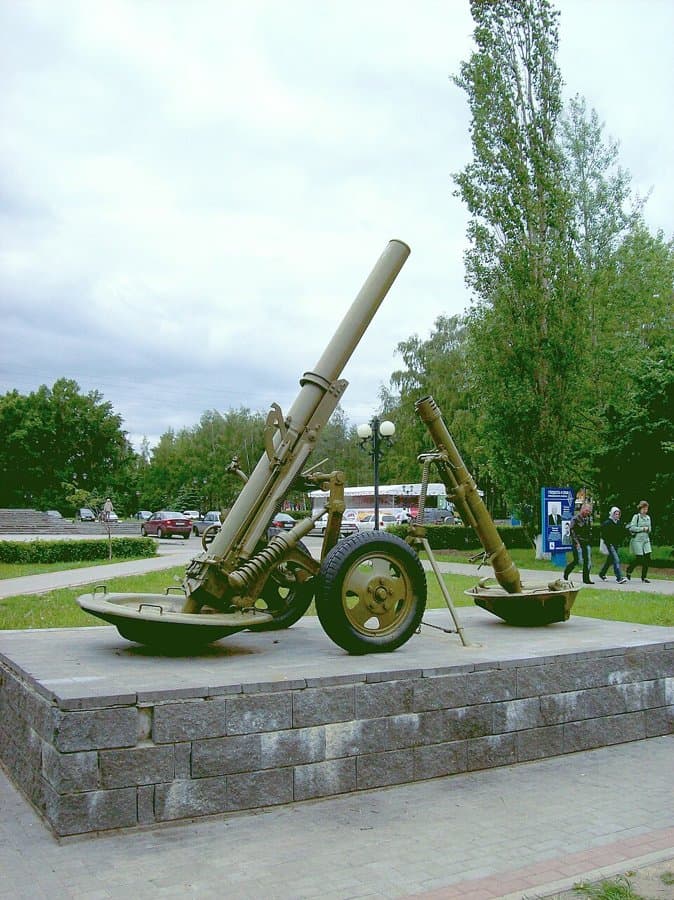
160 mm mortar M1943larger figure on 0 of 2
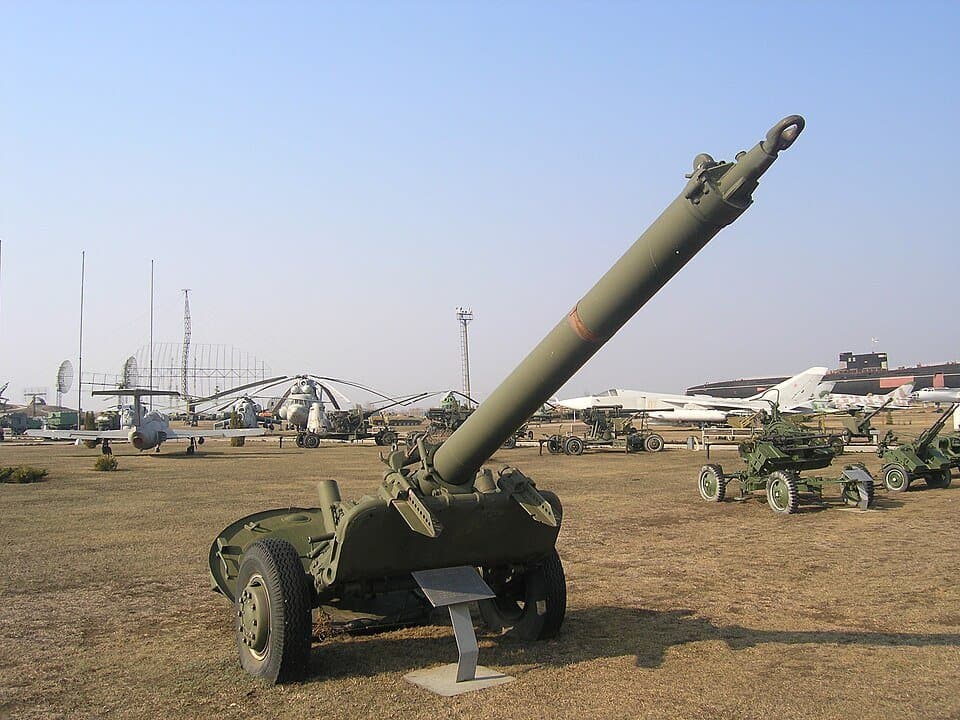
240 mm mortar M240larger figure on 2 of 2
Counts only measures both sources give with the same scope. A larger figure is not a better system.
Measured figures
Muzzle velocity
Single source245 m/s (800 ft/s)[source]
Bars compare reported quantities only. A larger figure does not make a system better; configurations and test conditions differ.
Configuration
| Specification | 160 mm mortar M1943 | 240 mm mortar M240 |
|---|---|---|
| Type | Heavy mortar[source] | Towed mortar[source] |
| Place of origin | Soviet Union[source] | Soviet Union[source] |
| In service | 1943–present[source] | 1953–present[source] |
| Wars | World War II Korean War Six-Day War Vietnam War Yom Kippur War Lebanese Civil War 1978 South Lebanon conflict South Lebanon conflict (1985–2000)[source] | Yom Kippur War Lebanese Civil War Soviet–Afghan War Iran–Iraq War First Chechen War Second Chechen War Syrian Civil War Russian invasion of Ukraine[source] |
| Shell | 40.8 kg (90 lb) bomb[source] | (HE) 130 kg (286 lbs)[source] |
| Elevation | +45° to +80°[source] | +45° to +65°[source] |
| Traverse | 25°[source] | 17°[source] |
| Rate of fire | 3 rounds/minute[source] | 1 round/minute[source] |
| Role | smoothbore breech loading heavy mortar[source] | — |
| Source measurement | The Soviet 160 mm mortar M1943 is a smoothbore breech loading heavy mortar that fired a 160 mm (6.3 in) bomb. The M1943 (also called the MT-13 ) was one of the heaviest mortar used by Soviet troops in World War II . Around 535 of these weapons were fielded with Soviet forces during the war. It was replaced in Soviet service after World War II by the M-160 mortar of the same caliber.[source]160 mm mortar M1943 · Lead; only the objects and conditions stated in this passage Originally a simple scaling-up of the 120 mm (4.7 in) M1938 mortar , it soon became apparent that drop-loading a 40.8 kg (90 lb) bomb into a 3.03 m (9.9 ft) long tube would be too difficult for any man to do. It was redesigned into a breech loading weapon , and contains a substantial recoil system to soak up the massive shock of firing a 160 mm (6.3 in) bomb and prevent the baseplate from burying itself too deeply.[source]160 mm mortar M1943 · Description; only the objects and conditions stated in this passage | — |
| Manufacturer | — | Yurga Machine-Building Plant[source] |
| Reported operators |
|
|