
Credit
Ministry of Defense of Ukraine · CC BY-SA 2.0 · Resized · CC BY-SA 2.0 · Source ↗ · Modified


Preparing your view.
At a glance
152 mm gun-howitzer D-20larger figure on 5 of 5
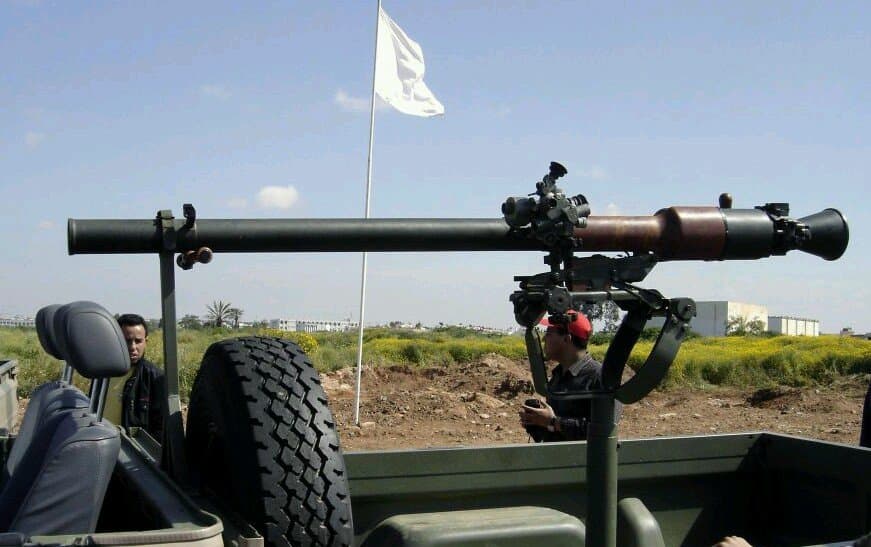
SPG-9larger figure on 0 of 5
Counts only measures both sources give with the same scope. A larger figure is not a better system.
Measured figures
Bars compare reported quantities only. A larger figure does not make a system better; configurations and test conditions differ.
Configuration
| Specification | 152 mm gun-howitzer D-20 | SPG-9 |
|---|---|---|
| Type | Towed howitzer[source] | Recoilless gun Anti-tank gun[source] |
| Place of origin | Soviet Union[source] | Soviet Union[source] |
| Used by | Soviet Union , many others[source] | — |
| Wars | Vietnam War Six-Day War Yom Kippur War Soviet–Afghan War Iran–Iraq War Lebanese Civil War First Nagorno-Karabakh War Syrian Civil War Russo-Ukrainian War Second Nagorno-Karabakh War many others[source] | Vietnam War Iran–Iraq War Salvadoran Civil War Lord's Resistance Army insurgency Gulf War Lebanese Civil War Iraq War Second Sudanese Civil War Third Sudanese Civil War Libyan Civil Wars Northern Mali conflict Syrian Civil War War in Iraq (2013-2017) War in Donbas Yemeni Civil War (2014–present) Saudi Arabian-led intervention in Yemen 2022 Kyrgyzstan–Tajikistan clashes Russo-Ukraine War Gaza war[source] |
| Designer | Petrov Artillery Design Bureau[source] | — |
| Designed | 1947[source] | — |
| Manufacturer | Artillery Plant Number 9, Yekaterinburg[source] | — |
| Shell | 152.4 x 547.5 mm R Separate loading charge and projectile[source] | — |
| Breech | Vertical semi-automatic sliding-wedge[source] | Interrupted screw[source] |
| Recoil | Hydraulic buffer and hydro-pneumatic recuperator[source] | None[source] |
| Carriage | Split trail[source] | Tripod[source] |
| Elevation | -5° to 45°[source] | +7°/−3°[source] |
| Traverse | 58°[source] | 30° total[source] |
| Sights | PG1M indirect sight and OP4M direct fire sight[source] | PGO-9 optical 4× sight or PGN-9 IR and passive night sight[source] |
| Former operator · Albania | Albania[source] | — |
| Former operator · Artsakh | Artsakh[source] | — |
| Former operator · Bolivia | Bolivia[source] | — |
| Former operator · East Germany | East Germany[source] | — |
| Former operator · Egypt | Egypt[source] | — |
| Former operator · Finland | Finland[source] | — |
| Former operator · Germany | Germany[source] | — |
| Former operator · Kazakhstan | Kazakhstan[source] | — |
| Former operator · Soviet Union | Soviet Union[source] | — |
| Former operator · Uzbekistan | Uzbekistan[source] | — |
| Former operator · Yugoslavia | Yugoslavia[source] | — |
| Source measurement | The 152 mm gun-howitzer M1955 , also known as the D-20 , ( Russian : 152-мм пушка-гаубица Д-20 обр. 1955 г. ) is a manually loaded, towed 152 mm gun-howitzer artillery piece, manufactured in the Soviet Union during the 1950s. It was first observed by the West in 1955, at which time it was designated the M1955. Its GRAU index is 52-P-546 .[source]152 mm gun-howitzer D-20 · Lead; only the objects and conditions stated in this passage 152 mm has been a Russian caliber since World War I, when Britain supplied 6-inch howitzers and Russia purchased 152 mm guns from Schneider (probably derived from the 155 mm Gun Mle 1877/16) for the Imperial Army. The new gun-howitzer, was a replacement of the pre-war ML-20 gun-howitzer (the 152 mm howitzer M1937 ) and various World War II era 152 mm field howitzers, Model 09/30 , Model 1910/30 , Model 1938 (M10) and Model 1943 (D-1) .[source]152 mm gun-howitzer D-20 · History; only the objects and conditions stated in this passage By Soviet definition, a 152 mm howitzer is "medium"-caliber artillery. It was designated a "gun-howitzer" because its muzzle velocity exceeded 600 m/s, and its barrel length exceeded 30 calibers. It equipped battalions in the motor rifle division artillery regiment and army level artillery brigades.[source]152 mm gun-howitzer D-20 · History; only the objects and conditions stated in this passage The design, which was probably initiated in the late 1940s, was first seen in public in 1955. It was designed by the well-established design bureau at Artillery Plant No. 9 in Sverdlovsk , now Motovilikha Plants in Yekaterinburg, led by the eminent artillery designer Fyodor Fyodorovich Petrov , who was responsible for several World War II pieces. The gun's factory designation was "D-20".[source]152 mm gun-howitzer D-20 · History; only the objects and conditions stated in this passage The carriage is the same one used for the D-74 122 mm field gun . The barrel assembly is the basis for the D-22 (GRAU index: 2A33 ), which is used for the self-propelled 2S3 Akatsiya ("Acacia").[source]152 mm gun-howitzer D-20 · History; only the objects and conditions stated in this passage The D-20 has a 26 caliber (3.962 m) barrel, with a double baffle muzzle brake and a semi-automatic vertical sliding-block breech, with a tied jaw and the block moving down to open. The barrel is mounted in a long ring cradle with the trunnions just forward of the breech. The recoil system (buffer and recuperator) is mounted on the cradle above the barrel. Compression balancing gear is attached behind the saddle support, passing through the complex shaped saddle to connect to the cradle just forward of the trunnions. This can be manually repressured by a pump below the breech. The breech has a projectile retaining catch to prevent the shell sliding out at higher elevations before it is rammed with a manual rammer .[source]152 mm gun-howitzer D-20 · Description; only the objects and conditions stated in this passage Top traverse totals 58° and the vertical elevation range is −5° to 45°.[source]152 mm gun-howitzer D-20 · Description; only the objects and conditions stated in this passage Like most Soviet artillery, the gun fires separate ammunition using metal cartridge cases that also provide obturation . The ammunition is interchangeable with that used with other 152 mm guns, although the more modern ones have a third, much larger cartridge. The D-20 uses two types of cartridge. One has a base charge and up to five increments, the other is a single 'super' charge cartridge.[source]152 mm gun-howitzer D-20 · Description; only the objects and conditions stated in this passage The standard shell weight is 44 kg with a muzzle velocity of 655 m/s, but some projectiles are more or less than this. The basic shell is high explosive (HE) and fragmentation (HE-frag). Other projectiles include smoke, illuminating , chemical and probably incendiary .[source]152 mm gun-howitzer D-20 · Description; only the objects and conditions stated in this passage Later projectiles include bomblet, anti-personnel land mine , flechette , Krasnopol precision-guided munition (PGM), communication jammer , and extended range HE using rocket assistance (RAP). The normal maximum range is 17.4 km, RAP being farther. Two direct-fire anti-tank projectiles have been used, high-explosive anti-tank (HEAT) and armour-piercing ammunition (APHE), the latter being 5.2 kg heavier and with a lower muzzle velocity.[source]152 mm gun-howitzer D-20 · Description; only the objects and conditions stated in this passage The maximum rate of fire is usually stated as five rounds per minute, and 65 rounds per hour sustained. In Soviet service, the unit of fire was 60 rounds.[source]152 mm gun-howitzer D-20 · Description; only the objects and conditions stated in this passage The detachment was either 8 or 10 men, probably differing between armies and the time period. In Soviet service, the 5,700 kg gun was usually towed by a URAL-375 6×6 truck or, in some regions, an AT-S or AT-L medium tractor.[source]152 mm gun-howitzer D-20 · Description; only the objects and conditions stated in this passage The Khitin is an improved version with an automatic rammer for an increased firing rate of 7-8 rounds per minute.[source]152 mm gun-howitzer D-20 · Variants / Russian Federation; only the objects and conditions stated in this passage The US Defense Intelligence Agency has reported the existence of several self-propelled artillery systems, mating existing cannon systems with a locally designed chassis. The SPH 152 mm M1974 appears to be a D-20 or Type 66 mounted on a tracked chassis Tokchon .[source]152 mm gun-howitzer D-20 · Variants / North Korea; only the objects and conditions stated in this passage M1981 − A 152 mm howitzer developed for the Romanian Army , it uses a carriage that is similar in some respects to the D-20, and the D-74 122 mm field gun , as a circular firing pedestal is fitted and is inverted and secured just forward of the gun shield when in travel position.[source]152 mm gun-howitzer D-20 · Similar weapons / Romania; only the objects and conditions stated in this passage M1985 − A 152 mm howitzer developed as a follow on to the M1981 for the Romanian Army, the carriage is very similar to the D-20, but it has a longer barrel giving it a greater range.[source]152 mm gun-howitzer D-20 · Similar weapons / Romania; only the objects and conditions stated in this passage HE-frag, OF-32 – range 17,400 metres[source]152 mm gun-howitzer D-20 · Ammunition; only the objects and conditions stated in this passage A Serbian Army M-84 Nora-A 152 mm howitzer at military parade in Niš[source]152 mm gun-howitzer D-20 · Gallery; only the objects and conditions stated in this passage | The SPG-9 Kop'yo ( Russian : СПГ-9 Копьё , transliterated: Stankovyi Protivotankovyi Granatomet "Kop'yo" - Easel Anti-tank Grenade Launcher "Spear") is a tripod-mounted man-portable, 73mm caliber recoilless gun developed by the Soviet Union . It fires fin-stabilized, rocket-assisted high explosive (HE) and high-explosive anti-tank (HEAT) shaped charge projectiles similar to those fired by the 73mm 2A28 Grom low pressure gun of the BMP-1 armored vehicle. It was accepted into service in 1962, replacing the B-10 recoilless rifle .[source]SPG-9 · Lead; only the objects and conditions stated in this passage The projectile is launched from the gun by a small charge, which gives it an initial velocity of between 250–400 metres per second (820–1,310 ft/s). The launch charge also imparts spin to the projectile by a series of offset holes. Once the projectile has traveled approximately 20 metres (66 ft) from the launcher, a rocket motor in its base ignites. For the PG-9 projectile, this takes it to a velocity of 700 metres per second (2,300 ft/s) before the motor burns out.[source]SPG-9 · Description; only the objects and conditions stated in this passage The SPG-9 is heavy, ~60 kilograms (130 lb), and normally transported by vehicle, and carried into position by its two person crew. It can be deployed in about a minute. The weapon is in service with a large number of armed forces, and a variety of ammunition is produced; however, they are mostly copies of the original Soviet PG-9 HEAT and OG-9 fragmentation high explosive (Frag-HE) rounds.[source]SPG-9 · Description; only the objects and conditions stated in this passage |
| In service | — | 1962–present[source] |
| Feed system | — | Manually breech-loaded[source] |
| Role | — | tripod-mounted man-portable, 73mm caliber recoilless gun[source] |
| Reported operators |
|
|