
Credit
Ministry of Defense of Ukraine · CC BY-SA 2.0 · Resized · CC BY-SA 2.0 · Source ↗ · Modified


Preparing your view.

At a glance
152 mm gun-howitzer D-20larger figure on 1 of 4
True scale
Side by side. From every angle. A human reference for perspective.
3.14 MB · Loads when you open it| Model | Length | Width / span | Height |
|---|---|---|---|
| 152 mm gun-howitzer D-20 | ≈ 8.69 m | ≈ 2.35 m (Width) | ≈ 2.33 m |
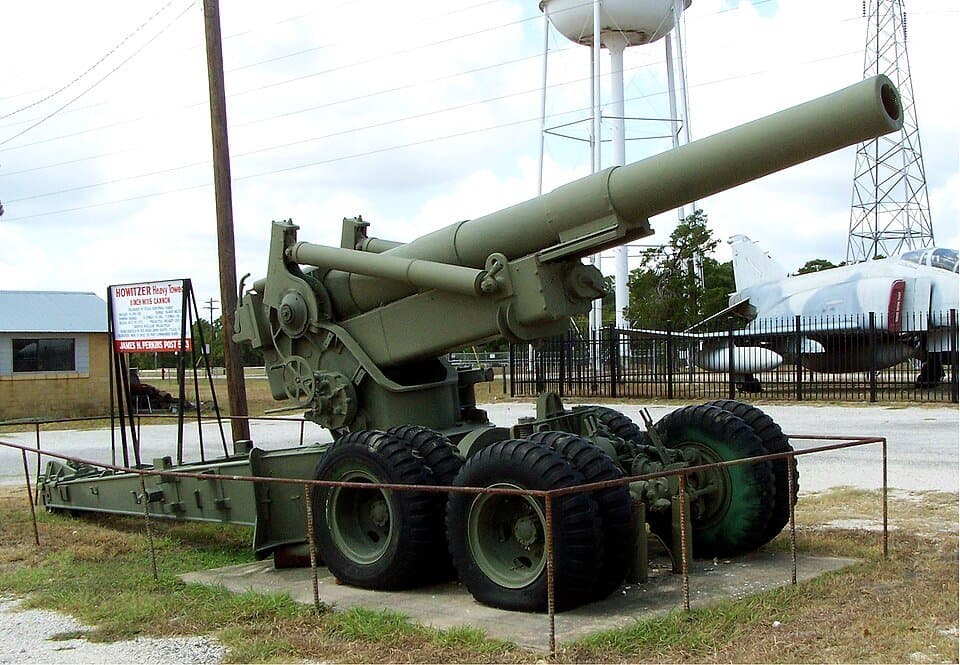
| M115 howitzer | ≈ 10.97 m | ≈ 2.5 m (Width) | ≈ 2.22 m |
Scaled uniformly to the sourced length of 8.69 m. The width was fitted to the sourced 2.35 m. Not an official model or a measured survey.
ForceTally · All rights reserved
Scaled uniformly to the sourced length of 10.972 m. Thin antennas or poles standing above the body were pressed down to it, so they do not set the height; the width was fitted to the sourced 2.5 m. Not an official model or a measured survey.
ForceTally · All rights reserved
The human reference is a generic 1.75 m figure. Models describe external size, not combat performance.
Measured figures
Length
Single source8.69 m (28 ft 6 in)[source]
Travel
Single sourceConfiguration
| Specification | 152 mm gun-howitzer D-20 | M115 howitzer |
|---|---|---|
| Type | Towed howitzer[source] | Towed heavy howitzer[source] |
| Place of origin | Soviet Union[source] | United States[source] |
| Used by | Soviet Union , many others[source] | — |
| Wars | Vietnam War Six-Day War Yom Kippur War Soviet–Afghan War Iran–Iraq War Lebanese Civil War First Nagorno-Karabakh War Syrian Civil War Russo-Ukrainian War Second Nagorno-Karabakh War many others[source] | World War II Korean War Vietnam War Iran–Iraq War Croatian war of independence |
M115 howitzerlarger figure on 3 of 4
Counts only measures both sources give with the same scope. A larger figure is not a better system.
Travel: 10.972 m (36 ft 0 in)[source]
Bars compare reported quantities only. A larger figure does not make a system better; configurations and test conditions differ.
| Designer | Petrov Artillery Design Bureau[source] | — |
|---|
| Designed | 1947[source] | 1939–1940[source] |
|---|
| Manufacturer | Artillery Plant Number 9, Yekaterinburg[source] | Stati Uniti d'America[source]Own subject first infobox · explicit producer country, not an inferred corporate manufacturer. |
|---|
| Shell | 152.4 x 547.5 mm R Separate loading charge and projectile[source] | Separate loading charge and projectile[source] |
|---|
| Breech | Vertical semi-automatic sliding-wedge[source] | Interrupted screw[source] |
|---|
| Recoil | Hydraulic buffer and hydro-pneumatic recuperator[source] | Hydro-pneumatic[source] |
|---|
| Carriage | Split trail[source] | Split trail[source] |
|---|
| Elevation | -5° to 45°[source] | −2° / +65°[source] |
|---|
| Traverse | 58°[source] | 30°[source] |
|---|
| Sights | PG1M indirect sight and OP4M direct fire sight[source] | — |
|---|
| Former operator · Albania | Albania[source] | — |
|---|
| Former operator · Artsakh | Artsakh[source] | — |
|---|
| Former operator · Bolivia | Bolivia[source] | — |
|---|
| Former operator · East Germany | East Germany[source] | — |
|---|
| Former operator · Egypt | Egypt[source] | — |
|---|
| Former operator · Finland | Finland[source] | — |
|---|
| Former operator · Germany | Germany[source] | — |
|---|
| Former operator · Kazakhstan | Kazakhstan[source] | — |
|---|
| Former operator · Soviet Union | Soviet Union[source] | — |
|---|
| Former operator · Uzbekistan | Uzbekistan[source] | — |
|---|
| Former operator · Yugoslavia | Yugoslavia[source] | — |
|---|
| Source measurement | The 152 mm gun-howitzer M1955 , also known as the D-20 , ( Russian : 152-мм пушка-гаубица Д-20 обр. 1955 г. ) is a manually loaded, towed 152 mm gun-howitzer artillery piece, manufactured in the Soviet Union during the 1950s. It was first observed by the West in 1955, at which time it was designated the M1955. Its GRAU index is 52-P-546 .[source]152 mm gun-howitzer D-20 · Lead; only the objects and conditions stated in this passage 152 mm has been a Russian caliber since World War I, when Britain supplied 6-inch howitzers and Russia purchased 152 mm guns from Schneider (probably derived from the 155 mm Gun Mle 1877/16) for the Imperial Army. The new gun-howitzer, was a replacement of the pre-war ML-20 gun-howitzer (the 152 mm howitzer M1937 ) and various World War II era 152 mm field howitzers, Model 09/30 , Model 1910/30 , Model 1938 (M10) and Model 1943 (D-1) .[source]152 mm gun-howitzer D-20 · History; only the objects and conditions stated in this passage By Soviet definition, a 152 mm howitzer is "medium"-caliber artillery. It was designated a "gun-howitzer" because its muzzle velocity exceeded 600 m/s, and its barrel length exceeded 30 calibers. It equipped battalions in the motor rifle division artillery regiment and army level artillery brigades.[source]152 mm gun-howitzer D-20 · History; only the objects and conditions stated in this passage The design, which was probably initiated in the late 1940s, was first seen in public in 1955. It was designed by the well-established design bureau at Artillery Plant No. 9 in Sverdlovsk , now Motovilikha Plants in Yekaterinburg, led by the eminent artillery designer Fyodor Fyodorovich Petrov , who was responsible for several World War II pieces. The gun's factory designation was "D-20".[source]152 mm gun-howitzer D-20 · History; only the objects and conditions stated in this passage The carriage is the same one used for the D-74 122 mm field gun . The barrel assembly is the basis for the D-22 (GRAU index: 2A33 ), which is used for the self-propelled 2S3 Akatsiya ("Acacia").[source]152 mm gun-howitzer D-20 · History; only the objects and conditions stated in this passage The D-20 has a 26 caliber (3.962 m) barrel, with a double baffle muzzle brake and a semi-automatic vertical sliding-block breech, with a tied jaw and the block moving down to open. The barrel is mounted in a long ring cradle with the trunnions just forward of the breech. The recoil system (buffer and recuperator) is mounted on the cradle above the barrel. Compression balancing gear is attached behind the saddle support, passing through the complex shaped saddle to connect to the cradle just forward of the trunnions. This can be manually repressured by a pump below the breech. The breech has a projectile retaining catch to prevent the shell sliding out at higher elevations before it is rammed with a manual rammer .[source]152 mm gun-howitzer D-20 · Description; only the objects and conditions stated in this passage Top traverse totals 58° and the vertical elevation range is −5° to 45°.[source]152 mm gun-howitzer D-20 · Description; only the objects and conditions stated in this passage Like most Soviet artillery, the gun fires separate ammunition using metal cartridge cases that also provide obturation . The ammunition is interchangeable with that used with other 152 mm guns, although the more modern ones have a third, much larger cartridge. The D-20 uses two types of cartridge. One has a base charge and up to five increments, the other is a single 'super' charge cartridge.[source]152 mm gun-howitzer D-20 · Description; only the objects and conditions stated in this passage The standard shell weight is 44 kg with a muzzle velocity of 655 m/s, but some projectiles are more or less than this. The basic shell is high explosive (HE) and fragmentation (HE-frag). Other projectiles include smoke, illuminating , chemical and probably incendiary .[source]152 mm gun-howitzer D-20 · Description; only the objects and conditions stated in this passage Later projectiles include bomblet, anti-personnel land mine , flechette , Krasnopol precision-guided munition (PGM), communication jammer , and extended range HE using rocket assistance (RAP). The normal maximum range is 17.4 km, RAP being farther. Two direct-fire anti-tank projectiles have been used, high-explosive anti-tank (HEAT) and armour-piercing ammunition (APHE), the latter being 5.2 kg heavier and with a lower muzzle velocity.[source]152 mm gun-howitzer D-20 · Description; only the objects and conditions stated in this passage The maximum rate of fire is usually stated as five rounds per minute, and 65 rounds per hour sustained. In Soviet service, the unit of fire was 60 rounds.[source]152 mm gun-howitzer D-20 · Description; only the objects and conditions stated in this passage The detachment was either 8 or 10 men, probably differing between armies and the time period. In Soviet service, the 5,700 kg gun was usually towed by a URAL-375 6×6 truck or, in some regions, an AT-S or AT-L medium tractor.[source]152 mm gun-howitzer D-20 · Description; only the objects and conditions stated in this passage The Khitin is an improved version with an automatic rammer for an increased firing rate of 7-8 rounds per minute.[source]152 mm gun-howitzer D-20 · Variants / Russian Federation; only the objects and conditions stated in this passage The US Defense Intelligence Agency has reported the existence of several self-propelled artillery systems, mating existing cannon systems with a locally designed chassis. The SPH 152 mm M1974 appears to be a D-20 or Type 66 mounted on a tracked chassis Tokchon .[source]152 mm gun-howitzer D-20 · Variants / North Korea; only the objects and conditions stated in this passage M1981 − A 152 mm howitzer developed for the Romanian Army , it uses a carriage that is similar in some respects to the D-20, and the D-74 122 mm field gun , as a circular firing pedestal is fitted and is inverted and secured just forward of the gun shield when in travel position.[source]152 mm gun-howitzer D-20 · Similar weapons / Romania; only the objects and conditions stated in this passage M1985 − A 152 mm howitzer developed as a follow on to the M1981 for the Romanian Army, the carriage is very similar to the D-20, but it has a longer barrel giving it a greater range.[source]152 mm gun-howitzer D-20 · Similar weapons / Romania; only the objects and conditions stated in this passage HE-frag, OF-32 – range 17,400 metres[source]152 mm gun-howitzer D-20 · Ammunition; only the objects and conditions stated in this passage A Serbian Army M-84 Nora-A 152 mm howitzer at military parade in Niš[source]152 mm gun-howitzer D-20 · Gallery; only the objects and conditions stated in this passage | During World War I , licensed production of the British 8-inch howitzer Mark VI was undertaken by the Midvale Steel and Ordnance Company, located in the Nicetown neighborhood of Philadelphia , Pennsylvania . Both American and British-manufactured weapons were used by the American Expeditionary Force in France. In 1940, the United States still had 475 Mark VII and Mark VIII 1/2 howitzers in storage, but there are no reports of the Mark VI or other marks being used during World War II.[source]M115 howitzer · Development; only the objects and conditions stated in this passage The original design of the M1 8-inch howitzer started in 1919, and resulted in the M1920 howitzer, but the program lapsed until resurrected in 1927. The T2 and T3 howitzers were prototypes of a partner piece for a new 155 mm gun. The first publicity photographs of the M1-type 8-inch howitzer on its redesigned carriage appeared in 1931, but development was slowed by the Great Depression. The T3 was standardized as the 8-inch howitzer M1 in 1940.[source]M115 howitzer · Development; only the objects and conditions stated in this passage Like the British 8-inch howitzer of the First World War (and most other large artillery), the M1 uses a Welin screw for its breech. The carriage was the same as used for the US 155 mm gun and was also adopted by the British for their BL 7.2-inch howitzer . It consists of a split trail with equilibrator assemblies, elevating and traversing mechanisms, a two-axle bogie with eight tires, and a single-axle, single-wheel limber for towing. Four spades, carried on the trails, were used to emplace the weapon.[source]M115 howitzer · Design; only the objects and conditions stated in this passage The M1 saw U.S. service in World War II, the Korean War , and the Vietnam War . During World War II, the M1 was towed by the Mack NO 7½ 6×6 Truck or the M4 High Speed Tractor . 59 battalions were raised during the war, of which 39 saw combat service in Northwest Europe or Italy and three in the Pacific.[source] |
|---|
| In service | — | 1944–Present[source] |
|---|
| Produced | — | 1942–1945[source] |
|---|
| No. built | — | 1,006[source] |
|---|
| Shell weight | — | 90.7 kg (200 lb)[source] |
|---|
| Former operator · Belgium | — | Belgium[source] |
|---|
| Former operator · Croatia | — | Croatia[source] |
|---|
| Former operator · Denmark | — | Denmark[source] |
|---|
| Former operator · Greece | — | Greece[source] |
|---|
| Former operator · Italy | — | Italy[source] |
|---|
| Former operator · Japan | — | Japan[source] |
|---|
| Former operator · Spain | — | Spain[source] |
|---|
| Former operator · West Germany | — | West Germany[source] |
|---|
| Former operator · United States | — | United States[source] |
|---|
| Role | — | towed heavy howitzer[source] |
|---|
| Reported operators |
|---|
The howitzer was mounted on a modified M4 medium tank chassis, in mount M17. The resulting vehicle was initially designated 8-inch howitzer motor carriage T89 and eventually standardized as the 8-inch howitzer motor carriage M43 . A total of 48 units were built.[source]M115 howitzer · Self-propelling mounts; only the objects and conditions stated in this passage
8-inch howitzer motor carriage T80 – based on T23 Medium Tank chassis, never advanced past proposal stage.[source]M115 howitzer · Self-propelling mounts; only the objects and conditions stated in this passage
8-inch howitzer motor carriage T84 – based on T26 Medium Tank chassis, a single pilot was built in 1945.[source]M115 howitzer · Self-propelling mounts; only the objects and conditions stated in this passage
The howitzer was mounted on a purpose-built tracked chassis to become the 8-inch self-propelled howitzer M110 . Notably, accuracy and rate of fire suffered from having to depress the cannon tube to loading elevation for each round in order to use the track-mounted auto loader, but the later M110A1 & M110A2 version had improved accuracy and ranges.[source]M115 howitzer · Self-propelling mounts; only the objects and conditions stated in this passage