
Credit
George Shuklin · CC BY-SA 1.0 · Resized · CC BY-SA 1.0 · Source ↗ · Modified


Preparing your view.
At a glance
122 mm howitzer 2A18 (D-30)larger figure on 1 of 1
Measured figures
Transport
Single sourceTransport: 5.4 m (17 ft 9 in)[source]
Length
Single sourceConfiguration
| Specification | 122 mm howitzer 2A18 (D-30) | SPG-9 |
|---|---|---|
| Type | Howitzer[source] | Recoilless gun Anti-tank gun[source] |
| Place of origin | Soviet Union[source] | Soviet Union[source] |
| In service | 1960–present[source] | 1962–present[source] |
| Used by | see Operators[source] |
Counts only measures both sources give with the same scope. A larger figure is not a better system.
2.11 m (6 ft 11 in)[source]
Effective; Effective firing range
Single sourceEffective; with rocket-assisted projectile
Single source15.4 km (9.6 mi) 21.9 km (13.6 mi) (with rocket-assisted projectile )[source]
Максимальная дальность, м 22000 (активно-реактивным снарядом)[source]
Effective; Effective firing range
Single sourceMaximum; Maximum firing range
Single sourceMuzzle velocity
Single source250–435 m/s (820–1,430 ft/s)[source]
Bars compare reported quantities only. A larger figure does not make a system better; configurations and test conditions differ.
| — |
| Wars | Ethiopian Civil War Lebanese Civil War Angolan Civil War Western Sahara War Uganda–Tanzania War Soviet–Afghan War Iran–Iraq War Gulf War First Nagorno-Karabakh War Somali Civil War Yugoslav Wars Eritrean-Ethiopian War Second Congo War Boko Haram insurgency Syrian Civil War War in Iraq (2013–2017) War in Donbas Yemeni Civil War (2014–present) Second Nagorno-Karabakh War Tigray War Russo-Ukrainian War War in Amhara Myanmar Civil war[source] | Vietnam War Iran–Iraq War Salvadoran Civil War Lord's Resistance Army insurgency Gulf War Lebanese Civil War Iraq War Second Sudanese Civil War Third Sudanese Civil War Libyan Civil Wars Northern Mali conflict Syrian Civil War War in Iraq (2013-2017) War in Donbas Yemeni Civil War (2014–present) Saudi Arabian-led intervention in Yemen 2022 Kyrgyzstan–Tajikistan clashes Russo-Ukraine War Gaza war[source] |
|---|
| Designer | F.F. Petrov[source] | — |
|---|
| Designed | 1950s[source] | — |
|---|
| Manufacturer | PJSC Plant No. 9[source] | — |
|---|
| Produced | 1960–present[source] | — |
|---|
| Variants | See variants[source] | — |
|---|
| Shell | 122 x 447 mm R Separate loading charge and projectile[source] | — |
|---|
| Breech | Semi-automatic vertical sliding-wedge[source] | Interrupted screw[source] |
|---|
| Recoil | Hydro-pneumatic[source] | None[source] |
|---|
| Carriage | tripod[source] | Tripod[source] |
|---|
| Elevation | −7° to 70°[source] | +7°/−3°[source] |
|---|
| Traverse | 360°[source] | 30° total[source] |
|---|
| Former operator · Artsakh | Artsakh[source] | — |
|---|
| Former operator · Boko Haram | Boko Haram[source] | — |
|---|
| Former operator · Czechoslovakia | Czechoslovakia[source] | — |
|---|
| Former operator · East Germany | East Germany[source] | — |
|---|
| Former operator · Germany | Germany[source] | — |
|---|
| Former operator · Islamic State | Islamic State[source] | — |
|---|
| Former operator · Israel | Israel[source] | — |
|---|
| Role | Soviet howitzer[source] | tripod-mounted man-portable, 73mm caliber recoilless gun[source] |
|---|
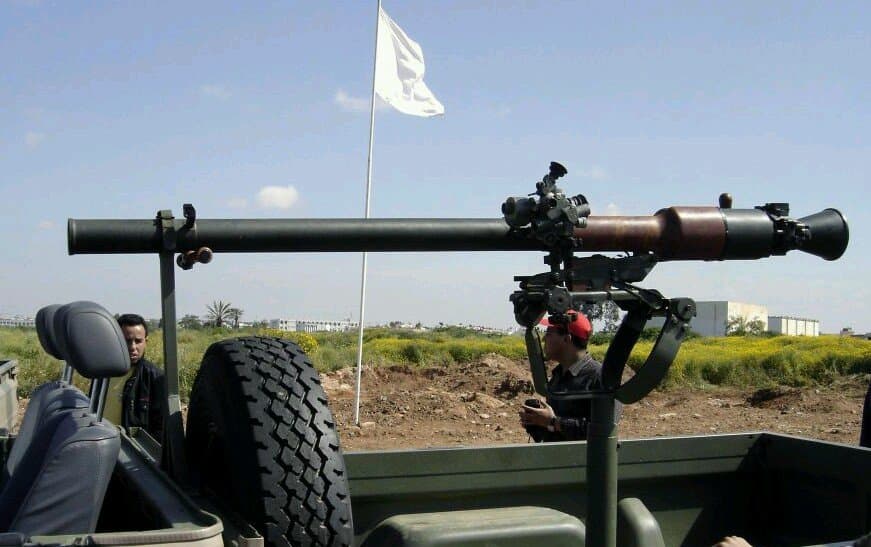
| Source measurement | The 122-mm howitzer D-30 ( GRAU index 2A18) is a Soviet howitzer that first entered service in 1960. It is a robust piece that focuses on the essential features of a towed field gun suitable for all conditions. The D-30 has a maximum range of 15.3 km (9.5 mi) or 21.9 km (13.6 mi) using rocket-assisted projectile ammunition.[source]122 mm howitzer 2A18 (D-30) · Lead; only the objects and conditions stated in this passage With its three-leg mounting, the D-30 can be rapidly traversed through 360 degrees. Although no longer manufactured in the countries of the former Soviet Union , the D-30 is still manufactured internationally and is in service in more than 60 countries' armed forces.[source]122 mm howitzer 2A18 (D-30) · Lead; only the objects and conditions stated in this passage The 122 mm (4.8 in) (originally 48 lines ) calibre was adopted by Russia in the early 20th century, becoming very important to Soviet artillery during the Second World War. Development of the D-30 began in the 1950s, as a replacement for the M-30 howitzer , widely used in divisional and regimental artilleries. The D-30 also replaced the remaining 76 mm (3.0 in) M1942 guns in motor rifle regiments.[source]122 mm howitzer 2A18 (D-30) · History; only the objects and conditions stated in this passage The D-30 was designed by the well established design bureau at Artillery Plant No 9 in Sverdlovsk (now Ekaterinburg), at the time led by the eminent artillery designer Fëdor Fëdorovich Petrov (1902–1978). This team was responsible for designing the earlier M-30, the post-war 152 mm D-20 gun-howitzer , and other guns.[source]122 mm howitzer 2A18 (D-30) · History; only the objects and conditions stated in this passage Soviet divisional artillery was assigned to manoeuvre regiments (in regimental artillery groups – RAGs) and as divisional troops (in divisional artillery groups – DAGs). A RAG was normally three batteries, each of six pieces, to each motor rifle and tank regiment. DAGs were mostly equipped with 152 mm (6.0 in) pieces, but the DAG of a motor rifle division included a D-30 battalion. The role of an RAG was a normal field artillery role to support maneuver forces with direct and indirect fire.[source]122 mm howitzer 2A18 (D-30) · History; only the objects and conditions stated in this passage Distinctive features of the D-30 include its low mobile mounting and above-barrel recoil system. The three-legged mobile mount is unusual for field artillery, with stabilizers that are clamped together for towing and deployed when in action. A large tow linkage is fixed to the muzzle; in transport the barrel serves as a trail. Similar mounts were a feature of several 76 mm (3.0 in) pre-war (1931–1935) universal (both field and anti-aircraft) guns designed by Leningrad's Kirov Plant (L-1, L-2 and L-3). Other examples were the 1939 French 47SA39 APX, and 1943 German 105 mm (4.1 in) light field howitzers designs by Skoda and Krupp ; neither entered service. The Bofors 105 mm (4.1 in) L28 Light Field Howitzer 4140 was similarly arranged with four legs and did enter Swedish service. The 1930s-designed British 2-pounder anti-tank gun was another piece featuring a three-legged mounting.[source]122 mm howitzer 2A18 (D-30) · Description; only the objects and conditions stated in this passage Compared to the M-30, the new howitzer had a significantly longer 35 calibre gun barrel, just short of being a gun-howitzer by Soviet definition. Like other guns of the period, it had a high efficiency muzzle brake ; this improved muzzle velocity by 175 m/s (570 ft/s) to a maximum of 650 m/s (2,100 ft/s) for HE, and with an increased maximum range by 3,500 m (2.2 mi) beyond the similar M-30. The maximum range was 2,000 m (1.2 mi) better than the 76 mm (3.0 in) M1942 at 15.4 km (9.6 mi). Weight increased by 650 kg (1,430 lb) over the M-30, to 3,150 kg (6,940 lb); the D-30 is over twice the weight of the 76 mm M1942 . Accuracy improved, with mean error at about 10 km (6.2 mi) dropping from 35 m (38 yd) with the M-30 to just 21 m (23 yd).[source]122 mm howitzer 2A18 (D-30) · Description; only the objects and conditions stated in this passage Effective stabilisation length is a fundamental aspect of a gun mount, and legs 120° apart need to be longer than those with a smaller angle. The D-30's design minimises this problem in several ways. Trunnions are close to the ground, as a result of placing the recoil system and cradle above the barrel. The trunnions are also at the very rear of the breech; this maximises the recoil space when firing at higher elevation angles. Their rearward position also pushes the recoiling element forward on the mount, maximizing relative rearward span of the stabilizers and so stability during recoil. Additionally, there is a very efficient muzzle brake, which absorbs about half the recoil. There is no mechanism to reduce recoil length as the angle of elevation increases.[source]122 mm howitzer 2A18 (D-30) · Description; only the objects and conditions stated in this passage Some of the design decisions have a price. The muzzle brake produces about twice the overpressure in the area around the gun than is acceptable to Western armies, and is the reason it is often seen being fired with a long lanyard, which reduces rate of fire. Furthermore, the maximum elevation angle is restricted to 18° (early versions) or 22° (later versions) when the breech is over a trail leg. This is enforced by a mechanical cam that prevents the piece firing for about 60% of the total top traverse, and limits range to about 12 km (7.5 mi), with full maximum range only possible in the central arc of about 48° between each pair of legs. The extreme rearward location of the trunnions means the elevating mass is unbalanced, requiring a strong balancing mechanism to enable manual elevation. To do this, the D-30 uses compression balancing gears.[source]122 mm howitzer 2A18 (D-30) · Description; only the objects and conditions stated in this passage A central jack is powered by hand-operated hydraulics. This jack is lowered while the wheels are raised to permit two of the stabiliser legs to be swung 120° rearwards. The mounting is then lowered, and the ends of the legs spiked to the ground. This mounting provides for quick traversing to fire in any direction.[source]122 mm howitzer 2A18 (D-30) · Description; only the objects and conditions stated in this passage The pair of large tires are suspended on a single trailing arm; the maximum towing speed is 60 km/h (37 mph) on the road. As was normal in Soviet designs, the tires were filled with foam. Initially, the D-30 had no brakes and no seat for the layer—non-essential luxuries.[source]122 mm howitzer 2A18 (D-30) · Description; only the objects and conditions stated in this passage Soviet 122 mm (4.8 in) howitzers used different ammunition to 122 mm (4.8 in) guns, although there is some compatibility. In the case of ammunition for the D-30, the standard 122 mm (4.8 in) howitzer shell weight of 21.8 kg (48 lb) was retained, with a metal cartridge case holding variable propelling charges. Cartridge and shell are loaded separately; this means that the shells have to be hand-rammed by a man to the right of the breech with a ramming rod. The D-30 could fire the older M-30 ammunition; however, new shells were also introduced, eventually including a rocket-assisted projectile with a range of 21.9 km (13.6 mi). The M-30's range of propelling charges, comprising base and eight increments, was replaced by a new set comprising base and four increments; single base propellant was retained. A more effective High Explosive (HE) shell was developed, as well as smoke, illumination, and chemical filled projectiles.[source]122 mm howitzer 2A18 (D-30) · Description; only the objects and conditions stated in this passage In keeping with Soviet doctrine, the anti-tank role is important; there is a HEAT shell capable of penetrating 460 mm (18 in) of steel armour plate.[source]122 mm howitzer 2A18 (D-30) · Description; only the objects and conditions stated in this passage The maximum rate of fire of the D-30 is 6–8 rounds per minute, and about 75 rounds per hour. There is disagreement as to whether this maximum rate of fire is achievable for indirect fire. Based on reloading speeds of similar guns using separate charges, solo re-laying, and given a stable emplacement, semi-automatic breech and no long lanyard, (examples are the 25-pdr and 105 mm (4.1 in) L118 ), and assuming concurrent lay adjustment during reloads, then it probably is when in the hands of a competent detachment. However, 5–6 rounds per minute may be more realistic with a poorly trained gun crew.[source]122 mm howitzer 2A18 (D-30) · Description; only the objects and conditions stated in this passage Sora 122mm Most modern self-propelled version of the D-30J with automatic loader, inertial navigation system (INS) and fire control system, mounted on a modified FAP 2026 chassis designed by Military Technical Institute Belgrade .[source]122 mm howitzer 2A18 (D-30) · Description / Self-propelled versions; only the objects and conditions stated in this passage PLZ-07 Chinese version of tracked D-30 122 mm. It has NBC protection system, night/day driving vision, firing control system.[source]122 mm howitzer 2A18 (D-30) · Description / Self-propelled versions; only the objects and conditions stated in this passage 2A18 or D-30 – basic model, as described. 2A18M or D-30M – new double baffle muzzle brake, square central base plate, towing lunette assembly. 2A18M-1 or D-30M-1 – with semi-automatic loader. Prototype. D-30A – modified recoil system, new muzzle brake. 2S1 Gvozdika self-propelled version.[source]122 mm howitzer 2A18 (D-30) · Description / Variants; only the objects and conditions stated in this passage D-30-2 Chinese improved copy of the D-30, modified to accept Norinco made extended range ammunition. D-30-3 – Chinese upgrade of the Type 56 85 mm (3.3 in) field gun with 122 mm (4.8 in) weapon. Type 85 or Type 86 – also called W86, Chinese licence-production or derivative of the D-30, towed. Type 96 – PL-96, Chinese licence-production or derivative of the D-30 and lightweight version of the Type 86. Mass-produced variant.[source]122 mm howitzer 2A18 (D-30) · Description / Variants; only the objects and conditions stated in this passage D 30-M – Egyptian license version of the D-30. SPH 122 – Self-propelled version, mounted on a modified M109 chassis. T-122 – Self-propelled version, mounted on a modified T-34 chassis.[source]122 mm howitzer 2A18 (D-30) · Description / Variants; only the objects and conditions stated in this passage D-30J – Yugoslav version of the D-30, it features a simplified muzzle brake, a hydraulic firing jack to ease and speed up combat operation, and maximum firing range is increased from 15,400 m (16,800 yd) to 17,300 m (18,900 yd) Saddam – Iraqi copy of the D-30J produced by Saad 5 (Saddam Engineering Complex). Production was halted after the Gulf War D-30JA1 – Improved Serbian version – further development of D-30J. Sora 122mm – Self-propelled version of D-30J M-91 "Mona" – Yugoslav variant with the 100 mm (3.9 in) ordnance of the MT-12 . Prototype only.[source]122 mm howitzer 2A18 (D-30) · Description / Variants; only the objects and conditions stated in this passage BK-6M HEAT shell[source]122 mm howitzer 2A18 (D-30) · Ammunition; only the objects and conditions stated in this passage | The SPG-9 Kop'yo ( Russian : СПГ-9 Копьё , transliterated: Stankovyi Protivotankovyi Granatomet "Kop'yo" - Easel Anti-tank Grenade Launcher "Spear") is a tripod-mounted man-portable, 73mm caliber recoilless gun developed by the Soviet Union . It fires fin-stabilized, rocket-assisted high explosive (HE) and high-explosive anti-tank (HEAT) shaped charge projectiles similar to those fired by the 73mm 2A28 Grom low pressure gun of the BMP-1 armored vehicle. It was accepted into service in 1962, replacing the B-10 recoilless rifle .[source]SPG-9 · Lead; only the objects and conditions stated in this passage The projectile is launched from the gun by a small charge, which gives it an initial velocity of between 250–400 metres per second (820–1,310 ft/s). The launch charge also imparts spin to the projectile by a series of offset holes. Once the projectile has traveled approximately 20 metres (66 ft) from the launcher, a rocket motor in its base ignites. For the PG-9 projectile, this takes it to a velocity of 700 metres per second (2,300 ft/s) before the motor burns out.[source]SPG-9 · Description; only the objects and conditions stated in this passage The SPG-9 is heavy, ~60 kilograms (130 lb), and normally transported by vehicle, and carried into position by its two person crew. It can be deployed in about a minute. The weapon is in service with a large number of armed forces, and a variety of ammunition is produced; however, they are mostly copies of the original Soviet PG-9 HEAT and OG-9 fragmentation high explosive (Frag-HE) rounds.[source]SPG-9 · Description; only the objects and conditions stated in this passage |
|---|
| Country of origin | China[source]Inventory Origin column; table 10, row 13, cell 5; revision 1368748817; retrieved 2026-10-02 | — |
|---|
| Feed system | — | Manually breech-loaded[source] |
|---|
| Sights | — | PGO-9 optical 4× sight or PGN-9 IR and passive night sight[source] |
|---|
| Reported operators |
|
|
|---|