
FORCETALLY
Loading the evidence…
Preparing your view.


Preparing your view.
At a glance
100 mm field gun M1944 (BS-3)larger figure on 6 of 6
Measured figures
Length
Single source9.37 m (30 ft 9 in)[source]
Length
Single sourceConfiguration
| Specification | 100 mm field gun M1944 (BS-3) | SPG-9 |
|---|---|---|
| Type | Field gun and anti-tank gun[source] | Recoilless gun Anti-tank gun[source] |
| Place of origin | Soviet Union[source] | Soviet Union[source] |
| In service | 1944–present[source] | 1962–present[source] |
| Used by | Soviet Union[source] |
SPG-9larger figure on 0 of 6
Counts only measures both sources give with the same scope. A larger figure is not a better system.
2.11 m (6 ft 11 in)[source]
Bars compare reported quantities only. A larger figure does not make a system better; configurations and test conditions differ.
| — |
| Wars | World War II Vietnam War Six-Day War India–Pakistan war of 1971 Yom Kippur War Lebanese Civil War Russo-Ukrainian War[source] | Vietnam War Iran–Iraq War Salvadoran Civil War Lord's Resistance Army insurgency Gulf War Lebanese Civil War Iraq War Second Sudanese Civil War Third Sudanese Civil War Libyan Civil Wars Northern Mali conflict Syrian Civil War War in Iraq (2013-2017) War in Donbas Yemeni Civil War (2014–present) Saudi Arabian-led intervention in Yemen 2022 Kyrgyzstan–Tajikistan clashes Russo-Ukraine War Gaza war[source] |
|---|
| Produced | 1944–1951[source] | — |
|---|
| Shell | 100 × 695 mmR (R/147mm)[source] | — |
|---|
| Breech | Semi-automatic vertical sliding-wedge[source] | Interrupted screw[source] |
|---|
| Recoil | hydro-pneumatic[source] | None[source] |
|---|
| Carriage | Split trail[source] | Tripod[source] |
|---|
| Elevation | -5° to 45°[source] | +7°/−3°[source] |
|---|
| Traverse | 58°[source] | 30° total[source] |
|---|
| Former operator · Afghanistan | Afghanistan[source] | — |
|---|
| Former operator · Bulgaria | Bulgaria[source] | — |
|---|
| Former operator · DR Congo | DR Congo[source] | — |
|---|
| Former operator · East Germany | East Germany[source] | — |
|---|
| Former operator · Egypt | Egypt[source] | — |
|---|
| Former operator · Ethiopia | Ethiopia[source] | — |
|---|
| Former operator · India | India[source] | — |
|---|
| Former operator · North Korea | North Korea[source] | — |
|---|
| Former operator · Mali | Mali[source] | — |
|---|
| Former operator · Poland | Poland[source] | — |
|---|
| Former operator · Romania | Romania[source] | — |
|---|
| Former operator · Somalia | Somalia[source] | — |
|---|
| Former operator · Soviet Union | Soviet Union[source] | — |
|---|
| Former operator · Syria | Syria[source] | — |
|---|
| Former operator · Timor-Leste | Timor-Leste[source] | — |
|---|
| Former operator · Yemen | Yemen[source] | — |
|---|
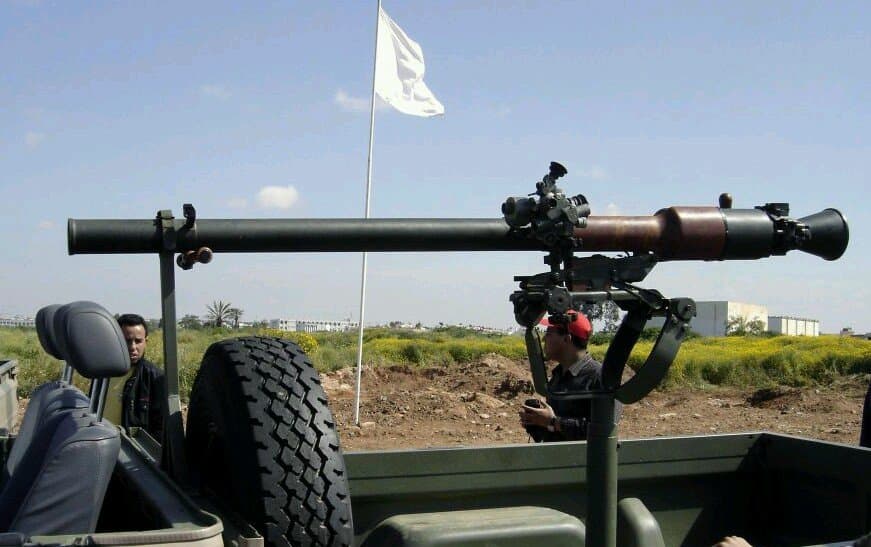
| Source measurement | The 100 mm field gun M1944 (BS-3) ( Russian : 100-мм полевая пушка обр. 1944 г. (БС-3) ) is a Soviet 100 mm (3.9 in) anti-tank and field gun .[source]100 mm field gun M1944 (BS-3) · Lead; only the objects and conditions stated in this passage During World War II the Soviet Army employed the gun in the light artillery brigades of tank armies (20 pieces along with 48 ZiS-3 ) and by corps artillery. In the Second World War the BS-3 was successfully used as a powerful anti-tank gun. It was capable of defeating any contemporary tank at long range, excluding the Tiger II : to destroy that heavy tank the gun needed to shoot at less than 1,600 m (5,200 ft) from the target. The gun was capable of defeating the turret of Tiger II at a range of 800–1,000 m (2,600–3,300 ft). The gun was also used as a field gun. Though in this role it was less powerful than the 122 mm A-19 , as it fired a smaller round, the BS-3 was more mobile and had a higher rate of fire.[source]100 mm field gun M1944 (BS-3) · History / World War II; only the objects and conditions stated in this passage The BS-3 remained in service into the 1950s. As of 1955 it was getting replaced in Soviet service by the T-12 antitank gun and the 85 mm antitank gun D-48 . A number of BS-3 pieces are still stored in Russian Ground Forces arsenals. In 2012, at least 12 BS-3 guns were still active with the 18th Machine Gun Artillery Division , located on the Kuril Islands , used as anti-ship and anti-landing guns.[source]100 mm field gun M1944 (BS-3) · History / Post World War II; only the objects and conditions stated in this passage During the Russo-Ukrainian War (2014–present) both sides employed towed anti-tank guns. The use of the 100 mm Rapira is well known, but the Ukrainian Army also used the older BS-3. Three Ukrainian BS-3s were destroyed by Russian military forces during the initial phase of their 2022 invasion of Ukraine . In September 2023, Ukraine's State Border Guard Service released footage of a Ukrainian BS-3 crew firing on Russian positions.[source]100 mm field gun M1944 (BS-3) · History / Post World War II; only the objects and conditions stated in this passage Projectile weight AP/APBC: 15.88 kg (34.97 lbs) HE/Fragmentation: 15.6 kg (34.39 lbs)[source]100 mm field gun M1944 (BS-3) · Ammunition data; only the objects and conditions stated in this passage Armor penetration (BR-412B, 30° degrees) 500 m : 190 mm (547 yds : 7.48 in) 1000 m : 170 mm (1,093 yds : 6.69 in)[source]100 mm field gun M1944 (BS-3) · Ammunition data; only the objects and conditions stated in this passage | The SPG-9 Kop'yo ( Russian : СПГ-9 Копьё , transliterated: Stankovyi Protivotankovyi Granatomet "Kop'yo" - Easel Anti-tank Grenade Launcher "Spear") is a tripod-mounted man-portable, 73mm caliber recoilless gun developed by the Soviet Union . It fires fin-stabilized, rocket-assisted high explosive (HE) and high-explosive anti-tank (HEAT) shaped charge projectiles similar to those fired by the 73mm 2A28 Grom low pressure gun of the BMP-1 armored vehicle. It was accepted into service in 1962, replacing the B-10 recoilless rifle .[source]SPG-9 · Lead; only the objects and conditions stated in this passage The projectile is launched from the gun by a small charge, which gives it an initial velocity of between 250–400 metres per second (820–1,310 ft/s). The launch charge also imparts spin to the projectile by a series of offset holes. Once the projectile has traveled approximately 20 metres (66 ft) from the launcher, a rocket motor in its base ignites. For the PG-9 projectile, this takes it to a velocity of 700 metres per second (2,300 ft/s) before the motor burns out.[source]SPG-9 · Description; only the objects and conditions stated in this passage The SPG-9 is heavy, ~60 kilograms (130 lb), and normally transported by vehicle, and carried into position by its two person crew. It can be deployed in about a minute. The weapon is in service with a large number of armed forces, and a variety of ammunition is produced; however, they are mostly copies of the original Soviet PG-9 HEAT and OG-9 fragmentation high explosive (Frag-HE) rounds.[source]SPG-9 · Description; only the objects and conditions stated in this passage |
|---|
| Manufacturer | Usines n o 7 et n o 232[source] | — |
|---|
| Country of origin | USSR[source]Inventory Origin column; table 3, row 9, cell 3; revision 1367329605; retrieved 2026-10-01 | — |
|---|
| Feed system | — | Manually breech-loaded[source] |
|---|
| Sights | — | PGO-9 optical 4× sight or PGN-9 IR and passive night sight[source] |
|---|
| Role | — | tripod-mounted man-portable, 73mm caliber recoilless gun[source] |
|---|
| Reported operators |
|
|
|---|