
FORCETALLY
Loading the evidence…
Preparing your view.


Preparing your view.

At a glance
100 mm field gun M1944 (BS-3)larger figure on 2 of 3
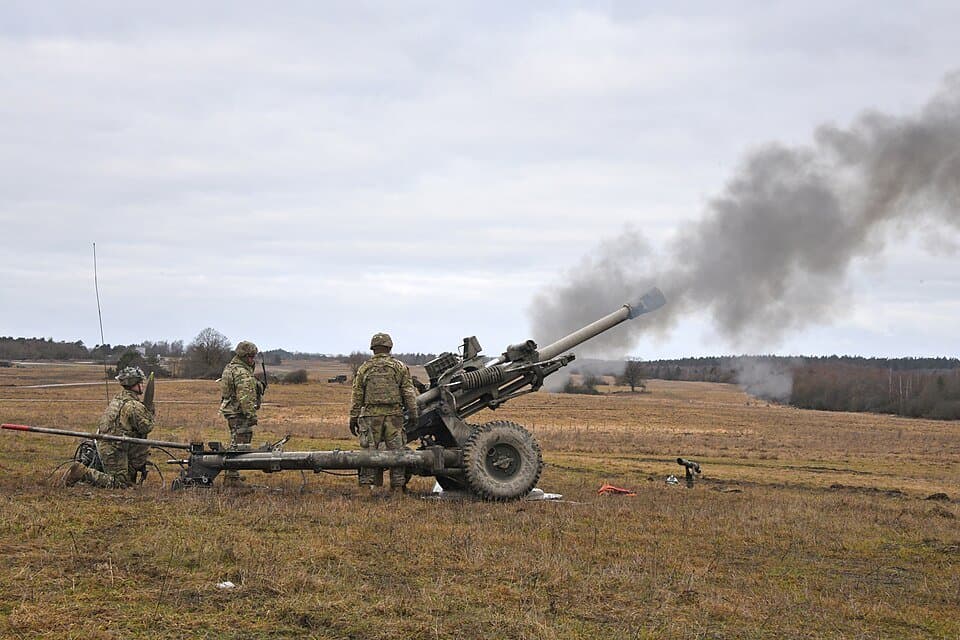
M119 howitzerlarger figure on 1 of 3
Counts only measures both sources give with the same scope. A larger figure is not a better system.
Measured figures
Configuration
| Specification | 100 mm field gun M1944 (BS-3) | M119 howitzer |
|---|---|---|
| Type | Field gun and anti-tank gun[source] | Towed field gun[source] |
| Place of origin | Soviet Union[source] | United States[source] |
| In service | 1944–present[source] | — |
| Used by | Soviet Union[source] | See operators |
Mass
Single source3,650 kg (8,047 lbs)[source]
Cannon alone
Single sourceCombat
Single sourceWith BII
Single sourceWithout BII
Single sourceWith BII: 5,110 lb (2,320 kg) Without BII: 4,690 lb (2,130 kg) Cannon alone: 1,389 lb (630 kg) Combat: 4,268 lb (1,936 kg)[source]
Muzzle velocity
Single source900 m/s (2,953 ft/s)[source]
Bars compare reported quantities only. A larger figure does not make a system better; configurations and test conditions differ.
| Wars | World War II Vietnam War Six-Day War India–Pakistan war of 1971 Yom Kippur War Lebanese Civil War Russo-Ukrainian War[source] | War in Afghanistan (2001-2021) Iraq War Saudi Arabian–led intervention in Yemen Russian invasion of Ukraine[source] |
|---|
| Produced | 1944–1951[source] | 1989–2013[source] |
|---|
| Shell | 100 × 695 mmR (R/147mm)[source] | Semi-fixed 105 x 372 mm R[source] |
|---|
| Breech | Semi-automatic vertical sliding-wedge[source] | — |
|---|
| Recoil | hydro-pneumatic[source] | — |
|---|
| Carriage | Split trail[source] | — |
|---|
| Elevation | -5° to 45°[source] | -5.625° (−100 mils) to +69.975° (+1,244 mils)[source] |
|---|
| Traverse | 58°[source] | 5.625° (100 mils) left or right[source] |
|---|
| Former operator · Afghanistan | Afghanistan[source] | — |
|---|
| Former operator · Bulgaria | Bulgaria[source] | — |
|---|
| Former operator · DR Congo | DR Congo[source] | — |
|---|
| Former operator · East Germany | East Germany[source] | — |
|---|
| Former operator · Egypt | Egypt[source] | — |
|---|
| Former operator · Ethiopia | Ethiopia[source] | — |
|---|
| Former operator · India | India[source] | — |
|---|
| Former operator · North Korea | North Korea[source] | — |
|---|
| Former operator · Mali | Mali[source] | — |
|---|
| Former operator · Poland | Poland[source] | — |
|---|
| Former operator · Romania | Romania[source] | — |
|---|
| Former operator · Somalia | Somalia[source] | — |
|---|
| Former operator · Soviet Union | Soviet Union[source] | — |
|---|
| Former operator · Syria | Syria[source] | — |
|---|
| Former operator · Timor-Leste | Timor-Leste[source] | — |
|---|
| Former operator · Yemen | Yemen[source] | — |
|---|
| Source measurement | The 100 mm field gun M1944 (BS-3) ( Russian : 100-мм полевая пушка обр. 1944 г. (БС-3) ) is a Soviet 100 mm (3.9 in) anti-tank and field gun .[source]100 mm field gun M1944 (BS-3) · Lead; only the objects and conditions stated in this passage During World War II the Soviet Army employed the gun in the light artillery brigades of tank armies (20 pieces along with 48 ZiS-3 ) and by corps artillery. In the Second World War the BS-3 was successfully used as a powerful anti-tank gun. It was capable of defeating any contemporary tank at long range, excluding the Tiger II : to destroy that heavy tank the gun needed to shoot at less than 1,600 m (5,200 ft) from the target. The gun was capable of defeating the turret of Tiger II at a range of 800–1,000 m (2,600–3,300 ft). The gun was also used as a field gun. Though in this role it was less powerful than the 122 mm A-19 , as it fired a smaller round, the BS-3 was more mobile and had a higher rate of fire.[source]100 mm field gun M1944 (BS-3) · History / World War II; only the objects and conditions stated in this passage The BS-3 remained in service into the 1950s. As of 1955 it was getting replaced in Soviet service by the T-12 antitank gun and the 85 mm antitank gun D-48 . A number of BS-3 pieces are still stored in Russian Ground Forces arsenals. In 2012, at least 12 BS-3 guns were still active with the 18th Machine Gun Artillery Division , located on the Kuril Islands , used as anti-ship and anti-landing guns.[source]100 mm field gun M1944 (BS-3) · History / Post World War II; only the objects and conditions stated in this passage During the Russo-Ukrainian War (2014–present) both sides employed towed anti-tank guns. The use of the 100 mm Rapira is well known, but the Ukrainian Army also used the older BS-3. Three Ukrainian BS-3s were destroyed by Russian military forces during the initial phase of their 2022 invasion of Ukraine . In September 2023, Ukraine's State Border Guard Service released footage of a Ukrainian BS-3 crew firing on Russian positions.[source]100 mm field gun M1944 (BS-3) · History / Post World War II; only the objects and conditions stated in this passage Projectile weight AP/APBC: 15.88 kg (34.97 lbs) HE/Fragmentation: 15.6 kg (34.39 lbs)[source]100 mm field gun M1944 (BS-3) · Ammunition data; only the objects and conditions stated in this passage Armor penetration (BR-412B, 30° degrees) 500 m : 190 mm (547 yds : 7.48 in) 1000 m : 170 mm (1,093 yds : 6.69 in)[source]100 mm field gun M1944 (BS-3) · Ammunition data; only the objects and conditions stated in this passage | The M119 howitzer is a lightweight 105 mm howitzer , used by the United States Army . It is the American licensed version of the British L119 light gun . The M119 is typically towed by the M1097 or M1152 High Mobility Multi-Purpose Wheeled Vehicle (HMMWV) , and can be easily airlifted by helicopter , or airdropped by parachute .[source]M119 howitzer · Lead; only the objects and conditions stated in this passage The howitzer was designed and produced by the British Royal Ordnance Factories as the L118 light gun . In the L118 configuration, the 105 mm ammunition is cased separate loading ammunition. The L118 entered service with the British Army in 1976 and is used by parachute and commando field artillery regiments. It saw combat during the Falklands War , where the 30 guns in action fired up to 400 rounds per gun per day, mostly at "charge super"—i.e., the most powerful propellant charge available.[source]M119 howitzer · Development; only the objects and conditions stated in this passage The L119 is the L118 reconfigured to fire NATO -standard 105 mm semi-fixed ammunition .[source]M119 howitzer · Development; only the objects and conditions stated in this passage The redesigned system operates the same, but modifies and simplifies some components, including a new buffer and recuperator with a majority of the components removed, and adds the Suspension Lockout System (SLOS) that fixes recoil length at 25 in (64 cm), which removes variable-recoil hardware, reduces stress on the carriage, and lowers buffer rod forces; the new system reduces cost, the system consists of 124 parts and the redesign will reduce that number by 40 percent to 75 parts and reusing 47 parts will consist of 65 percent for the current system, therefore only needing to manufacturing 28 new parts with overall weight savings of 45 lb (20 kg).[source]M119 howitzer · Development; only the objects and conditions stated in this passage |
|---|
| Manufacturer | Usines n o 7 et n o 232[source] | Joint Manufacturing Technology Center of Rock Island Arsenal[source] |
|---|
| Country of origin | USSR[source]Inventory Origin column; table 3, row 9, cell 3; revision 1367329605; retrieved 2026-10-01 | — |
|---|
| Variants | — | M119, M119A1, M119A2, M119A3[source] |
|---|
| Sights | — | 3 × M90A2 telescope, M137A1 panoramic telescope[source] |
|---|
| Role | — | lightweight 105 mm howitzer ,[source] |
|---|
| Reported operators |
|
|
|---|
with M67 propelling charges: M1 (HE) – High Explosive projectile, range: 11.5 km (7.1 mi), 2.1 kg of explosive filling M60 (WP) – White Phosphorus smoke generating projectile, range: 15.1 km (9.4 mi) (current variant: M60A2) M84 (HC) – Hexachloroethane smoke generating projectile, range: 11.5 km (7.1 mi) (current variant: 105 mm M84A1) M314 (VL) – Visible Light illuminating projectile, range: 19.5 km (12.1 mi) (current variant: M314A3) M444 (APICM) – Dual-Purpose Improved Conventional Munition (withdrawn from service), range: 11.5 km (7.1 mi) M916 (DPICM) – Dual-Purpose Improved Conventional Munition (withdrawn from service), range: 11.5 km (7.1 mi) M927 (HERA) – High Explosive Rocket Assisted projectile, range: 16.5 km (10.3 mi) M1064 (IR) – Infrared illuminating projectile, range: 19.5 km (12.1 mi) M1130 (HE PFF BB) – High Explosive Pre-Formed Fragments Base Bleed projectile – range: 13.0 km (8.1 mi)[source]M119 howitzer · Ammunition; only the objects and conditions stated in this passage
with M176 propelling charges: M548 (HERA) – High Explosive Rocket Assisted projectile, range: 15.1 km (9.4 mi)[source]M119 howitzer · Ammunition; only the objects and conditions stated in this passage
with M200 propelling charge: M760 (HE) – High Explosive projectile, range: 14.0 km (8.7 mi) M915 (DPICM) – Dual-Purpose Improved Conventional Munition (withdrawn from service), range: 14.1 km (8.8 mi)[source]M119 howitzer · Ammunition; only the objects and conditions stated in this passage
with M219 propelling charge: M913 (HERA) – High Explosive Rocket Assisted projectile, range: 19.5 km (12.1 mi)[source]M119 howitzer · Ammunition; only the objects and conditions stated in this passage
with M350 propelling charges: M1130A1 (HE PFF BB) – High Explosive Pre-Formed Fragments Base Bleed projectile, range 17.0 km (10.6 mi)[source]M119 howitzer · Ammunition; only the objects and conditions stated in this passage